 On Friday 3rd May, people will gather in a religious building to thank God for weapons. Not any weapons, but weapons designed to kill thousands of innocent people.
The building in question is not, as some might imagine, a fundamentalist mosque. It is not a way-out church in the USA calling on its members to bomb abortion clinics. It is Westminster Abbey, a prominent Christian church in the centre of London and at the heart of the British establishment. It is one of London’s most prominent landmarks and a leading tourist attraction.
The Abbey is holding “a service to recognise fifty years of continuous at-sea deterrent”. In this context, “deterrent” is a euphemism for nuclear submarines.
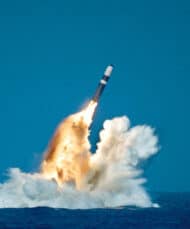
Each warhead on the Trident nuclear submarines owned by the UK government has about eight times as much destructive power as the atomic bomb that flattened Hiroshima in 1945. There are five warheads on each Trident missile, and each submarine carries up to eight missiles. There are four Trident submarines.
In other words, the UK’s Trident nuclear weapons system is about 1,280 times as destructive as the Hiroshima bomb. The Hiroshima bomb killed at least 140,000 people.
This is the weapons system that Westminster Abbey will be thanking God for on Friday.
The Abbey’s spokespeople have insisted that this is not a service of “thanksgiving”, although it has been alleged that invitations for the service originally used this word. Instead, the Abbey describes the service as:
“A service to recognise the commitment of the Royal Navy to effective peace-keeping through the deterrent over the past fifty years and to pray for peace throughout the world.”
With this statement, the Abbey has adopted a clear political position in favour of Trident. The use of the word “deterrent” implies a belief in the dubious claims made by apologists for Trident. The Abbey claims not only that the Royal Navy is committed to peacekeeping but that this peacekeeping has been “effective”.
I recognise that there are arguments in favour of Trident, unconvincing though I find them to be. But these arguments make no sense in Christian contexts. As Christians, we can all too easily fall back on the habit of reaching conclusions on the basis of the principles that dominate in the secular world. I admit I have fallen for this trap at times, as have many other Christians. However, surely our aim is to begin with a different starting-point, to seek to base our decisions and choices on Jesus – his teachings, actions, life, death and resurrection.
Fundamental to such a faith – and shared with many other religions – is the notion that our ultimate trust is in God, not in earthly institutions and inventions that promise to protect us if we submit ourselves to their power. Such submission is the essence of idolatry: putting our ultimate trust in things that we have made, rather than in the God who made us. As Jesus said, no-one can serve two masters. We can either trust in God or in the powers of weapons, money and nation-states. We cannot worship both.
Jesus’ practice of active nonviolence is, I suggest, linked to this principle. I accept that in the Hebrew Bible (which Christians tend to call the Old Testament) there are several examples of God endorsing violence. But Jesus taught something different. Furthermore, even in the Old Testament, the Israelite armies are instructed to trust God, not their own might. Gideon was even told to reduce the size of his army so that they would not think they had won through their own strength. I am guessing that passage won’t be read in Westminster Abbey on Friday.
The service is “by invitation only”. The idea of an invitation-only act of worship angers me almost as much as the fact that the service is celebrating nuclear weapons. The Christian Gospel is fundamentally at odds with “invitation only”. Jesus did not preach to people by “invitation only”. The Kingdom of God is not open only to the rich, powerful and important people who attend by “invitation only”. It s difficult to imagine anything more contrary to the essence of Christian worship than “invitation only”.
I respect many people, including many Christians, who reach different conclusions to mine on a variety of subjects. I appreciate that many Christian churches differ from my own outlook and preferences, and I am glad that such churches are worshipping God and proclaiming the good news of Jesus.
This service at Westminster Abbey is different. By promoting weapons of mass destruction, by encouraging trust in military might, by proclaiming loyalty to a nation-state ahead of the Gospel and by excluding those who are not invited from an act of worship, Westminster Abbey will be championing outright blasphemy and idolatry on Friday 3rd May.
I am glad that there will be many protests going on near the Abbey, as well as alternative acts of worship and genuine prayers for peace. As a supposedly Christian church champions military idolatry, I cannot help but conclude that to nonviolently challenge, prevent, delay or disrupt this service could be a profoundly moral and Christian act.
 Symon Hill