I am on the way to London to join the national Alternative Remembrance Sunday Ceremony. We will commemorate all victims of war of all nationalities and lay wreaths of white poppies in their memory.
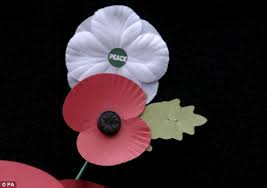
Sadly, some people will today misuse Remembrance Sunday to avoid recognising the reality of war and to fuel the values of violence, militarism and nationalism on which war depends.
Keir Starmer will lay a wreath at the Cenotaph even as he contributes to more war deaths through the provision of arms to Saudi Arabia, Israel and elsewhere. Tomorrow, on 11th November itself, BAE Systems will encourage their workers to pause for two minutes’ silence at 11.00am – before they return to making and selling weapons that supply regimes around the world. The Royal British Legion – distributors of red poppies – continue to insist that remembrance should be only for British and allied armed forces personnel, excluding civilians and people of other nationalities.
It seems that even the majority of red poppy wearers do not agree with the British Legion. Polling in 2019 revealed that over 80% of the British public believe that victims of all nationalities should be commemorated on Remembrance Sunday.
Militarised “remembrance” has little to do with remembering and is much more about forgetting – forgetting the realities and complexities of war, forgetting the suffering of people of other nationalities, forgetting to ask why former British armed forces personnel should be left by the state to rely on charity for support.
The question facing many Christians today is: which of these approaches to Remembrance is your church taking?
Some churches, I know, will focus on remembering all victims of war, on the need for reconciliation and peacebuilding, and on resisting war in the present and the future. Some will go for a full-on militarised ceremony, with marches, national flags and pro-war interpretations of history.
Most churches will fall somewhere between these two approaches. This sometimes reflects a middle-of-the-road position on the part of the church in question, although in my experience it is often more about an attempt to include people with different approaches to the issue, or even to avoid opening up difficult discussions.
In England (I realise the situation is slightly different in other parts of the UK), the Church of England is more likely than other churches to go for a nationalistic, militaristic narrative. This is unsurprising given that it is a state church. To be fair , there are many CofE churches who will not tow this line, and I applaud them. Sadly, however, there are those who view the upholding of nationalism as part of the Church of England’s job.
What surprises and worries me is how many non-conformist churches are happy to promote nationalism on Remembrance Sunday.
By non-conformist, I mean Protestant churches outside of the Church of England, also known as dissenters or as free churches. Many of these churches grew out of seventeenth-century struggles that saw King Charles I and his bishops being overthrown and replaced with a disappointingly short-lived republic. Several non-conformist denominations – such as Baptists – have always placed a strong emphasis on the separation of church and state.
As a Baptist, I am sad to see Baptist churches co-opted into militarism today.
I know that several Anglican churches will include the singing of God Save the King in their services today. More shockingly, I have heard of non-conformist churches doing the same – even Baptist churches.
This is outrageous.
A monarchist, militarist, nationalist song has no place within an act of Christian worship.
God Save the King is described as the British “national anthem” but in reality it says nothing at all about Britain or the British people. It is solely about royalty. Early Christians were persecuted for refusing to say that Caesar is lord. Only Jesus is lord, they said. Within three centuries, Christianity had decided to bow to Caesar, and even now people sing their allegiance to an earthly king in church.
I could not in conscience sing the words of God Save the King. If we had a national anthem that actually celebrated the British people, I might well sing it in other contexts – but not in church. In Christian worship, let’s not celebrate any one nationality but rejoice in God’s love for all people and Jesus’ breaking down of barriers.
Remembrance Sunday is the very last occasion on which we should be singing the so-called “national anthem”. We need to remember victims of war of all nationalities and to reject the nationalism that fuels war. More than on any other day, churches should not be nationalistic on Remembrance Sunday.
There are churches that do great things for much of the year in service of God and their neighbours. Why do some of these same churches undermine their witness for Jesus by singing a militaristic, royalist anthem on a day dedicated to remembering the horrors of war?
 Symon Hill
Pingback: Whose Remembrance? – CSBV