Backlash continues over police raid on Quaker Meeting House

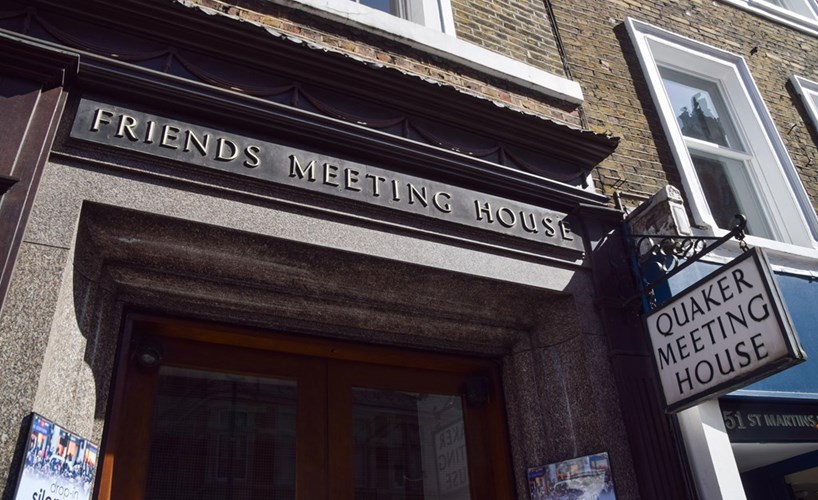
Churches Together in England (CTE) have become the latest organisation to criticise the police raid on Westminster Quaker Meeting House.

CTE are a bit late to the party, given that a full two weeks passed between the raid on 27th March and the CTE statement on 10th April. Nonetheless, given that CTE includes Christians with such a range of views, and that as a body it’s not exactly known for progressive positions, the statement is very welcome.

CTE have asked for a meeting with the Metropolitan Police and called for “an appropriate review by the police and its accountability structures”. While police “accountability structures” are weak to the point of barely existing, it would be interesting to see what comes out of a meeting between CTE, the Quakers and the Metropolitan Police.

If you’re not yet aware of this incident: at least 20 police broke down the door of Westminster Quaker Meeting House on the evening of 27th March. They swarmed through the building and arrested six young women attending a welcome talk by the nonviolent protest group Youth Demand.

Police also entered the other rooms in the building, including a room being used by a life drawing class and – staggeringly – a room hosting a private counselling session.

Youth Demand is not a Quaker group. However, they share with many Quakers a commitment to nonviolent direct action, in this case over climate change and war in Gaza.

Quaker Meetings were frequently broken up by the authorities in the seventeenth century. Now as then a place of worship has been attacked by violent representatives of the state seeking to stop peaceful people from acting on their conscience.

There has been coverage of the Meeting House raid in many places, including on the front page of the Sunday Times on 30th March. Personally I have written about it for the Morning Star and for Premier Christianity.

Other critics of the police raid on the Meeting House include Christian Aid, the Green Party, several MPs and members of the House of Lords and even Jacob Rees-Mogg.

The much shorter list of people who have refused to condemn or even question the raid includes Yvette Cooper, the Labour Home Secretary.

Police raid Quaker place of worship hosting campaign group’s welcome talk

On Thursday 27th March, at least 20 police officers broke down the door of a place of worship in central London and arrested young people who belong to a peaceful protest group.

New anti-protest laws have in recent years allowed the police to become ever more heavy-handed and anti-democratic in their approach to protest. Raids on people who are planning direct action – and not even doing it – have become more common.

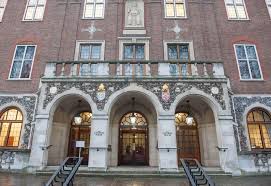
Nonetheless, the police attack on Westminster Quaker Meeting House (pictured right) is particularly alarming for several reasons.

Firstly, the event was described by Youth Demand as a “welcome talk that was “publicly advertised”, to discuss protests against the genocide in Gaza. In other words, this event was open to anyone. That includes people with no experience of taking part in, or even talking about, civil disobedience or direct action. Anybody who went along out of interest may very likely be frightened of attending any political meeting again. This is police intimidation.

Secondly, it seems you can now be raided for having conversations about actions that you might take. Given that this was a welcome meeting, it is disingenuous for the police to imply that everyone there was in the middle of some sort of high-level planning of mass disruption. The police comment given to the media focused on what “Youth Demand have stated” their intentions to be. This is very different to everyone present being intent on taking part in such things. Given that the police raided other Youth Demand members’ homes in London and Exeter, it seems that they were attempting not only to arrest certain members of Youth Demand but also to intimidate all the others.

Thirdly, the police have raided a place of worship. Apologists for the police have been quick to jump on social media and point out that the people arrested were not Quakers (or at least, probably not Quakers). This is irrelevant. Quakers have a strong theology of not separating the “sacred” and the “secular”, so they do not believe their buildings to be more sacred than other places. This is also irrelevant, however. Religious groups expect their buildings to be places of safety and welcome; those who visit them should be able to expect this (speaking personally, Westminster Quaker Meeting House was a great place of welcome and community to me after I nervously moved to London 20 years ago). Westminster Quaker Meeting House is also the home of two Quaker wardens, who have now experienced the violation of their home by the police.

The police are clearly abandoning the sort of sensitivity and caution that might once have made them reluctant to break into a place of worship. A statement from Quakers in Britain described the incident as “an aggressive violation of our place of worship”.

Of course, this whole incident cannot be understood without the context of the genocide in Gaza, which is enabled by Keir Starmer’s government. Like the Tory government before them, they are happy to arm Israeli troops killing civilians in Gaza and Saudi troops killing civilians in Yemen – and many other vicious regimes around the world. The young people arrested in Westminster Quaker Meeting House were not planning violence. They were seeking to resist violence.

This police raid seems fairly clearly to be an attempt to deter people from taking part in Youth Demand’s upcoming protests. For this reason if for no other, let’s make sure we support them! Tessa, a member of Youth Demand speaking outside Bromley Police Station yesterday insisted that “this blatant act of intimidation by the Met Police” would not stop them.

Among other things, it is vital that religious groups condemn the police’s behaviour and their violation of free speech, freedom of assembly and religious liberty. This time it was a Quaker Meeting House. Next time it could be a church, mosque, temple or synagogue.

Royalists failed to silence me – but free speech remains in danger

I wrote the following article for the Morning Star, who published it in today’s issue (11th March 2025).

Two and a half years after throwing me in the back of a police van for opposing the monarchy, Thames Valley Police have admitted that I was wrongfully arrested.

I am pleased and relieved of course. But I am also acutely aware that most people who are unlawfully arrested receive little or no publicity and are not in a position to take legal action against the police.

I was able to do so only because of Liberty, whose excellent lawyers advised and represented me. I was helped, practically and emotionally, by a wide range of friends, comrades and strangers.

But this is not about me. It never was.

It is about the rights of all people to speak out, to express themselves, to challenge the powerful, to refuse to bow down, to assert the dignity and equality of all humans.

Leaving church in September 2022, I found myself amid crowds of people trying to negotiate their way around town despite roads being closed for a ceremony declaring Charles Windsor to be king.

I remained silent as the High Sheriff of Oxfordshire read out expressions of grief for Elizabeth Windsor.

But then he declared Charles to be our king and “rightful liege lord.” I called out “Who elected him?”

A couple of people told me to shut up. I said that a head of state was being imposed without our consent.

I might well have left it there. But three security guards came over and told me to be quiet. With no sense of irony, they stood menacingly right in front of me and said they were asking me “nicely” not to express my views.

When I asserted my right to speak, they began to push me backwards. I briefly feared that I would be knocked over.

The police intervened — not to arrest the security guards for assaulting me, but to arrest me for expressing my views. I was forcibly led away and handcuffed.

I will forever be grateful for two people — complete strangers to me — who followed us down the road. They repeatedly asked the police why I was being arrested. They said they didn’t agree with me but they thought Britain was a “free country.”

The police contradicted themselves several times about which law I had been arrested under.

I was called back for a police interview and told that one of the security guards had alleged that I had assaulted him. This was a reversal of the truth.

Three months after my arrest, I was charged with breaking the Public Order Act 1986 through behaviour likely to cause “harassment, alarm or distress.”

Two weeks later, the Crown Prosecution Service dropped the charges, saying there was little prospect of conviction.

On the same day that I was arrested, a 22-year-old woman in Edinburgh — who has preferred to remain anonymous — was arrested while peacefully holding an anti-monarchy placard. Shortly afterwards, Paul Powlesland was threatened with arrest in London if he wrote “not my king” on a piece of paper.

When it came to the coronation, Graham Smith and other staff at Republic were arrested as they arrived to set up for a lawful demonstration. The police used powers that had been rushed into law less than a week earlier.

After my arrest, I was taken aback by the level of media interest. I received hundreds of supportive messages, dozens of abusive messages and a few death threats. Andrew Schraeder, a Conservative councillor in Basildon, tweeted that I should be sent to the Tower of London.

I also heard from many other people who had been wrongly arrested, or otherwise mistreated by the police, who had received far less publicity than me.

Several anti-monarchists were arrested at the royal wedding in 2011. We all know how anti-protest legislation has been used against nonviolent anti-war and climate campaigners. And I have lost count of the number of protests I have attended in which black and Asian people have been the first to be questioned or arrested.

Certain cases of appalling police behaviour at least make the news, such as the vile police assault on a vigil mourning Sarah Everard in 2021. At other times, police behaviour receives little attention. A homeless woman in Oxford told me of how she had been beaten up in the back of a police van. She did not, of course, have the resources to take legal action.

Yet it is rightwingers — including some on the extreme right — who misleadingly present themselves as defenders of free speech.

This claim reached the heights of absurdity when JD Vance criticised Britain for a lack of free speech, with an outrageous lie about people in Scotland being prevented from praying in their homes.

Similar claims about the suppression of free speech are made by Nigel Farage — a far-right multimillionaire who receives excessive media coverage in inverse proportion to the coherence of his arguments.

Far-right types on social media claim to be upholding “free speech” when they want an excuse to peddle racism, misogyny, homophobia, transphobia and other doctrines that demonise their fellow human beings.

Meanwhile, various celebrities claim that they are being “cancelled” when voluntary organisations such as students’ unions decide not to invite them to speak.

Vance, Farage and their gang do not of course mention the arrests of peaceful people resisting war, monarchy or climate change. The excessive prison sentences for Just Stop Oil and Palestine Action campaigners receive no criticism from them.

It is not the rich and powerful whose free speech is threatened. Free speech is under threat in Britain because police are arresting and charging people for nonviolent protest and the expression of opinions. Unlike Vance and Farage, most people have limited power to do much about it.

But as every socialist and trade unionist knows, we all have more power when we act together. Now is a vital time for the left to seize the narrative and take back the cause of free speech from the hatemongers.

In demanding our rights to freedom of speech, we assert the reality that we have equal value to the kings, presidents, generals and billionaires who are so keen to be heard while expecting the rest of us to shut up. Let’s make sure they know that shutting up is the last thing we will be doing.

It’s not peaceful anti-royalists like Lidia Thorpe who are disrespectful – it’s those who want us to bow down to an unelected king

I wrote the following piece for the ‘i’ paper today following Lidia Thorpe’s protest in the Australian Parliament. (My article in the ‘i’ has been edited slightly so there are some minor differences with the wording below).

Charles Windsor gave no answer. He never does.

As he finished his speech to the Australian Parliament, Senator Lidia Thorpe walked towards Charles, calling out that he was not her king and challenging him over his family’s treatment of First Nations people in Australia.

The unelected head of state did not respond. He simply waited for the elected senator to be forcibly removed from her own Parliament.

On social media, Thorpe was immediately accused of being “disrespectful”.

But how else is Thorpe to express her views to Charles? She cannot stand against him in an election – he is elected by nobody. She cannot debate him on television – he rarely gives serious interviews and is never properly challenged.

I was one of several people in the UK who was arrested for voicing opposition to monarchy when Charles was declared king in September 2022. After a long-winded process, I was charged with a breach of the Public Order Act, charges which were dropped two weeks later with little explanation.

Alongside hundreds of supportive messages and a few death threats, I received messages saying that I was “disrespectful”. It seems to be royalists’ favourite accusation.

In reality, it is not democratic republicans such as Senator Thorpe and me who are disrespectful. It is Charles and his allies.

Charles showed his disrespect for democracy and debate in Australia before the royal tour had even begun, when he turned down a polite request to meet with the Australian Republic Movement (ARM).

Rejecting the invitation, the monarch’s spokespeople said that he respected the Australian people’s right to decide for themselves whether to keep the monarchy. This is disingenuous. Charles and Camilla have travelled to Australia just as support for a republic is growing there. While ARM compare the royal visit to a farewell tour by ageing rock stars, Australian royalists are making no secret of their hope that the visit will whip up support for monarchy. At present no referendum on the issue is planned, but pressure is growing and it is likely that one will be held within the next few years.

Members of the Windsor family consistently avoid any encounter, however calm and polite, with opponents of monarchy. Charles has never met any republican group. He does not appear on Newsnight or the Today programme to answer difficult questions. When meeting members of the public in Cardiff in 2022, he could not even bring himself to respond to someone who calmly asked him about the cost of the coronation.

But it is people who object to this sort of behaviour who are described as “disrespectful”.

The police routinely go to ludicrous lengths to protect the royals from even having to see or hear republicans. In Bolton last year, a 16-year-old with a republican placard was threatened with a dispersal notice and arrest if he did not leave the area in which Charles was due to arrive.

Of course it is the police and the government, not the Windsor family, who must bear most of the blame for this sort of behaviour. But the royals cannot wash their hands of it. An intervention from Charles, let alone a public comment, would make a considerable difference to police behaviour.

Like many people, I will continue to challenge monarchy not because I am disrespectful but because I believe that all human beings are entitled to dignity and respect. This can only really happen in a society in which we treat each other as equals and make decisions democratically – whether in communities, in workplaces or in the appointment of a head of state.

Bowing down to your equal human being is what really shows disrespect for humanity.