Why Christians should back free speech – and not believe J.D. Vance

I wrote the following article for Premier Christianity, who published it on their website on Thursday 13th March 2024. As I was writing for a Christian audience I focused on the faith that I share with them, although (as I hope all my writing makes clear), I believe passionately in working alongside people of many faiths and none.

Two and a half years after I was put in the back of a police van, my hands cuffed behind my back, Thames Valley Police have admitted that I was unlawfully arrested. 

I am acutely aware that most people who are wrongly arrested receive little or no publicity and are not in a position to take legal action against the police. 

I was able to take legal action only because of Liberty, whose excellent lawyers advised and represented me. I was helped, practically and emotionally, by a wide range of friends, comrades and strangers. They included fellow Christians, along with people of other faiths and of none.  

My arrest took place in September 2022, shortly after I left church in Oxford. I found myself amid crowds of people trying to negotiate their way around town as roads were closed for a ceremony declaring Charles Windsor to be king. 

I remained silent as the High Sheriff of Oxfordshire read out expressions of grief for Elizabeth Windsor. But then he declared Charles to be our king, stating that we owe him “obedience”. I had just been in church, celebrating King Jesus. Unlike earthly kings, Jesus calls us to choose to follow him. He does not demand our obedience based on accidents of birth. 

I find it hard to stomach the description of Charles Windsor as our “rightful liege lord”. To me, it seems to be demeaning to God’s image to expect one sinful human being to bow down to another.  

I called out: “Who elected him?” 

A couple of people told me to shut up. I said that a head of state was being imposed on us without our consent. 

I might well have left it there. But three security guards came over and told me to be quiet. When I asserted my right to speak, they began to push me backwards. 

The police intervened – not to arrest the security guards for assaulting me, but to arrest me. I was led away and handcuffed. 

I will forever be grateful for two complete strangers who followed us down the road, asking the police why they were arresting me. They said that while they didn’t agree with my opinion, they thought Britain was a “free country.” 

Several other people were arrested around the same time, for similarly minor acts of dissent. A woman in Edinburgh who prefers to remain anonymous was arrested while peacefully holding a republican placard. 

Three months later, I was charged with breaking the Public Order Act 1986 through behaviour likely to cause “harassment, alarm or distress.” I had not harassed, threatened or insulted anybody. Two weeks later, the Crown Prosecution Service dropped the charges, saying there was little prospect of conviction. 

After my arrest, I was taken aback by the level of media interest. I received hundreds of supportive messages, dozens of abusive ones and a few death threats. I have also heard from many other people who had been wrongly arrested.  

Anti-protest legislation introduced by the Conservative government – which Labour has failed to repeal – has been used against non-violent anti-war and climate campaigners. But it is not only legislation that is the problem, but the culture within the police force.  

I have lost count of the number of times I have attended protests at which Black and Asian people are the first to be questioned or arrested. Police ignorance about free expression has been highlighted by clumsy attempts to enforce buffer zones where abortions take place. While it is reasonable to prevent intimidation or aggression, this should not be confused with quiet and respectful praying.   

Unfortunately, those who talk loudest about free speech seem to be uninformed about whose free speech is being denied. JD Vance recently undermined his own argument about Britain’s lack of free speech with an outrageous untruth about people in Scotland being prevented from praying in their homes. 

Meanwhile, various celebrities claim that they are being “cancelled” when voluntary organisations such as Students’ Unions decide not to invite them to speak. 

But it is not the rich and powerful whose free speech is threatened. Free speech is at risk in the UK because police are arresting people for nonviolent protest and expressing their opinion. Unlike Vance and the supposedly “cancelled” celebrities, most have limited power to do much about it. 

As Christians we believe that all people have value and worth, and that Christ died for us all. The voice and dignity of one person is as valuable as those of any other. Called to love our neighbours – whatever their faith or lack of it – we cannot call for our rights to be respected without recognising the rights of others.  

This is why I urge all Christians to uphold freedom of expression and principles of equality. This means urging Keir Starmer’s government to repeal the anti-protest laws that Tory ministers put in place. It also means calling for a major overhaul of policing. 

In calling for our rights to freedom of speech, we are asserting the value, dignity and equality of every human being, made in the very image of God.  

Royalists failed to silence me – but free speech remains in danger

I wrote the following article for the Morning Star, who published it in today’s issue (11th March 2025).

Two and a half years after throwing me in the back of a police van for opposing the monarchy, Thames Valley Police have admitted that I was wrongfully arrested.

I am pleased and relieved of course. But I am also acutely aware that most people who are unlawfully arrested receive little or no publicity and are not in a position to take legal action against the police.

I was able to do so only because of Liberty, whose excellent lawyers advised and represented me. I was helped, practically and emotionally, by a wide range of friends, comrades and strangers.

But this is not about me. It never was.

It is about the rights of all people to speak out, to express themselves, to challenge the powerful, to refuse to bow down, to assert the dignity and equality of all humans.

Leaving church in September 2022, I found myself amid crowds of people trying to negotiate their way around town despite roads being closed for a ceremony declaring Charles Windsor to be king.

I remained silent as the High Sheriff of Oxfordshire read out expressions of grief for Elizabeth Windsor.

But then he declared Charles to be our king and “rightful liege lord.” I called out “Who elected him?”

A couple of people told me to shut up. I said that a head of state was being imposed without our consent.

I might well have left it there. But three security guards came over and told me to be quiet. With no sense of irony, they stood menacingly right in front of me and said they were asking me “nicely” not to express my views.

When I asserted my right to speak, they began to push me backwards. I briefly feared that I would be knocked over.

The police intervened — not to arrest the security guards for assaulting me, but to arrest me for expressing my views. I was forcibly led away and handcuffed.

I will forever be grateful for two people — complete strangers to me — who followed us down the road. They repeatedly asked the police why I was being arrested. They said they didn’t agree with me but they thought Britain was a “free country.”

The police contradicted themselves several times about which law I had been arrested under.

I was called back for a police interview and told that one of the security guards had alleged that I had assaulted him. This was a reversal of the truth.

Three months after my arrest, I was charged with breaking the Public Order Act 1986 through behaviour likely to cause “harassment, alarm or distress.”

Two weeks later, the Crown Prosecution Service dropped the charges, saying there was little prospect of conviction.

On the same day that I was arrested, a 22-year-old woman in Edinburgh — who has preferred to remain anonymous — was arrested while peacefully holding an anti-monarchy placard. Shortly afterwards, Paul Powlesland was threatened with arrest in London if he wrote “not my king” on a piece of paper.

When it came to the coronation, Graham Smith and other staff at Republic were arrested as they arrived to set up for a lawful demonstration. The police used powers that had been rushed into law less than a week earlier.

After my arrest, I was taken aback by the level of media interest. I received hundreds of supportive messages, dozens of abusive messages and a few death threats. Andrew Schraeder, a Conservative councillor in Basildon, tweeted that I should be sent to the Tower of London.

I also heard from many other people who had been wrongly arrested, or otherwise mistreated by the police, who had received far less publicity than me.

Several anti-monarchists were arrested at the royal wedding in 2011. We all know how anti-protest legislation has been used against nonviolent anti-war and climate campaigners. And I have lost count of the number of protests I have attended in which black and Asian people have been the first to be questioned or arrested.

Certain cases of appalling police behaviour at least make the news, such as the vile police assault on a vigil mourning Sarah Everard in 2021. At other times, police behaviour receives little attention. A homeless woman in Oxford told me of how she had been beaten up in the back of a police van. She did not, of course, have the resources to take legal action.

Yet it is rightwingers — including some on the extreme right — who misleadingly present themselves as defenders of free speech.

This claim reached the heights of absurdity when JD Vance criticised Britain for a lack of free speech, with an outrageous lie about people in Scotland being prevented from praying in their homes.

Similar claims about the suppression of free speech are made by Nigel Farage — a far-right multimillionaire who receives excessive media coverage in inverse proportion to the coherence of his arguments.

Far-right types on social media claim to be upholding “free speech” when they want an excuse to peddle racism, misogyny, homophobia, transphobia and other doctrines that demonise their fellow human beings.

Meanwhile, various celebrities claim that they are being “cancelled” when voluntary organisations such as students’ unions decide not to invite them to speak.

Vance, Farage and their gang do not of course mention the arrests of peaceful people resisting war, monarchy or climate change. The excessive prison sentences for Just Stop Oil and Palestine Action campaigners receive no criticism from them.

It is not the rich and powerful whose free speech is threatened. Free speech is under threat in Britain because police are arresting and charging people for nonviolent protest and the expression of opinions. Unlike Vance and Farage, most people have limited power to do much about it.

But as every socialist and trade unionist knows, we all have more power when we act together. Now is a vital time for the left to seize the narrative and take back the cause of free speech from the hatemongers.

In demanding our rights to freedom of speech, we assert the reality that we have equal value to the kings, presidents, generals and billionaires who are so keen to be heard while expecting the rest of us to shut up. Let’s make sure they know that shutting up is the last thing we will be doing.

It’s not peaceful anti-royalists like Lidia Thorpe who are disrespectful – it’s those who want us to bow down to an unelected king

I wrote the following piece for the ‘i’ paper today following Lidia Thorpe’s protest in the Australian Parliament. (My article in the ‘i’ has been edited slightly so there are some minor differences with the wording below).

Charles Windsor gave no answer. He never does.

As he finished his speech to the Australian Parliament, Senator Lidia Thorpe walked towards Charles, calling out that he was not her king and challenging him over his family’s treatment of First Nations people in Australia.

The unelected head of state did not respond. He simply waited for the elected senator to be forcibly removed from her own Parliament.

On social media, Thorpe was immediately accused of being “disrespectful”.

But how else is Thorpe to express her views to Charles? She cannot stand against him in an election – he is elected by nobody. She cannot debate him on television – he rarely gives serious interviews and is never properly challenged.

I was one of several people in the UK who was arrested for voicing opposition to monarchy when Charles was declared king in September 2022. After a long-winded process, I was charged with a breach of the Public Order Act, charges which were dropped two weeks later with little explanation.

Alongside hundreds of supportive messages and a few death threats, I received messages saying that I was “disrespectful”. It seems to be royalists’ favourite accusation.

In reality, it is not democratic republicans such as Senator Thorpe and me who are disrespectful. It is Charles and his allies.

Charles showed his disrespect for democracy and debate in Australia before the royal tour had even begun, when he turned down a polite request to meet with the Australian Republic Movement (ARM).

Rejecting the invitation, the monarch’s spokespeople said that he respected the Australian people’s right to decide for themselves whether to keep the monarchy. This is disingenuous. Charles and Camilla have travelled to Australia just as support for a republic is growing there. While ARM compare the royal visit to a farewell tour by ageing rock stars, Australian royalists are making no secret of their hope that the visit will whip up support for monarchy. At present no referendum on the issue is planned, but pressure is growing and it is likely that one will be held within the next few years.

Members of the Windsor family consistently avoid any encounter, however calm and polite, with opponents of monarchy. Charles has never met any republican group. He does not appear on Newsnight or the Today programme to answer difficult questions. When meeting members of the public in Cardiff in 2022, he could not even bring himself to respond to someone who calmly asked him about the cost of the coronation.

But it is people who object to this sort of behaviour who are described as “disrespectful”.

The police routinely go to ludicrous lengths to protect the royals from even having to see or hear republicans. In Bolton last year, a 16-year-old with a republican placard was threatened with a dispersal notice and arrest if he did not leave the area in which Charles was due to arrive.

Of course it is the police and the government, not the Windsor family, who must bear most of the blame for this sort of behaviour. But the royals cannot wash their hands of it. An intervention from Charles, let alone a public comment, would make a considerable difference to police behaviour.

Like many people, I will continue to challenge monarchy not because I am disrespectful but because I believe that all human beings are entitled to dignity and respect. This can only really happen in a society in which we treat each other as equals and make decisions democratically – whether in communities, in workplaces or in the appointment of a head of state.

Bowing down to your equal human being is what really shows disrespect for humanity.

Draconian jail terms for Just Stop Oil show why Labour must scrap Tory anti-protest laws

On Wednesday morning, police entered a café in London and arrested a group of customers. They were planning a peaceful protest at the State Opening of Parliament against the UK’s government’s military support for Israel.

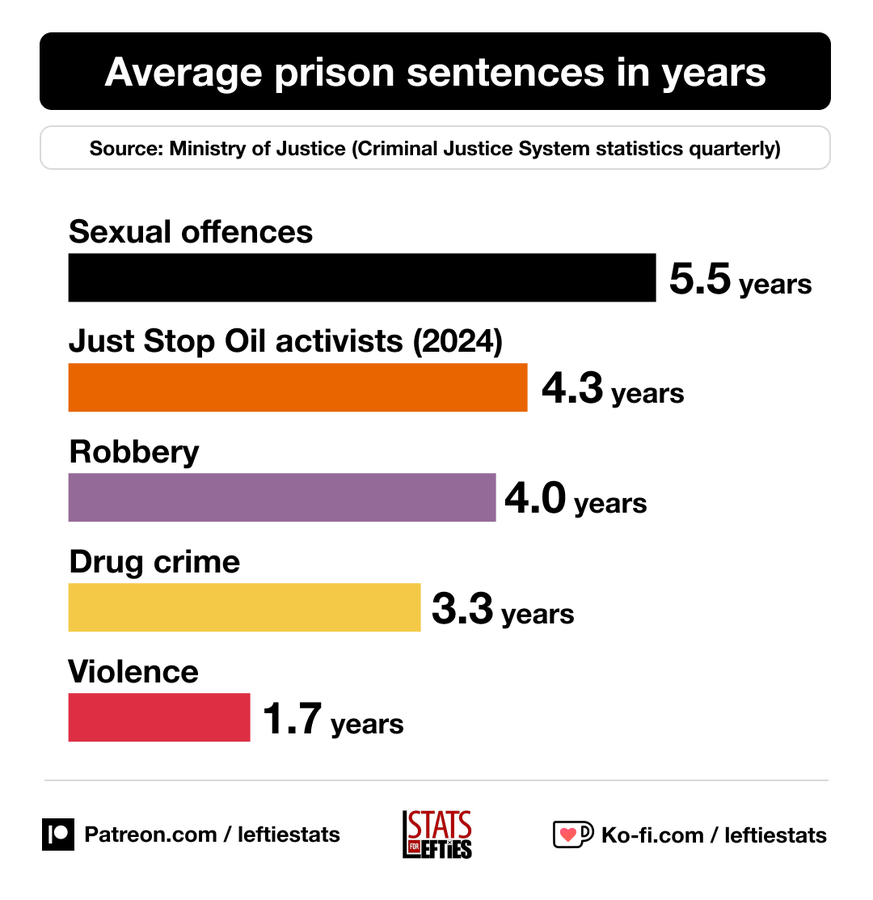
On Thursday, five members of Just Stop Oil were each sentenced to between 4 and 5 years in prison for planning to disrupt the M25 in protest against the UK government’s inaction on climate change.

These two incidents have two things in common.

Firstly, they both involved people being punished not for what they did but what they were thinking about doing.

Secondly, they were possible because of recent Tory legislation restricting peaceful protests and introducing new powers to arrest and punish people simply for planning protests.

It is now vital that the Labour government repeals the legislation that enabled these outrages.

I write as one of the first people arrested under the Police, Crime, Sentencing and Courts Act 2022.

At least, the police told me that I was being arrested under that act when they bundled me into a police van for expressing anti-monarchy views at a royal proclamation in Oxford. But they later told the media that they had arrested me under the Public Order Act 1986.

The reality is that many police have little idea about the law relating to protests. It is not only recent Tory laws that need repealing, but the whole framework of laws and culture relating to freedom of expression and rights to assemble and protest.

The trial of the Just Stop Oil protesters that finished yesterday was particularly unfair, with the judge’s bias being blatant throughout. He tried to stop them giving evidence about the reality of climate change, even ordering the arrest of protesters who sought to emphasise the right of juries to acquit on the basis of conscience.

The defendants said that this undermined their own promise to tell “the truth, the whole truth and nothing but the truth”. Thus they have been nicknamed the Whole Truth Five.

The judge clearly did not want the jury reminded of other occasions on which juries have exercised their right to acquit peaceful protesters. This has happened many times. For example, in 1996 the four women who disarmed a warplane bound for Indonesian attacks on East Timor were found Not Guilty on all charges after spending six months in prison on remand.

Personally, I do not support all the tactics and attitudes of Just Stop Oil. I fear that they focus far too much on disrupting ordinary people’s everyday lives rather than the activities of the powerful. Some of them fail to connect climate change with other injustices such as inequality, poverty and war, with which it is inextricably bound up.

But anyone who cares about climate change and about freedom to protest – whatever their views on Just Stop Oil – should be alarmed that people have been imprisoned for planning a protest.

The excessive length of the sentences is chilling. The Whole Truth Five will spend longer in prison than some people convicted of sexual offences and violent crime. This is really frightening.

I do not yet know what will happen to the members of Youth Demand who were arrested in a café on Wednesday simply for planning a peaceful protest over Israel at the State Opening of Parliament in London. I will be watching out for further news.

The Labour policies announced in the King’s Speech shortly after those arrests were in several ways more progressive than I had feared. But they do not go nearly far enough, and they include nothing about repealing Tory attacks on political freedoms.

Arrests and convictions must not deter us from exercising our freedom of expression and our rights to peaceful protest. And we must ramp up the pressure on the new government to overhaul protest laws and police powers.

Otherwise, any of us could be facing five years in jail before too long.


My book The Peace Protesters: A history of modern-day war resistance explores nonviolent activism, particularly peace activism, in the UK in the last 40 years (published by Pen & Sword, 2022).

A knightood for Bates would undermine what the sub-postmasters have fought for

I wrote this article for the ‘i’ paper, who published it online on 11th January, with a shorter version in the print edition the next day.

The statistics are shocking enough – more than 700 innocent sub-postmasters were wrongly prosecuted in the Horizon IT scandal – but it is the personal horror stories that really hit home. Seema Misra in Ashford, sentenced to prison while pregnant, who gave birth wearing an electronic tag. Sathyan Shiju in London, who tried to take his own life after being accused of stealing £20,000. Christopher Head in Newcastle, unable to secure another job after being sacked and told to pay £88,000 that he did not have.

It would be an insult to suggest that any amount of money could adequately compensate these people.

Meanwhile, Rishi Sunak seems to be practising government by TV drama, talking seriously about compensation only since the ITV broadcast of Mr Bates vs the Post Office, which depicted former sub-postmaster Alan Bates decades-long fight to expose the Horizon system scandal.

Now there are calls to give Alan Bates a knighthood. He and the others who challenged these outrageous convictions should certainly be celebrated, but the calls for an honour will do nothing to stop something like this from happening again. It just papers over the cracks.

There is a long tradition of using titles and honours to buy people off, or as an easy way to superficially endorse a popular person or cause. The reverse is also true. Former Post Office boss Paula Vennells has returned her CBE. She is no longer a Commander of the Order of the British Empire.

It has been reported that Vennells earned over £400,000 in her final year at the head of the Post Office. This is not true. She was paid over £400,000, whether she earned it is a different question. It is perhaps easier to return a CBE than to pay back an unimaginably large salary. It is also much easier for the Government to give Mr Bates a knighthood than to address the root causes of the problem.

It would also seem that Alan Bates, too, believes this. Speaking about turning down an OBE, he told Good Morning Britain last week: “It would have been a slap in the face to the rest of the group because Paula Vennells, the CEO for many years of Post Office, received a CBE for her services to Post Office. Well, what service has she actually done?”

Worryingly, the highest honour that some people can imagine is to kneel before an hereditary head of state and be tapped with a weapon. It is a ceremony that upholds and entrenches inequality. The irony is that inequality was one of the causes of the Post Office scandal in the first place.

True, the initial cause was a faulty computer system. When one or two sub-postmasters were convicted, senior managers may have assumed they were indeed guilty. But when the number of convictions rose to the hundreds, why did the people in charge not ask questions. Did they really think it likely that 700 sub-postmasters were all simultaneously corrupt?

Part of the answer has been revealed by whistleblowers and Freedom of Information requests. In a document from 2008, Post Office investigators used a racial slur to describe suspects. An Indian sub-postmaster has also revealed that a member of Post Office staff had said that “all the Indians” were defrauding the Post Office. Such comments go beyond unconscious bias. They represent out-and-out up-front racism.

The failure of senior people at the Post Office to question the convictions starkly demonstrates another problem rooted in inequality: the tendency of senior people not to trust their workers or to listen to more junior people. In a hierarchical business, what chance did workers on the ground have of influencing policy?

Until we have democratic, egalitarian workplaces based around mutual respect and co-operation, injustices such as the Horizon scandal will continue. Instead of focusing on knighthoods and CBEs, the best way to honour the victims of the Post Office scandal is to change the way we work.

We need a referendum on the monarchy

Early in December, I wrote an article for the ‘i’ paper calling for a referendum on the monarchy. This followed weeks of arguments and revelations about Omid Scobie’s new book on the royal family. More importantly, it followed a poll showing declining support for the monarchy as an institution.

Although you can read the article on the ‘i’ paper’s website, I forgot to post a copy of it on here (I need to get bettter at remembering to do this!). The article is below.

One of the most frequently heard arguments for royalty is that they unite the country. Supporters of monarchy say the British public will rally behind a king or queen in a way they never will for a politician or political movement.

This is a bizarre claim for a family that cannot even keep themselves united, producing brothers so disunited that they feel the need to live in separate continents.

We have had another week of scandals about the personal feuds and jealousies of Britain’s favourite dysfunctional family. Amid all the gossip about the private lives of the super-privileged, the views of voters have rarely been mentioned.

So you might not have heard that opposition to the monarchy has reached a record high.

A Savanta poll has put support for retaining a monarchy at 52 per cent of the British population.This compares to 62 per cent in a YouGov poll only three months ago. The number backing an elected head of state now exceeds a third of the population, at 34 per cent (the remainder are “don’t knows”). Among adults under 35, supporters of monarchy are outnumbered by those wanting to elect a head of state, by 43 per cent to 38 per cent.

Royalists can of course point out that 52 per cent is still more than half. What they cannot reasonably claim is that the monarchy unites Britain.

It is impossible to hear the figure of 52 per cent without thinking of the Brexit referendum. In the wake of the vote, Leave voters emphasised that 52 per cent is a majority. Yet not even the world’s greatest optimist would claim that Brexit is an issue on which the British population is united.

This is why we need a referendum on the future of the monarchy.

On the surface, royalists have good grounds to welcome a referendum. Looking at the polls, they may well expect to win. They would have the backing of most of the media – including the sort of newspapers that could be relied on to launch vicious personal attacks on their opponents.

The problem for royalists in a referendum would be that both sides would be expected to be open to challenges and questions. But barring Harry and Meghan’s celebrity-style interviews, the Windsors almost never answer questions, let alone difficult ones. The Dutch translation of Omid Scobie’s book Endgame identified Charles Windsor and Kate Middleton as the two royals alleged to have made prejudiced comments about the appearance of Harry and Meghan’s son Archie. But they are not expected even to respond to this accusation. Whether or not the allegation is true, any other public figure would be expected to comment if accused of racism. Yet they can seemingly ignore it.

Such arrogance would be painfully on display in a referendum campaign. Andrew’s infamous Newsnight interview gives a clue as to how well royals might cope if they were subjected to serious questioning. Alternatively, they would hold themselves aloof from the debate and be seen to treat the rights of voters with contempt.

A referendum would expose the reality that monarchy and democracy don’t mix.

As pro-royal commentators rush to condemn Scobie and Endgame, the focus on family feuds risks missing the main point. Scobie’s premise is that this could be the “endgame” not just for Charles or William but for the British monarchy itself.

Scobie describes the royal family as “debilitatingly out-of-touch, even expendable, with an increasing percentage of the public”. That’s just in Britain. Countries such as Belize and Jamaica – where William and Kate travelled through the crowds standing up in a Land Rover like colonial conquerors – are likely to ditch the monarchy before Charles has got the throne warm.

In light of the latest revelations and polling figures, it’s time people in the UK were allowed to make a decision: do we want a system in which we bow down to our supposed superiors because of an accident of birth, or do we trust ourselves to run society together as equals?