While writing my new book on the history of peace activism, I was privileged to spend time researching peace campaigns that have often been overlooked or downplayed. For me, one of the most interesting topics for research has been the campaigns against the Falklands War in 1982. I wrote the following article for the Morning Star, who published it on 2nd May 2022.
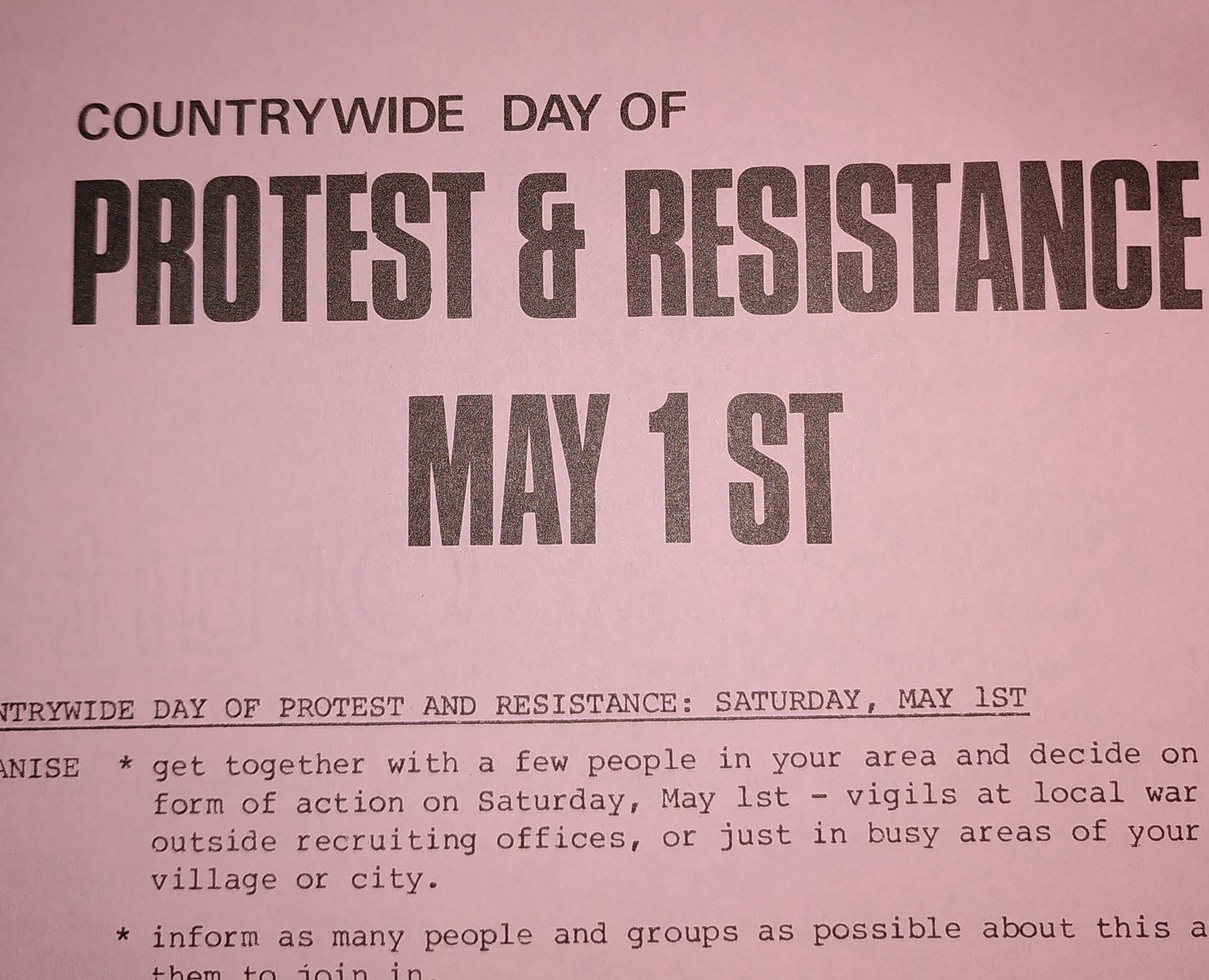
On May Day 40 years ago, anti-war campaigners were arrested in cities around Britain.
Argentinian troops had invaded the Falklands Islands a month earlier. The British naval task force had been dispatched to the South Atlantic and the Thatcher government avoided a negotiated settlement. All-out war looked likely to break out very soon.
On May 1, 1982, the Peace Pledge Union (PPU) called a Countrywide Day of Protest and Resistance. Demonstrations and vigils took place in at least 30 towns and cities. Some involved small-scale marches, others were more dramatic. Women in Sheffield occupied a Royal Navy recruitment office. Another recruitment office was paint-bombed in Holborn. Protesters in Glasgow were arrested while handing out leaflets and selling newspapers.
The day coincided with the RAF’s bombing of Port Stanley airstrip, the first British military action on the Falkland Islands themselves. When peace activists in Britain heard the news, some were keen to respond with direct action.
At about 3pm, they heard that there were press and television cameras clustered around the Ministry of Defence (MoD). “It seemed too good a chance to pass over,” explained Charles Davey of London Peace Action. Plans were made speedily for a vigil at the MoD, followed by pouring artificial blood on the steps.
“We knew we were likely to be arrested,” said Davey. “We discussed who would — who could — take part; who would be in the support group talking to the press, police, observing.”
Five of the blood-pourers were arrested and charged with criminal damage. The ministers, generals and admirals, meanwhile, were never arrested for spilling real blood.
I cannot claim to have taken part in any of these actions myself. Forty years ago, I was only five years old, so I had other things on my mind.
If you’re older than me, you may well have first-hand memories of the protests against the Falklands War. If you’re much younger than me, then it may feel like a historical event only.
I am in between — I grew up knowing about the Falklands War as a recent event. As a teenager during the Gulf War of 1991, I heard frequent comparisons with the Falklands. It took me a while to realise that much of what I had heard about the Falklands was wrong, or at least selective.
Like most working-class people who grew up under Thatcher, I have no illusions about the depths she would sink to, so I was unsurprised to discover that her rhetoric about the rights of Falkland Islanders was not matched by her behaviour in the preceding years. The British government had for some years been negotiating with Argentina for a compromise over the Falklands. When the Nationality Act was passed in 1980, Falklanders were denied British nationality. The British government had happily authorised arms sales to the Galtieri regime in Argentina.
None of this justifies Galtieri’s military aggression. It serves instead as a reminder that both the British and Argentinian governments had their own ends in mind. There were better ways to resolve the dispute than for two right-wing rulers to send working-class teenagers to kill each other.
In recent years, I have realised that another common claim about the Falklands War is also inaccurate. I have often been told that it was almost universally supported by the British public. But as I researched my new book on the history of peace activism, it became ever clearer to me that the opposition was both more widespread and more active than is often assumed.
While there is no doubt that the majority of the British population supported the war, a significant minority were opposed. Shortly after the war had finished, as Thatcher and her allies whipped up jingoistic hysteria, a poll for The Economist found that 22% of the population considered that the war had been wrong.
Given the jingoistic atmosphere, it is not surprising that some who had doubts kept their heads down. Older peace activists have told me it was “the hardest war to campaign against.”
Ann Feltham, a PPU member who leafleted regularly against the war, recalls that “while some people were hostile, many took leaflets or confided that they too had doubts.”
On the day of resistance on 1st May, Nottingham pacifists were surprised by how many passers-by agreed with them when they handed out leaflets with the local CND group. In the naval city of Plymouth, activists found far less support. Robert Harris, a peace activist in Bangor, found a more sympathetic response from Welsh-language media than their English-language counterparts.
At times, there was vicious hostility. “It was a very difficult time to be an anti-militarist,” remembers PPU member Albert Beale. “It was very lonely in a sense.” When anti-war campaigners marched through London on 23rd May, they encountered pro-war slogans blasted through loudspeakers by the so-called Coalition for Peace through Security, a Tory group set up to attack the peace movement.
907 people were killed in the Falklands War: three civilian Falklanders, 255 UK armed forces personnel and 649 Argentinians. The much greater number of people wounded in body or mind can only be guessed at.
The final arrests related to the Falklands War came on 12th October at the Victory Parade. A group who had planned to chain themselves across the road were bundled into a police van before they could do so. One was knocked unconscious in the process. Peace News reported on “the many people held in police vans for the duration of the march, presumably for not looking enthusiastic and patriotic enough.”
By the end of 1982, the Anti-Falklands War Support Network reported that they were aware of 118 arrests of anti-war activists. This is a small number compared to many earlier and later wars. There is no doubt that the Falklands War had a lot of public support.
But as I have researched it, interviewed people who resisted it and dug through the archives of peace campaigns, I have discovered that it is an outright denial of the evidence to say that almost everyone supported the Falklands War. Wherever there is war, there will be resistance.
My new book is called The Peace Protestors: A history of modern-day war resistance. It will be published by Pen & Sword on 30th May 2022. It can be pre-ordered now, with a £5 discount.
 Symon Hill
Dear Symon
I was fascinated by reading your article and wanted to make you aware of a musical I have written which is based around all the points you raise.
Sad Little Island is based on the characters from the book The Tin Pot Foreign General and the Old Iron Woman by Raymond Briggs (of the Snowman fame) which is a satirical look at events surrounding the Falklands war. I have pasted in a link to a reading of the short book below (5 min view)
The show is about the futility of war – the sacrifices made and what lessons are – or more accurately aren’t – ever learned and how there are no survivors as even those who live are forever scarred.
We’re looking for comment, support and financial investment for planned stagings of the show in January and August next year.
The below links provide more information
https://drive.google.com/file/d/1pvkW69uwLelL_2syR_7HHl1j6Rzgyucl/view?usp=sharing
https://www.facebook.com/share/1B4Nw1Mj4H/?mibextid=wwXIfr
Thank you for your consideration and any comment, sponsorship, endorsement signposting or other help would be most gratefully received!
Thank you and Kindest regards
Chris Adshead
07980 269682
Thanks for this, Chris! I’m sorry I’ve only just seen your comment. I will have a look and get back to you!
Thank you Symon – that’s wonderful
Regards for now
Chris
Sent from Outlook for iOShttps://aka.ms/o0ukef
Hi Symon, apologies for the follow up as I’m sure you’re extremely busy but I thought I’d just let you know that Falklands Island Radio interviewed me this week and will be running a feature on the show.
In addition, we have now secured the dates for our first theatre run which will be at the Playroom Theatre in Cambridge on the evenings of Thursday 8th Friday 9th and Saturday 10th of January 2026.
You’d be more than welcome as our guest!
Happy to answer any questions you may have so do let me know once you’ve had a chance to peruse!
Thanks once again and kindest regards,
Chris
Sent from Outlook for iOShttps://aka.ms/o0ukef
This is brilliant news, Chris! I’m sorry I’ve not got back to you sooner. I’ve been struggling with health issues and with being a bit overwhelmed and have not been keeping on top of my blog site, so have only just seen your comment.
Congratulations on securing the dates for your first theatre run! I would be delighted to attend one of the performances in Cambridge! Thursday 8th would probably be best for me or possibly Friday 9th; I couldn’t make Saturday 10th. Is there anything I can do to help to promote it?
Hi Symon – just to add to my earlier hereâs the interview with Falkland Islands Radio and two songs from the show called Apart and Believe
Regards as ever
Chris
Sent from Outlook for iOShttps://aka.ms/o0ukef