Last month (on Sunday 1st February 2026) I had the honour of preaching at Foleshill Road United Reformed Church in Coventry. They are always very welcoming.
Below is the text of my sermon (this is basically the text that I wrote beforehand but in practice I deviated from the wording at times and added in a few extra comments).
The sermon was based on two Bible readings, from the Lectionary for the day:
The first reading that we heard today is perhaps one of the most famous passages in the New Testament: Jesus’ list of blessings. “Blessed are the poor in spirit…” and so on. Known as the beatitudes, they come at the beginning of Jesus’ Sermon on the Mount.
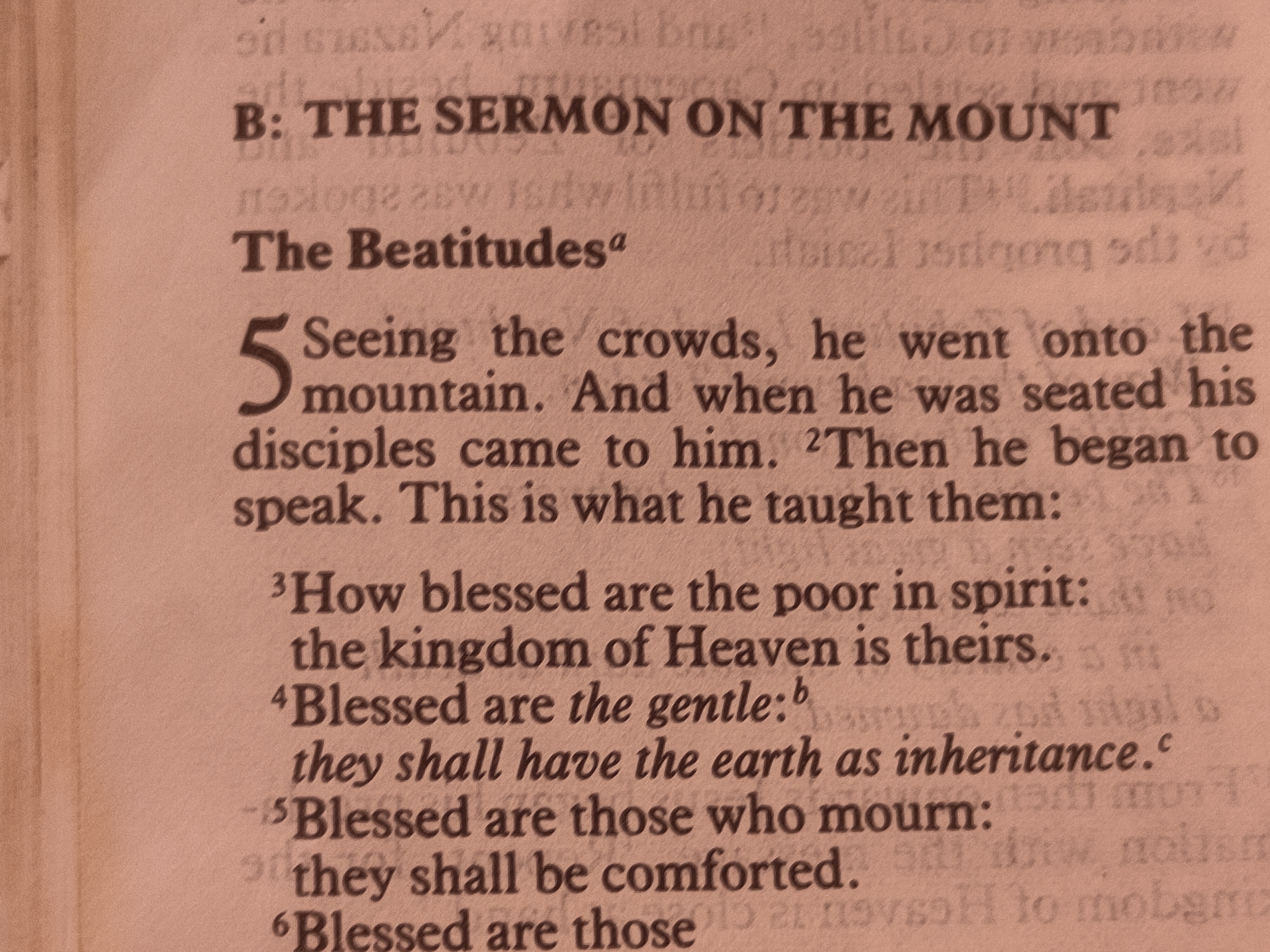
Although they might be familiar to many of us, these statements of Jesus are really quite weird. Jesus announces that people who are suffering are blessed. Isn’t that a bit odd? The rich and powerful might feel that they are the ones who have been blessed.
Jesus lived in the Roman Empire. The emperor’s wealth and power were seen as an indication of his divine status. In many other cultures also, it has been assumed that the rich and powerful are blessed by God. Despite Jesus’ teaching, Christians are not immune from this attitude. Following Donald Trump’s election victory, there were Christians in the US saying that Trump had survived the recent assassination attempt because God had chosen him to lead America. Meanwhile, Patriarch Kirill, the leader of the Russian Orthodox Church, says that God has blessed the rule of Vladimir Putin.
So how can we make sense of Jesus’ words? Well, let’s look at where this passage fits. Here we are at the beginning of Chapter 5 in Matthew’s Gospel. Quite a lot has already happened in the first four chapters. Jesus has recruited disciples, started healing and talked a lot about the Kingdom of Heaven. The Kingdom of Heaven is a major theme in Matthew’s Gospel.
Incidentally, “Kingdom of Heaven” in Matthew is the equivalent of “Kingdom of God” in other gospels. We could also call it the “Empire of Heaven”, as “kingdom” and “empire” are the same word in the original Greek of the New Testament.
Let’s remember that Jesus was speaking to people in a predominantly poor society that was facing ongoing exploitation by the Roman Empire. Historians estimate that many – perhaps most – of the population lived near or below subsistence level. Attempted resistance to Roman rule had been brutally suppressed.
In short, Jesus was speaking in a context of poverty and injustice.
Now we are not in first-century Palestine. We are in twenty-first century Britain. We have many things that they did not – economically, socially and politically. Many of these advances were gained by our ancestors struggling for them.
Nonetheless, now, according to Oxfam, the four richest people in Britain own as much as the poorest 20 million. With society still recovering from the Covid pandemic, mental health problems are extremely common. On a global level, the beginning of 2026 has seen fast and unpredictable changes in world politics, with peaceful protesters are being killed in Iran and even in the US, and it is hard to predict where the next war will begin.
Our context is different, but I want to suggest that Jesus still speaks to a world facing injustice, poverty and violence.
So here at the beginning of Matthew Chapter 5, Jesus lists 9 groups of people who he says are blessed.
We can get a bit confused with the word “blessed”. Today the word “blessed” gets used in lots of ways. We might say we feel blessed by what God has done for us, we might pray that God will bless someone or something. There are people who say “Oh, bless!” about a child, or occasionally an adult.
Sometimes the word “bless” is used to patronise people. I am reminded of the theologian John Hull, who used to teach at the University of Birmingham. John Hull was blind and on one occasion, he encountered a Hare Krishna group. One of them told John that because of his blindness he was blessed. When John asked him to explain, the man said, “Well, your teacher Jesus said that it’s wrong to think lustfully about women. And you can’t do that.” John replied, “Dream on, pal”.
The word translated “blessed” in this chapter is sometimes translated as “happy” or “fortunate”. At least one translation uses the word “congratulations”: “Congratulations to the poor in spirit!… Congratulations to those who mourn!”.
These are odd things to be congratulated for.
“Blessed are the poor in spirit”. That’s what Jesus says in Matthew’s Gospel. In Luke’s Gospel, Jesus simply blesses people who are “poor”. I don’t think these two things are very different. Poverty, oppression and humiliation were a daily experience for many of Jesus’ listeners. Many people’s spirits had been broken by such experiences. These people were materially poor, and they were poor in spirit.
Yet Jesus says, “Blessed are the poor in spirit, for theirs is the Kingdom of Heaven”.
Jesus does not say that the Kingdom of Heaven will be theirs. Theirs is the Kingdom of Heaven. The Kingdom of Heaven is a reality that is both now and not yet, breaking into our present even as we look for its complete fulfilment in the future.
Then we have, “Blessed are those who mourn, for they will be comforted”.
Anyone can be in mourning. The richest and most privileged person can be struck with grief. Jesus says they are blessed. However, in a land crushed through poverty and military occupation, it is the poor and oppressed who are most likely to be grieving, particularly to be grieving collectively. Grief can be not only an individual horror but a collective trauma.
So we come to the third beatitude: “Blessed are the meek”. We tend to think of “meek” as meaning quiet, shy, submissive. I am reminded of Monty Python’s Life of Brian, in which someone hearing the Sermon on the Mount says, “I’m glad there’s something for the meek – they have hell of a time”.
Because this can mislead us, some translators use words such as “powerless” or “crushed”. Psalm 37 repeatedly promises the meek that they will inherit the land. This is exactly the same thing that Jesus promises here: “Blessed are the meek, for they will inherit the land” – or “inherit the earth”. The allusion to Psalm 37 cannot have been lost on Jesus’ listeners, living under imperial control.
So in the first three beatitudes, Jesus has spoken of groups who overlap quite a lot – people who are oppressed, crushed, grieving and powerless.
Then Jesus changes tack slightly. He moves on from talking about people who are suffering and talks instead about how people respond to these realities.
“Blessed are those who hunger and thirst for righteousness”. Jesus promises that those who are hunger for things to be made right will be filled. Things will be made right. Justice will come about.
He goes to declare that the merciful, the pure in heart, the peacemakers are also blessed.
All these phrases seem to refer to people who are going against conventional wisdom and living differently – by showing mercy, working for righteousness, building peace. Let’s note that peacemaking is about resolving conflict, not avoiding conflict! Indeed, building peace will put you into conflict with people who have an interest in pursuing violence. But Jesus shows a way of engaging in conflict. If you read on beyond this passage, you’ll find that shortly after announcing these blessings, Jesus encourages his listeners to love their enemies!
This is a reminder that while Jesus sides with the poor and marginalised, he shows his love for all people at the same time, while encouraging us all to repent of sin. While most of Jesus’ followers were probably poor, he also called the rich and powerful to repentance. Let’s not forget Zacchaeus who we find in Luke Chapter 19, a wealthy and exploitative man who after meeting Jesus gave half his wealth to the poor. He repented, and hungered for righteousness.
So Jesus says the oppressed are blessed. Then he says that those who try to change things are blessed. Then he changes tack slightly again.
“Blessed are those who are persecuted for righteousness’ sake, for theirs is the kingdom of heaven. Blessed are you when people revile you and persecute you and utter all kinds of evil against you falsely on my account. Rejoice and be glad, for your reward is great in heaven.”
Jesus is realistic. He knows what often happens to people who challenge dominant values and side with the marginalised
This can be hard to relate to. In the UK today, Christians are not as a group persecuted. Yet Christians still face extreme persecution in countries including North Korea, Iran, Saudi Arabia and elsewhere.
As Christians in the UK we may nonetheless face negative reactions when our faith inspires us to live differently, to speak out, to campaign for a better world.
In the USA today, Christians who never expected persecution are finding the situation changed. Pastors in the US have spoken of being detained by ICE, Trump’s deportation enforcers known for snatching people off the streets with very little accountability. Following ICE’s killing of peaceful protesters, I was shocked to read that the Anglican Bishop of New Hampshire, Rob Hirschfield, has asked his clergy to make sure their wills are written. He said, “It may be that now is no longer the time for statements, but for us, with our bodies, to stand between the powers of this world and the most vulnerable”.
Jesus says the oppressed are blessed. He says those who try to live differently and change things are blessed. He finishes by saying that people who suffer lies and persecution because they live differently and try to change things – well, they’re blessed too.
But how on Earth can any of these people be blessed? Marginal, outcast, apparently irrelevant people? Isn’t it absurd?
Of course it’s absurd. That’s the point. Jesus is turning common assumptions on their head.
The Empire of Rome belongs to the Emperor, the Senate, the rich and powerful people in Rome and their puppets among local leaders who had sold out to them. But the Empire of Heaven belongs to the poor in spirit, the grieving, the powerless, the people who hunger for righteousness, the peacebuilders, the merciful, the persecuted and so on. As we heard earlier in the passage from 1st Corinthians, God makes foolish the wisdom of the world.
The world’s wisdom is turned upside-down by the life, death and resurrection of Jesus Christ. The Roman Empire thought they could execute a troublemaking Jewish peasant. But God sides with the poor and oppressed, so the troublemaking Jewish peasant rose from the dead and the powers of this world are put on notice that their days are numbered. Sin and death may look strong, but Jesus’ resurrection reveals that love and life will ultimately triumph.
As Paul writes in 1st Corinthians – in the passage we heard earlier – “God chose what is foolish in the world to shame the wise; God chose what is weak in the world to shame the strong”.
The change that comes with resurrection cannot be put off until we die. As Christians we believe in life after death, and we also believe in life before death. Resurrection means that the dead are raised and that the living can live differently. It also allows us to look at the effects of our actions beyond the time of our own lives. Jesus makes the world’s transformation possible.
Jesus calls us to live in loyalty to the Kingdom of Heaven, or Kingdom of God now, not just in the future.
Of course, we frequently fail. We are all entangled in sinful systems and unjust structures. We wrestle with difficult decisions and moral confusions. However often we fear to ask for forgiveness, God in God’s mercy never tires of forgiving us. And if the situation we face leads us to be crushed, powerless, poor in spirit? God reminds us he is on our side.
So when will the powerless inherit the land? When will those who hunger and thirst for righteousness be filled?
While the Kingdom of God can only reach its fulfilment with the return of Jesus, the New Testament makes clear that the Kingdom of God is constantly breaking into our world. When people are fed, when love appears, when injustice is challenged and kindness triumphs over cruelty, the Kingdom of God is breaking in.
It can be hard to keep faith in the worst times. As the hymn we sang earlier puts it, “It’s hard to dance with the devil on your back”. But the reality of the resurrection gives us hope. As Martin Luther King put it, the moral arc of the universe bends towards justice.
 Symon Hill