The march of Christian Nationalism (reflections on a strange day in Morecambe)

There is both good news and bad from the ‘Make Great Britain Christian Again’ conference that took place at Emmanuel Church in Morecambe this weekend.

On Saturday I joined with other concerned people to pray and witness outside this far-right event, which misused the name of Christ to peddle racist and fascist doctrines.

The bad news of course is that this far-right event went ahead at all. The Free Church of England – who insist that they own the building despite Emmanuel Church’s members splitting from them – tried to declare it cancelled. But the organisers pushed on.

Standing outside the building the far-right nature of the conference became ever clearer as time went on.

Several of the main speakers have a demonstrable history of stirring up racism  and bigotry (I can go into detail if requested!). Some of the conference attenders who engaged with us began by sounding reasonable before expressing views that were racist, authoritarian or both. Black and white people, according to one of the attenders who spoke with me, have biological differences based on “different sorts of blood”, which can cause medical problems if it is mixed. Others repeated widely discredited claims about the percentage of rapes in the UK that are committed by Muslims or migrants.

When asked to provide evidence for their claims, there were several cases of people looking vaguely at their phones and saying, “I can’t quite find it now…”.

While lots of people mentioned God, and often the Bible, there were far fewer reference to Jesus and almost none to the teachings of Jesus.

One of my most bizarre conversations was with James Renton, a student minister at Emmanuel Church. James wants to expel all Muslims from the UK. When I asked about a white British friend of mine who has become a Muslim, James said it was “especially” important to deport him because he is “a traitor to his country”.

The friend in question is one of the most compassionate and loving people I know, contributing more to society than most people I have ever met.

Unlike the man who thought he had white blood, James was keen to say that he was concerned with religion, not race. This did not really hold up when he kept talking about protecting “the indigenous people of Britain”, saying “we have been here 1500 years”.

As news emerged of the views expressed inside the conference, it became clear that some of that was even more bigoted than what we heard outside. I will write more about then when I have had more chance to watch the videos of the conference talks.

But I have good news too!

I was pleased that quite a number of the attenders were willing to engage with us. I am not naive about this: some conversations were more worthwhile than others. But there were some genuine – if difficult – conversations. It was clear that not everyone attending the conference realised how extreme some of the speakers were. A few said that they did not believe in everything being taught there – “I don’t listen to the anti-gay stuff”, as one of them put it.

I hope our conversations may have made an impact on these people, however slight.

The other good news is that resistance to Christian Nationalism is clearly growing as it becomes more visible. There were quite a lot more people praying or protesting outside the conference than I had expected. Several were members of the Better Story network, some were local to Morecambe while others had travelled a long way – one person came from as far as Brighton to witness against Christian Nationalism. At the beginning of the day, there were also local members of Stand Up To Racism, a group that includes people of several faiths and none.

We cannot keep ignoring the far-right and hope they will go away. It is staggering that there are still people advocating this approach, despite the far-right advancing rapidly in the UK just in the last few years. Hearing churchgoing Christians spewing far-right myths this weekend, I was struck by just how much these ideas are infecting Christian churches.

We need to go further than those church leaders who speak vaguely about concern. We need to challenge this far-right distortion of the gospel very clearly, while praying that God will guide us in loving our enemies and seeking forgiveness for all, including ourselves.

To make a real difference, we need to be prepared to say that the problems that are wrongly blamed on migrants and Muslims – poverty, homelessness, unemployment – are caused by the sinful structures we have established and our failure to build society in ways that can meet everyone’s needs rather than prioritising the interests of a wealthy and privileged few.

The Christian Nationalist organisers seem to have regarded their conference as a success. They sold out their tickets and they are planning a three-day conference next year. They seem to themselves as the beginning of a new movement. One of the most extreme speakers, Dominic Muir, predicted “a bold company of men, a restoration of masculine Christianity”.

These far-right distorters of the Gospel think that their time has come. They are on the march. We cannot sit back and ignore them. We need to be bold, and proclaim the truth of God’s inclusive and transforming love. _________________________________________________________________________________________________________

My book, The Upside-Down Bible: What Jesus really said about money, sex and violence (Darton, Longman and Todd, 2015) can be bought in paperback or e-book, priced £9.99.

Why we can’t ‘Make Great Britain Christian Again’

British Christian Nationalists will hold a conference this weekend under the title ‘Make Great Britain Christian Again’.

I do not think they can make Britain Christian again – because Britain has never been a Christian country, in the sense of a country based on the teachings of Jesus. Nor has anywhere else.

Racist speakers

The conference is not merely conservative, either in a theological or political sense. It is a solidly far-right event, with speakers who are out-and-out racists with views bordering on Fascism.

Speakers include clergy from fringe right-wing denominations such as the Confessing Anglican Church. Organisers include Brett Murphy, the priest of the church at which the conference will take place – Emmanuel Church in Morecambe. Murphy says that he takes being called “far-right” as a “badge of honour”. He wants an authoritarian government that will ban LGBTQ Pride marches and the wearing of hijabs.

Other speakers include Pentecostal minister Chris Wickland, an ally of racist hatemonger Tommy Robinson. Wickland argued recently that white people are being “ethnically cleansed” in the UK. A last-minute addition to the speakers’ list is ‘Young Bob’, an infamously far-right social media influencer.

Christian heritage

When do these people think that Britain was Christian? When it was the world’s leading participant in the transatlantic slave trade? When England was conducting pogroms against Jews? When crusaders were killing innocent people in the name of Christianity, or imperial forces were stealing land while millions lived in poverty back home?

Christianity inspired many people to resist such things. Jesus was an inspiration for many people in Britain’s history who opposed the rich and powerful and brought about change.

There are many aspects of Britain of which I am proud. We are fortunate to have a degree of democracy and relative freedom of speech and religious liberty. We have these things because our ancestors campaigned for them, not because the rich and powerful kindly handed them down to us. In many cases, Jesus’ teachings have influenced British history not by forming the basis of the establishment but by encouraging grassroots movements for change.

No such thing as a Christian country

People at the conference this weekend can search their Bibles in vain for any reference to a Christan country. The Hebrew Bible – which Christians tend to call the Old Testament – includes God’s guidance to the ancient Israelites on running their country. To try to transfer this across to a “Christian country” is historically nonsensical and deeply anti-Semitic.

The New Testament tells the story of how Jesus proclaimed the Kingdom of God – a very different sort of kingdom to all the powers of this world. The authorities of the Roman Empire, who crucified Jesus, were defeated when God raised him from the dead, showing that all the powers of violence and sin and oppression cannot defeat the power of God’s love and grace. 

A different message

I am pleased to be one of a group of concerned Christians who will be praying outside the far-right conference in Morecambe at the weekend. Some are members of the Better Story network, while others belong to local churches or other groups. Members of Better Story will engage in conversation with those attending, as well as with passers-by. We will seek not to dehumanise anyone, and to remember that Jesus urges us to love our enemies. We will be on social media, to ensure that the far-right distortion of Christianity is not the only message that is heard.

In one of the earliest books of the New Testament, Paul’s Letter to the Galatians, the apostle Paul wrote, “There is no longer Jew or Gentile, there is no longer slave or free, there is no longer male and female, for you are all one in Christ Jesus” (Galatians 3,28).

It is that message of God’s inclusive, liberating love that we will be proclaiming outside this far-right conference this weekend.

________________________________________________________________________________________________________

Please feel free to add a comment or contact me if you would like more information about the issues or events mentioned above.

My book, The Upside-Down Bible: What Jesus really said about money, sex and violence (Darton, Longman and Todd, 2015) can be bought in paperback or e-book, priced £9.99.

God is not a tyrant in the sky

When people tell me that they don’t believe in God, I sometimes ask them if they would mind telling me why. It often turns out that what they don’t believe in is a sort of powerful, controlling being. I am not surprised that they don’t believe in someone like that. I don’t either.

As a Christian, I can hardly blame people for thinking that Christians regard God as an old bloke in the sky. And however much Christians insist that this is not how we view God, we can easily slip back into imagining God as some sort of patriarchal tyrant glowering down at us.

You might have sung the Christmas carol Away in a Manger. In one of the worst lines ever to appear in a Christian song, the carol declares, “I love thee, love Jesus, look down from the sky”.

Jesus is not in the sky. But this carol has given generations of children and adults the idea that Christians believe that Jesus – and God – is up there, away from us, in the sky. But Jesus reveals a God who is accessible to us here and now, in the messiness of everyday life on Earth.

Okay, it’s not just Away in a Manger that’s to blame. Michelangelo painted a picture of an old man with a beard on the Sistine Ceiling. He did not intend to suggest that God the Father literally looks like that, but he gave countless millions of people the idea that that’s the way we should think about God.

But this is not the God proclaimed by Jesus Christ. Part of the problem is that we are so constrained by our human limitations that when we think of power we think of human power. When we think of something beyond ourselves we imagine a big all-seeing human-type being.

But God is not a being. God is being itself. God is loving and just. But God is more than that. God is love itself. God is justice itself. Therefore wherever love and justice are present, God is present. There can be no love without God.

If you’re asking, “Do I believe in God?”, the question is not “Do I believe in a powerful scary bloke in the sky?” Whether or not you do, I certainly don’t (and I doubt that I would worship him if I did).

Instead, the question is “Do I believe in the power of love?” Beyond this, “Is the power of love greater than other powers in the world?” and “Does the power of love exist objectively over and above the other powers and beings in the world?”

As a Christian, I believe that the power of love is more than a passing feeling.

I believe that the power of love exists, and will exist, whatever happens to other powers and beings in the world. I call that power “God”.

The good news that Christians proclaim is that in Christ the power of love will triumph, and has already triumphed, over the other powers of the world.

You may find this difficult to believe. But if you want to explore the truth or otherwise of Christian faith, then this is a better starting-point than images of despotic men in the sky. I will go into more detail in another post very soon.

_________________________________________________________________________________________________________

My book, The Upside-Down Bible: What Jesus really said about money, sex and violence (Darton, Longman and Todd, 2015) can be bought in paperback or e-book, priced £9.99.
The God of Jesus is a God who suffers with us

Two weeks ago (Sunday 5th July 2026) I led worship at New Road Baptist Church in Oxford. I was honoured to do so; this is the church that I attended for years while living in Oxford and where I served as a deacon from 2021 to 2023. I was delighted to receive such a warm welcome there again.

Below is the text of my sermon. To be clear: this is basically the text that I wrote beforehand but in practice I deviated from the wording at times and added in a few extra comments.

The sermon followed two Bible readings:

Song of Songs 2, 8-13

Matthew 11, 16-19 and 25-30

I have the privilege of working as a university chaplain at Aston University. It is a real honour to be part of a multifaith chaplaincy team in a multicultural city. I learn so much from students of and staff of many faiths and of none. And one of the great things about being a chaplain is that I don’t know from one day to the next who I will see or what sort of conversations I will have. Some conversations will be extremely challenging, such as when students turn up in a state of considerable distress. At other times, I’m just chatting with students over cups of tea.

Then there are times when we’re talking about faith. Students of many faiths and none show a great ability to listen to each other about matters of faith and values. And I often find myself being asked questions about Christian faith, about Jesus and about the Bible.

Muslim students who want to know about Christianity often ask me, “What’s the difference between Catholics and Protestants?”. A Jewish student once asked me, “Do Christian deliberately make enemies so that they can love them?”

At times I am really saddened by how many non-religious students expect Christians to be judgemental. There are people who imagine that the Bible consists largely of lists of rules to be obeyed and sins to be condemned. And I cannot blame people for thinking this. It is not their fault. It is our fault. Well, perhaps not all of us individuals! But it is the fault of Christians. Christians have all too often given the impression that Christianity is all about condemning people.

Perhaps one reason why some people assume that the Bible is full of harsh rules and condemnations is that sometimes we don’t trust people to open the Bible and read it for themselves.

I recently experienced the surprised reaction of an atheist student who randomly opened a Bible in the Chaplaincy and found himself reading the book of Leviticus. Along with some rules that he found objectionable, he was taken aback to find a strong emphasis on justice for the poor, with rules to prevent poor people being exploited, far more radical than anything we encounter in society today. There are some parts of the Bible that even many Christians don’t talk about very often!

That leads me to the Lectionary readings for today. As we heard earlier, one of this week’s readings is from the Song of Songs, also known as the Song of Solomon. It’s not a book that appears often in the Lectionary. Are the Lectionary-compilers are nervous of letting us look at it?

Song of Songs is an erotic poem hidden in the middle of the Bible. Hidden in plain sight, there it is in every copy of the Bible but rarely quoted. It is full of comments about passionate, physical love: “The voice of my beloved! Look, he comes, leaping upon the mountains, bounding over the hills”. The two main characters express affection and enthusiasm for each other – and for each other’s bodies. The passage that we read today is one of the milder excerpts from the Song of Songs. If you want to read the harder stuff, I recommend reading the whole Song of Songs, because the 18-rated passages won’t appear in the Lectionary.

So what’s an erotic poem doing in the Bible? It is a joyful celebration of love, of healthy and godly sexual expression. The Song of Songs does not directly mention God, but it is honouring to God. God is positive about human bodies throughout the Bible. It is an outrage that in our sin we have turned our bodies into a reason to shame each other, rather than something to celebrate.

In the creation narrative in Genesis 2, the first humans are described as “naked and not ashamed”, it is only after sin comes in Genesis 3 that they become ashamed of their bodies. God’s desire is that we are at ease with our bodies. It is not human bodies that are sinful, but the misuse and mistreatment of human bodies.

Human bodies can be harmed and mistreated. Sexual expression can be abusive, selfish and dishonest. Bodies and sexuality in themselves are gifts from God.

We should not be surprised to find an erotic poem in the Bible. We should not be surprised that God joyfully celebrates us. God does not inflict suffering on us. God suffers with us.

And this relates to the second passage that we heard earlier. “Come to me who are weary and heavy laden,” said Jesus in the passage that we heard earlier from Matthew’s Gospel. Several scholars point out that the phrase “heavy laden” was used by various Jewish writers at the time to refer to the effects of poverty and oppression under the Roman Empire. As the biblical scholar Warren Carter puts it, Jesus’ listeners were afflicted by “the political, economic and religious elite, and by the control of social superiors”.

So: God is not a boss, not a tyrant inflicting suffering on us. God is with us in the midst of our suffering, celebrating our bodies, our humanity, calling us to repentance, offering forgiveness and calling us to trust in the Kingdom of God – a very different sort of “kingdom” from the powers of this world, the powers of money and military might. “Take my yoke upon you and learn from me,” says Jesus. Jesus’ yoke is not like the yoke of the Roman Empire or other oppressive forces. It is a gentle yoke for those who choose a different way.

Thus the good news of the gospel can never be cheap or easy good news. The good news that Jesus brings is much deeper than shallow reassurances. People know how horrible the world can be. You have only to switch on the radio or open a social media platform to be reminded. In a world that has enough food to feed everyone in it, if only we organised it differently, people die every day from preventable hunger. Can there be any bigger sin in the world? 

The good news of the gospel is not trite or simplistic. It is not simply telling people that everything will be okay. The gospel involves proclaiming hope in the midst of horror, love in the midst of hate, the good news of the gospel in the middle of the bad news of the world’s sin and injustice.

The God of Jesus Christ is not a god who causes suffering but a god who suffers with us. He endured one of the most unimaginably painful forms of death that human cruelty has ever invented. He was sentenced to death by the forces of the Roman Empire that were occupying Palestine.

The Roman authorities may have thought that they could easily get rid of a troublemaking Jewish peasant. They were wrong. When God raised Jesus from the dead, the victory of love over evil was assured. The forces of sin, oppression and empire were put on notice that their defeat had begun.

This does not mean that we should simply sit back, accept things as they are, and wait for God to intervene in the future. Jesus promised his followers that the Holy Spirit would be with them now. The Kingdom of God is both now and not yet, breaking into our mundane and often unjust realities even as we await its total fulfilment in the future.

Trusting in the power of God, the power of love, is an alternative to trusting in the idols that are worshipped by the powers of this world – the powers of money or markets or military might. Jesus makes clear that this will lead to negative reactions from those who prefer the status quo. In the passage we heard earlier, we saw Jesus noting this his critics attacked him for eating and drinking, despite having attacked John the Baptist for being an ascetic!

So Jesus’ followers might be smeared. They might face far worse. Earlier this year, Christian pastors in the US spoke of being detained by ICE, Trump’s deportation enforcers who are known for snatching people off the streets with very little accountability. I was struck by the words of the Anglican Bishop of New Hampshire, Rob Hirschfield, who asked his clergy to make sure their wills were written because he fears where the situation may be heading. He said, “It may be that now is on longer the time for statements, but for us, with our bodies, to stand between the powers of this world and the most vulnerable”.

We may not be in that position in Britain. However, it is very clear that the far-right is on the march in Britain, with racist riots becoming increasingly common. Some of that racist violence is carried out by people claiming to defend what they describe as Christian Britain. Perhaps we need to ask what Jesus is calling us to do to defend the good news of God’s love.

Hatred and injustice will not win. Love will triumph. This is the Gospel we proclaim. It is the gospel of Jesus. It is the gospel of love. And it is good news.  

_________________________________________________________________________________________________________

My book, The Upside-Down Bible: What Jesus really said about money, sex and violence (Darton, Longman and Todd, 2015) can be bought in paperback or e-book, priced £9.99.
The gospel of hospitality in the midst of prejudice

On Sunday 14th June 2026 I had the privilege of leading worship at Foleshill Road United Reformed Church in Coventry. As usual, they were very welcoming. I am sorry that I forgot to post the text of my sermon on here before now!

My sermon is below (this is basically the text that I wrote beforehand but in practice I deviated from the wording at times and added in a few extra comments).

The sermon followed two Bible readings:

Genesis 18,1-15 and 21,1-17

Matthew 9,35 – 10,16

Usually when I preach, I focus on the Bible passages that are set in the Lectionary. One of the great thing about using the lectionary is that it leads us to reflect more deeply on parts of scripture that we might not otherwise think about as much. And today we’ve had two intriguing passages that seem to me to be very relevant to issues that we face in the world today.

I must admit that I’ve struggled a bit with that passage from Genesis about Abraham and his three visitors. But it’s fascinating. Although there are many things that we can learn from this passage, I want to suggest that one of the main themes of this story is hospitality. As we discussed earlier, hospitality takes many forms in many cultures. In the part of the world that we now often call the Middle East, there is a massive hospitality culture.

Abraham doesn’t know these three people, or anything about them, but his main desire when they come near his home is to give them food. I was recently discussing this passage with a Jewish friend who pointed out to me that it is not actually Abraham himself who prepares the food for his guests. It is Sarah who does the cooking and it is a servant boy who kills the calf. Though to be fair Abraham seems to serve the food.

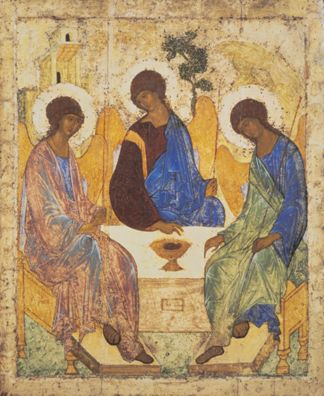
We could spend a lot of time discussing who the guests are. People have spent centuries upon centuries reflecting upon the guests’ identity and discerning possible answers. The idea that they were in some sense divine, or at least messengers from God, goes back long into Jewish tradition, while within Christian tradition, there is long tradition of associating these visitors with the Trinity. Glimpses of God are partial, messages are mysterious and yet in offering hospitality to these apparently random passers-by, Abraham, Sarah and their household are able to encounter something of God. They would not have done so if Abraham had not run to greet them. I think it is crucial to note that it is hospitality, an openness to the other, that leads to this encounter with the divine.  

The second passage – from Matthew’s Gospel – is also about hospitality. Now I admit that we don’t have time to go into as much detail with this passage as I would like to – but then I often don’t have time to go into passages as much as I would like to! In this passage, Jesus tells his disciples to focus on taking his message to Jews rather to Gentiles and Samaritans, but this is clearly a stage in a process; later in the same Gospel, in Matthew, Jesus tells his followers to take the gospel to “all nations”. 

In the Genesis passage, Abraham and his household offer hospitality. In the Matthew passage, Jesus tells his followers to expect hospitality.

He tells them to take no gold, silver or copper, no extra tunics or sandals because “workers deserve their food”. Jesus seems to say that we should prepared not only to offer hospitality but to receive it, to assert our rights as well as to respect those of others. This may come as a surprise to some people. So I must go back to something we discussed earlier: the hospitality culture in the Middle East, still there now let alone in the time of Jesus.

Of course the form that hospitality takes varies from culture to culture. But hospitality has always been central to Christianity, whatever cultural forms Christianity takes. The Letter to the Hebrews declares, “Do not neglect to show hospitality to strangers, for by doing that some have entertained angels without knowing it.” St Benedict, founder of the Benedictine order of monks, told his monks to greet ever visitor to the monastery as if they were welcoming Christ himself.

Hospitality to strangers is not an invitation to naivety. We have to be careful about what today we call safeguarding. But being careful does not mean distrusting people just because they are strangers, or different to us. They, like us, are made in God’s image. God loves them just as God loves us.

The apostle Paul teaches in Galatians that “There is no longer Jew or Gentile, there is no longer slave or free, there is no longer male and female, because you are all one in Christ Jesus”. The love of strangers, the love across barriers of difference, is central to the gospel of Jesus Christ. That is why it is so appalling to see people on far-right marches, with racist messages, claim that they are defending “Christian values”. They are doing the opposite.

With the coming of Jesus, divisions of nationality, class, gender and status are overcome by the Kingdom of God. This is a central aspect of the gospel that we as Christians proclaim!

However, I suspect that most of us exclude people far more than we like to think we do. We may often do so unconsciously. When I started a new job a few years ago, I was shown round by two colleagues who said they would introduce me to “everyone” who worked there. At one point, we passed the cleaners as they went about their work. I paused uncertainly as my colleagues carried on walking. It was clear that “everyone” did not include the cleaners.

What does it really mean to be hospitable? I work as a chaplain in a multi-faith chaplaincy team at Aston University. I would like to tell you about a student who I met a couple of years ago. I’m going to call him Matthew. That’s not his real name, but I want to respect his privacy. Matthew was a postgraduate student from Nigeria.

Matthew turned up at the Chaplaincy one day in a state of considerable sadness. It was only a few weeks after he had arrived in Britain. His parents back home in Nigeria had discovered that he was gay. They had immediately broken off contact with him. On top of the unimaginable distress that this caused him, they had withdrawn financial support and stopped paying his tuition fees, meaning Matthew faced destitution and removal from his course.

If Matthew returned to Nigeria, he would be arrested for the crime of having sex with another man. More than that, he could be murdered, a not uncommon fate for gay people in his community.

I thank God that my colleagues and I were able to help Matthew to access some short-term financial support, and to introduce him to a church locally that welcomed him and did not condemn him for his sexuality. He decided to apply for asylum in the UK and I did what I could to introduce him to people who could advise him on the process. He was welcomed by a group of LGBT+ asylum-seekers, most of whom are Christians or Muslims, who gave him a sense of community and encouragement.

But then one day when Matthew came to see me in the Chaplaincy he had an awkward question. Despite the heartbreaking split with his family and the fears for his future, he had felt uplifted in the UK by the welcome and support he had encountered from the church he attended and from the LGBT+ asylum-seekers’ group. Up until that point he had not paid much attention to the British media. But now he had started to do so. He saw with alarm the way that asylum-seekers were described in many mainstream British newspapers. He was baffled by coverage that implied that life was easy for asylum-seekers when he knew from experience that the process of proving the need for asylum was tough, confusing and humiliating. Why, he asked, did so many British people seem to hate asylum-seekers?

I sat there facing him, and I was ashamed. Ashamed that parts of the British media, and parts of Britain, had descended to this. Ashamed that one of the richest countries in the world, with one of the highest military budgets in the world, claimed to be unable to meet the basic needs of its population as well as to welcome those fleeing persecution. But also I was ashamed of myself, and of the Christian Church, that we have not done more to stand up to the sort of narrative, to these sort of attitudes.

Now of course, there are many important debates to be had about migration, about asylum, about the right policies to adopt for different situations. I am sure that those of us in this church, like Christians generally, will disagree with each other about which party to vote for and which policies to endorse. And that’s a good thing. I don’t trust churches whose members all agree with each other! However, I suggest that hospitality, support for people in distress, refusal to demonise groups of people, rejection of lies – these should be principles that all Christians can stand for. And that means challenging the anti-migrant, anti-asylum-seeker and frankly racist narratives that are gripping much of the UK.

How did we arrive at the point in which it is normal to imply that all asylum-seekers and migrants are murderers and rapists because a tiny percentage of individual murderers and rapists happen to be asylum-seekers or migrants? One of the surest signs of prejudice against a group is to hold all its members responsible for the actions of individuals.

We cannot pretend that these things are not happening. Nor can we as Christians ignore the Bible’s consistent emphasis on the need to welcome the stranger. Take Leviticus 19,34: “The foreigner residing among you must be treated as your native-born. Love them as yourself, for you were foreigners in Egypt. I am the Lord your God.” This is not simply a one-off quote but typical one.

It would be a lot easier for me not to preach about this subject. But faced with lectionary readings on hospitality in the midst of racist riots, it would have been bizarre to avoid it.

Nonetheless, I am conscious of the danger of hypocrisy. If we criticise anti-migrant protesters for demonising others, do we risk demonising them? Do we risk talking of all of them as if they are all the same? The New Testament does not teach us to pretend we have no enemies. But it teaches us to love everyone, to love our enemies even though they are our enemies. It teaches us to recognise our own sin, and our own complicity in the sins of others.

So as we challenge exclusion, and racism, and prejudice, and the denial of hospitality, let us have the courage to ask ourselves. Who are we excluding? To whom are we failing to show hospitality? In the church, in our politics, or simply in our everyday lives, who do we demonise, overlook or simply leave out?

The reading that we heard from Matthew’s Gospel finishes with some challenging advice from Jesus: he urges his followers to be “wise as serpents and innocent as doves”. I think that’s a good phrase to reflect on as we think about how to live, how to operate in a world that increasingly seems to be dominated by hatred, bigotry and racism. We are called to be “wise as serpents and innocent as doves”.

That is very different to the attitudes that we often encounter in the world. There are people who cynically maintain that to be realistic we must water down our principles and take what we can for ourselves. Some give the impression that anyone who acts compassionately is unrealistic and naïve. But Jesus teaches us that we can be realistic about the horrors of the world – wise as serpents – while remaining compassionate and principled – innocent as doves.

Confronting hatred and racism is not easy. The situation we face may get worse before it gets better, and churches may have a tough part to play in the struggles ahead. So let us be prepared to be wise as serpents and innocent as doves, striving to love our enemies and recognising that hospitality is central to biblical faith. As the Letter to the Hebrews says, in showing hospitality to strangers, we may entertain angels unawares. Or at the very least, we may entertain human beings, created in the very image of God.

_________________________________________________________________________________________________________

My book, The Upside-Down Bible: What Jesus really said about money, sex and violence (Darton, Longman and Todd, 2015) can be bought in paperback or e-book, priced £9.99.

University chaplaincies under threat

I wrote this article for the Church Times, who published it on 24th April 2026.

If you took your lead from the more disheartening corners of social media, you might think that humans could never get on with people different from themselves. I am lucky to have regular reminders that this is untrue — because I work in a university chaplaincy.

This really hit me after the far-right riots of summer 2024. That September, students of many backgrounds, faiths, and nationalities turned up at our university and undermined all the far-right’s myths in the first week of term.

One day that week, in the chaplaincy, I saw a student in a kippah and a student in a hijab chatting about the differences between halal and kosher. The next day, a student with colourful hair and revealing clothes sat alone at a board games event before a group of conservatively dressed Muslim women invited her to join their game.

At our weekly philosophical discussion group, I have watched students with passionately different views on the British Empire restrain themselves from interrupting as they listened to one another. Members of a generation routinely patronised in the media show a greater ability at dialogue than politicians three times their age.

Several academic studies show that Christian chaplains in higher education (HE) still outnumber chaplains of other faiths put together, but the numerical dominance is declining. There seems to have been a particular buzz around Muslim chaplaincy recently, with new books, conferences, and courses.

Christians have nothing to fear from multifaith chaplaincy: following Christ surely leads us to serve our neighbours of all faiths and none. Some students who come to our chaplaincy seek reassurance that our purpose is not to convert them. When we focus, instead, on meeting their needs, they are left with a much better impression of Christianity; and some end up asking about Christian faith.

The Revd Dr Jenny Morgans, an Anglican chaplain at King’s College, London, and author of Christian Women at University, reports that “chaplaincies particularly serve students experiencing isolation, including international students and LGBTQIA+ students, who may feel marginalised in other religious spaces”.

This echoes my experience. I am asked about Jesus and faith by students who would be unlikely to go to church — including some who would be afraid to do so — to ask such questions. Yet, I know one senior church leader who advocated withdrawing chaplaincy funding because it did not result in more people turning up at his churches.

The threat to Christian chaplaincy in HE does not come from Muslim, Jewish, or Humanist chaplaincy: it comes from university funding decisions — and from attitudes in churches.

Since the HE sector is facing funding problems, axing chaplaincy budgets can seem — to the sort of university managers who cannot fit pastoral care into a spreadsheet — a quick way to save a few pounds. But not all chaplains are funded by universities themselves. Traditionally, about half of the funding for Christian chaplains comes from churches. Some of that money is drying up.

It is not easy to find up-to-date statistics: several denominations are astonishingly bad at providing them. Go to a gathering of HE chaplains, however, and you will find that the mood of enthusiasm for our work is marred by a thread of sadness about cuts and under-appreciation.

The funding picture is varied, but some trends are visible. While academic research is inevitably a few years behind, experience suggests that it is no longer as unusual as it was in England to find a university without an Anglican chaplain.

Having spoken with several chaplains who are wrestling with funding negotiations, I do not want to put their chances in jeopardy by naming specific universities; but the examples are not hard to find.

The withdrawal of denominational funding can happen quickly and have significant consequences. A recent Roman Catholic decision to scrap the funding for both RC chaplains at a large redbrick university left the university’s chaplaincy team almost halved, putting significant strain on the other chaplains.

In the Midlands, meanwhile, an informal deal between the Methodists, Baptists, and United Reformed Church has broken down. There was a “gentlemen’s agreement” about which denomination would fund a Free Church chaplaincy post at which universities. But, as new people in each denomination faced pressure over budgets, they did not feel bound by a deal that sounded as though it had been written on the back of an envelope in a pub two decades before.

There need to be more than clearer structures and accountability, however: there need to be changes in culture so that chaplaincy is truly valued. Churches can learn from chaplaincies, and so can the world as a whole.

It is not true that difference must lead to prejudice, and disagreement must lead to hatred. It is true that God has created human beings different from one another and yet able to live and learn together. Many university chaplaincies testify to this truth through their everyday work. It is work that churches can do much more to support.

_________________________________________________________________________________________________________

Symon Hill is a Baptist chaplain at a university in the West Midlands. His books include The Upside-Down Bible: What Jesus really said about money, sex and violence (Darton, Longman and Todd, 2015).

Economic justice is central to the message of Jesus

I was recently asked to preach on the theme of economic justice at Wakefield Baptist Church. They are a very welcoming and active church and I was honoured to be invited to preach there.

The service was on St David’s Day, 1st March 2026. It was just after US and Israeli forces had begun bombing Iran and the congregation of Wakefield Baptist Church includes a large number of Iranian Christian refugees. The format of the service was changed a bit at the last moment, with members of the church’s leadership team speaking about Iran before and after I delivered my sermon. I also made some comments about Iran before preaching my sermon as planned. Below is basically the text that I wrote beforehand but in practice I deviated from the wording at times and added in a few extra comments.

The sermon was based on two Bible readings:

Luke 12, 13-21

Luke 19, 11-27

Jesus wants us to think. If he didn’t want us to think, he would simply have issued lists of rules and sets of instructions. But he talked in parables. He told stories. He almost never gave a direct answer to a question. He often responded to a question by asking another question and he came at issues sideways on. This is not the behaviour of someone who wants us to accept things without thinking about them. Parables invite us to reflect, to ponder, to work things through.

Now not all churches are comfortable with this. Some churches give the impression that they prefer rules to questions. Sadly this has left many people with the impression that Christianity is about being told what to think. Personally I really enjoy sharing passages of Jesus’ teachings with people who are not used to reading them – because they are often very surprised to see how Jesus talked.

It can also be a surprise to see the topics that Jesus talked about. When church leaders talk about poverty, or war, or immigration, they are often told to “stay out of politics”, which is an odd idea given that faith involves the whole of life. But it is assumed that church leaders will comment on issues such as marriage and sexuality and so-called “family values”. So some people get the impression that Jesus spent his time talking about such things. It can come as shock to discover that Jesus said far more about money than he said about marriage, sexuality or “family values”. Reading the New Testament, it’s clear that money, poverty and inequality are among the topics that Jesus mentions most often, especially in the Gospel of Luke.

Now of course parables can have lots of different meanings. That’s one of the wonderful things about a parable! It can continue to provide more and more meanings. Nonetheless, I think that when Jesus’ original hearers heard him talking about money, they were hearing something that was relevant to their own everyday lives. Jesus lived in a deeply unequal society, impoverished by the brutal exploitation of the Roman Empire. Jesus’ listeners really responded well to a teacher, to a leader, who talked, among many other topics, about the reality of inequality and injustice.

Of course, our society is in many ways different to the society in which Jesus lived. We have many rights that were denied to the poorest people in Jesus’ day. We have these rights because our ancestors campaigned for them, often inspired by their faith in Jesus.

Nonetheless, the world remains hideously unequal. The world has enough food to feed everyone in it. Yet in our sin we have distributed food so badly that some starve while others hoard their wealth. Oxfam report that the richest four individuals in the UK own as much as the poorest 20 million people in the UK. That’s nearly a third of the population, owning as much as four people. You don’t mean to tell you that internationally, the inequality is even greater.

Last week it was reported that Elon Musk, the world’s richest person, is close to become the first ever trillionaire. How many noughts are there in a trillion? There are 12 noughts in a trillion. A trillion is a million million. According to Oxfam, Elon Musk’s wealth would be enough to pay off the entire public debt of 31 of the world’s poorest countries.

And so we come to the reading we heard earlier from Luke 12, Jesus’ Parable of the Rich Fool. It’s about a man who is so arrogant about his own wealth that he builds bigger barns to store it in, not knowing that he won’t live to see them completed. The man in the parable can control his money, he can control his buildings, but he can’t control his span of life. His wealth leads him to overestimate his own power.

This man has a conversation. Who is the conversation with? It’s with himself! He speaks with his own soul! He says, “Soul, you have ample goods laid up for many years”. The theologian Ched Myers says this story is a sort of cartoon. It’s about a rich man who is so unconcerned about other people than even when he has a conversation it’s with himself. He doesn’t seem to have a relationship with others who might benefit from his possessions, or with those whose labour has helped to produce his possessions. He doesn’t even seem to have much of a relationship with God. The only relationship he seems to have is with his wealth.

This man who thinks he has everything is impoverished in terms of both companionship and insight. And then he loses his life. It’s quite a sad story.

How has he gained all his possessions? Well, we’re not told. However, historians report that in Jesus’ time it had become common for landowners to increase their wealth by taking over the land of indebted small-scale farmers who could not pay their debts. This may have been the sort of wealthy landowner who Jesus’ listeners had in mind.

The problem is not simply that the man is too attached to his possessions. Anyone who needs to build bigger barns to store things for himself is stopping others from using them – others who may be in greater need.

In the Bible, almost every reference to storing food is negative – unless it refers to storing food to share with others. You may remember that in the book of Exodus, when the Israelites were wandering in the wilderness on the way to the promised land, they were fed with manna from heaven. They collected manna but people who tried to take more than their share found that the extra that they took went rotten.

According to Exodus 16,18, “The one who gathered much did not have too much, and the one who gathered little did not have too little. Everyone had gathered just as much as they needed.”

This is the Bible’s economic vision! We find it in Jesus’ parables. If instead we trust in the accumulation of wealth, we put our faith in something unreliable and temporary, instead of in the living God. As Jesus puts it in this parable, “So it is with those who store up treasures for themselves but are not rich towards God.”

Today of course, the super-wealthy do not need big barns. In Jesus’ day, most wealth consisted of physical possessions such as grain or gold. Nowadays even most money does not exist as coins or notes. Wealth today mostly consists of numbers on screens. It has meaning only because we all believe that the numbers on screens mean something. If we all stopped believing in the numbers on screens, the system would fall apart.

It is important to note that Jesus does not encourage us to hate rich people, even those with excessive wealth and power. Also in Luke’s Gospel, we read of Zacchaeus, an exploitative and fraudulent owner of a privatised tax-collection business. After meeting Jesus, Zacchaeus gave away half his wealth and paid back those he had defrauded four times over. Zacchaeus seems to have been welcomed into the community of Jesus’ followers, many of whom seem to have shared their property in common.

Following Jesus and challenging injustice is not about judging and demonising people. We need to recognise our own complicity in sin and ask God to send his Holy Spirit to empower us to live differently. Despite all the problems caused by inequality, we constantly hear people simplistically blaming social and economic problems on groups who they want to demonise. They blame migrants, or refugees, or Muslims, or Jews, or trans people, or benefit recipients, or whoever this week’s scapegoat happens to be. Let’s not sink to that level. We are called to love our neighbours, even to love our enemies, as we work for change and ask God to guide us.

What are we to make then of the second passage that we read? It’s a famous passage, although this is Luke’s version of the story. The version in Matthew’s Gospel is probably better known. Matthew’s version is often known as the Parable of the Talents, because the rich man gives each of the three servants, or slaves, a unit of currency known as a talent. In Luke’s version the currency is different, so depending on the translation, he gives them a mina, or a pound. But this isn’t a pound as we think of it in Britain today. It is much more than that!

Basically, without getting too much into the maths and the language, the rich man is giving each of the three servants a stonking amount of money. As we saw, he rewards the first two for making more money, and is angry with the third servant for not doing so. And in Luke’s version of the story, he then has his enemies killed in front of him.

So I’ve got a question for you: when you read this story, or when you hear this story, which of the characters do you most identify with? Honestly, with which of the characters do you most empathise, or sympathise?

(Members of the congregation then offered their answers to this question).

Have you heard sermons about this passage before? I had heard lots of sermons about this passage, and it had always worried me until I started to think about it differently. I had always been told that the rich man represents God. This bothered me a lot. It bothered me because the rich man in this story is a bully and a tyrant. He angrily punishes someone who says he is frightened of him and he casually has his enemies killed.

Why – why on earth – do we think that such a character represents God? What does that say about our perception of God? The God revealed in Jesus Christ is not a bully and a tyrant. It’s true that in some of Jesus’ parables there may be a character who represents God, but in many others there is not. Why do we assume that someone must represent God in this parable? What if nobody in this parable represents God?

I want to suggest that the more we think about it, the more this makes sense. Luke’s Gospel is full of challenges to the rich. Jewish people rejected lending money at interest. Yet in this parable the rich man says that a servant could have made money by investing money and gaining interest. It seems highly unlikely that a Jewish teacher such as Jesus would have encouraged such a thing.

Once we recognise that, the parable suddenly opens up! There are lots of fresh possibilities!

What if the rich man in the story is not somebody to be admired but someone to be challenged? Well, who is it who challenges him? It’s the third servant! Although I’m not entirely convinced that everything that the third servant says is true. He says to the rich man, “I was afraid of you”. “I was afraid of you”. But he doesn’t sound afraid, does he? Because he then goes on to say, “You are a harsh man; you take what you did not deposit, and reap what you did not sow.” He speaks this to a rich and powerful man who is the sort of person who orders his enemies to be killed in front of him. And here’s his servant telling him to his face that he’s a harsh man and reaps what he does not sow!

The third servant is speaking truth to power. The third servant is the hero of the story.

The parable finishes with a summary of the reality of economic injustice: “To all those who have, more will be given; but from those who have nothing, even what they have will be taken away”.

This isn’t a description of how things should be. It’s a description of how things are. It’s a description of an unequal world – a sinful world.

Jesus’ parables expose the realities of economic injustice today as they did 2,000 years ago. But now, as then, Jesus calls us to challenge that injustice. This isn’t simply about political protest. It’s about trusting in the God of love and justice rather than in the idols of money and earthly power. Luke’s Gospel gives us a clue about this in this parable – but it’s very brief and we could easily miss it! So let’s go back and have a quick look again.

Just before Jesus tells the parable about the rich man and the three servants, Luke tells us that Jesus told the parable because his disciples “supposed that the Kingdom of God was to appear immediately”. In other words, the Kingdom of God was not going to appear immediately, but the parable had something to say about that.

It seems to me that Jesus’ parable made clear that injustices and sins such as economic inequality would continue for now as the Kingdom was not going to appear straight away. At the same time, the parable showed the third servant challenging injustice. Thus the parable shows that it is possible to live in loyalty to the Kingdom of God even though the Kingdom has not yet been fully realised.

Throughout the New Testament, the Kingdom of God is shown to be both now and not yet. The Kingdom of God is not simply a dreamy hope for a distant future. Nor is it simply a fluffy personal feeling. The Kingdom of God is an alternative to the powers that dominate this world, an alternative in which all God’s children and all God’s creation are loved and cared for. The Kingdom of God is a reality that breaks into the present even as we hope for its total fulfilment in the future. From small moments of kindness to global campaigns for justice, the Kingdom of God breaks in. When we reach out across boundaries, when we take the risk of loving our neighbours, when we trust in God and defy the idols, we are serving the Kingdom of God.

The life, teachings, death and resurrection of Jesus call us back to trust in the Kingdom of God when we are tempted to trust in the world’s priorities instead.

At times the idols of money and markets and military might seem so much stronger. No doubt the Roman authorities who crucified Jesus thought that they could easily get rid of this troublemaking Jewish peasant. But Jesus died for us, and the troublemaking Jewish peasant rose from the dead: all the powers of death could not hold him. All the forces of sin and oppression and empire were put on notice that their days were numbered. We can have confidence that it is the Kingdom of God that will triumph.

In that faith let us continue to follow Jesus. Let us be inspired by the third servant in the parable, ready to speak out for truth and love in the face of injustice.

_________________________________________________________________________________________________________

My book, The Upside-Down Bible: What Jesus really said about money, sex and violence (Darton, Longman and Todd) can be bought in paperback or e-book, priced £9.99.

Jesus’s blessings turn the world upside-down

Last month (on Sunday 1st February 2026) I had the honour of preaching at Foleshill Road United Reformed Church in Coventry. They are always very welcoming.

Below is the text of my sermon (this is basically the text that I wrote beforehand but in practice I deviated from the wording at times and added in a few extra comments).

The sermon was based on two Bible readings, from the Lectionary for the day:

Matthew 5, 1-12

1st Corinthians 1, 18-31

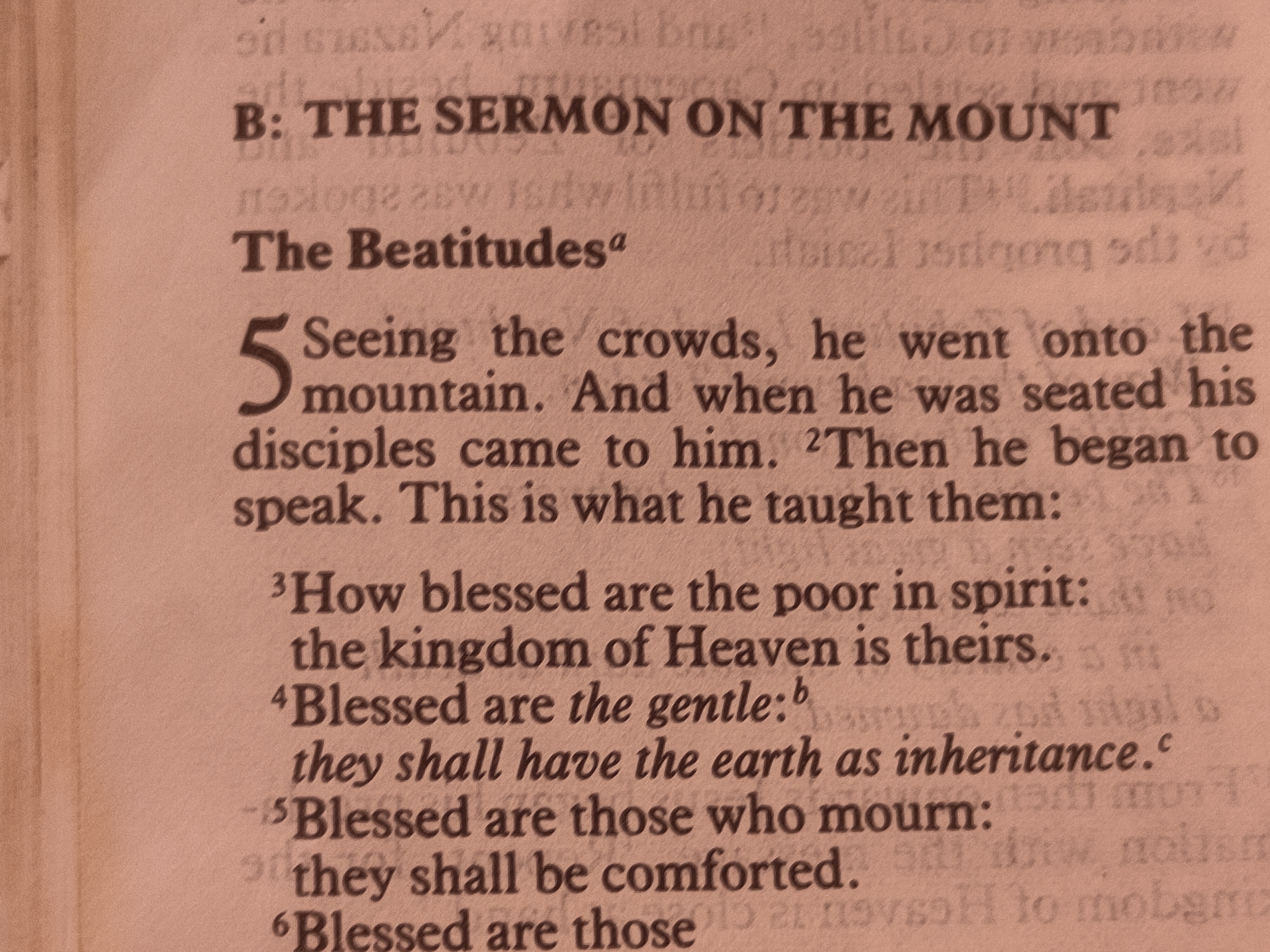
The first reading that we heard today is perhaps one of the most famous passages in the New Testament: Jesus’ list of blessings. “Blessed are the poor in spirit…” and so on. Known as the beatitudes, they come at the beginning of Jesus’ Sermon on the Mount.

Although they might be familiar to many of us, these statements of Jesus are really quite weird. Jesus announces that people who are suffering are blessed. Isn’t that a bit odd? The rich and powerful might feel that they are the ones who have been blessed.

Jesus lived in the Roman Empire. The emperor’s wealth and power were seen as an indication of his divine status. In many other cultures also, it has been assumed that the rich and powerful are blessed by God. Despite Jesus’ teaching, Christians are not immune from this attitude. Following Donald Trump’s election victory, there were Christians in the US saying that Trump had survived the recent assassination attempt because God had chosen him to lead America. Meanwhile, Patriarch Kirill, the leader of the Russian Orthodox Church, says that God has blessed the rule of Vladimir Putin.

So how can we make sense of Jesus’ words? Well, let’s look at where this passage fits. Here we are at the beginning of Chapter 5 in Matthew’s Gospel. Quite a lot has already happened in the first four chapters. Jesus has recruited disciples, started healing and talked a lot about the Kingdom of Heaven. The Kingdom of Heaven is a major theme in Matthew’s Gospel.

Incidentally, “Kingdom of Heaven” in Matthew is the equivalent of “Kingdom of God” in other gospels. We could also call it the “Empire of Heaven”, as “kingdom” and “empire” are the same word in the original Greek of the New Testament.

Let’s remember that Jesus was speaking to people in a predominantly poor society that was facing ongoing exploitation by the Roman Empire. Historians estimate that many – perhaps most – of the population lived near or below subsistence level. Attempted resistance to Roman rule had been brutally suppressed.

In short, Jesus was speaking in a context of poverty and injustice.

Now we are not in first-century Palestine. We are in twenty-first century Britain. We have many things that they did not – economically, socially and politically. Many of these advances were gained by our ancestors struggling for them.

Nonetheless, now, according to Oxfam, the four richest people in Britain own as much as the poorest 20 million. With society still recovering from the Covid pandemic, mental health problems are extremely common. On a global level, the beginning of 2026 has seen fast and unpredictable changes in world politics, with peaceful protesters are being killed in Iran and even in the US, and it is hard to predict where the next war will begin.

Our context is different, but I want to suggest that Jesus still speaks to a world facing injustice, poverty and violence.

So here at the beginning of Matthew Chapter 5, Jesus lists 9 groups of people who he says are blessed.

We can get a bit confused with the word “blessed”. Today the word “blessed” gets used in lots of ways. We might say we feel blessed by what God has done for us, we might pray that God will bless someone or something. There are people who say “Oh, bless!” about a child, or occasionally an adult.

Sometimes the word “bless” is used to patronise people. I am reminded of the theologian John Hull, who used to teach at the University of Birmingham. John Hull was blind and on one occasion, he encountered a Hare Krishna group. One of them told John that because of his blindness he was blessed. When John asked him to explain, the man said, “Well, your teacher Jesus said that it’s wrong to think lustfully about women. And you can’t do that.” John replied, “Dream on, pal”.

The word translated “blessed” in this chapter is sometimes translated as “happy” or “fortunate”. At least one translation uses the word “congratulations”: “Congratulations to the poor in spirit!… Congratulations to those who mourn!”.

These are odd things to be congratulated for.

“Blessed are the poor in spirit”. That’s what Jesus says in Matthew’s Gospel. In Luke’s Gospel, Jesus simply blesses people who are “poor”. I don’t think these two things are very different. Poverty, oppression and humiliation were a daily experience for many of Jesus’ listeners. Many people’s spirits had been broken by such experiences. These people were materially poor, and they were poor in spirit.

Yet Jesus says, “Blessed are the poor in spirit, for theirs is the Kingdom of Heaven”.

Jesus does not say that the Kingdom of Heaven will be theirs. Theirs is the Kingdom of Heaven. The Kingdom of Heaven is a reality that is both now and not yet, breaking into our present even as we look for its complete fulfilment in the future.

Then we have, “Blessed are those who mourn, for they will be comforted”.

Anyone can be in mourning. The richest and most privileged person can be struck with grief. Jesus says they are blessed. However, in a land crushed through poverty and military occupation, it is the poor and oppressed who are most likely to be grieving, particularly to be grieving collectively. Grief can be not only an individual horror but a collective trauma.

So we come to the third beatitude: “Blessed are the meek”. We tend to think of “meek” as meaning quiet, shy, submissive. I am reminded of Monty Python’s Life of Brian, in which someone hearing the Sermon on the Mount says, “I’m glad there’s something for the meek – they have hell of a time”.

Because this can mislead us, some translators use words such as “powerless” or “crushed”. Psalm 37 repeatedly promises the meek that they will inherit the land. This is exactly the same thing that Jesus promises here: “Blessed are the meek, for they will inherit the land” – or “inherit the earth”. The allusion to Psalm 37 cannot have been lost on Jesus’ listeners, living under imperial control. 

So in the first three beatitudes, Jesus has spoken of groups who overlap quite a lot – people who are oppressed, crushed, grieving and powerless.

Then Jesus changes tack slightly. He moves on from talking about people who are suffering and talks instead about how people respond to these realities.  

“Blessed are those who hunger and thirst for righteousness”. Jesus promises that those who are hunger for things to be made right will be filled. Things will be made right. Justice will come about.

He goes to declare that the merciful, the pure in heart, the peacemakers are also blessed.

All these phrases seem to refer to people who are going against conventional wisdom and living differently – by showing mercy, working for righteousness, building peace. Let’s note that peacemaking is about resolving conflict, not avoiding conflict! Indeed, building peace will put you into conflict with people who have an interest in pursuing violence. But Jesus shows a way of engaging in conflict. If you read on beyond this passage, you’ll find that shortly after announcing these blessings, Jesus encourages his listeners to love their enemies!

This is a reminder that while Jesus sides with the poor and marginalised, he shows his love for all people at the same time, while encouraging us all to repent of sin. While most of Jesus’ followers were probably poor, he also called the rich and powerful to repentance. Let’s not forget Zacchaeus who we find in Luke Chapter 19, a wealthy and exploitative man who after meeting Jesus gave half his wealth to the poor. He repented, and hungered for righteousness.

So Jesus says the oppressed are blessed. Then he says that those who try to change things are blessed. Then he changes tack slightly again.

“Blessed are those who are persecuted for righteousness’ sake, for theirs is the kingdom of heaven. Blessed are you when people revile you and persecute you and utter all kinds of evil against you falsely on my account. Rejoice and be glad, for your reward is great in heaven.”

Jesus is realistic. He knows what often happens to people who challenge dominant values and side with the marginalised

This can be hard to relate to. In the UK today, Christians are not as a group persecuted. Yet Christians still face extreme persecution in countries including North Korea, Iran, Saudi Arabia and elsewhere.

As Christians in the UK we may nonetheless face negative reactions when our faith inspires us to live differently, to speak out, to campaign for a better world.

In the USA today, Christians who never expected persecution are finding the situation changed. Pastors in the US have spoken of being detained by ICE, Trump’s deportation enforcers known for snatching people off the streets with very little accountability. Following ICE’s killing of peaceful protesters, I was shocked to read that the Anglican Bishop of New Hampshire, Rob Hirschfield, has asked his clergy to make sure their wills are written. He said, “It may be that now is no longer the time for statements, but for us, with our bodies, to stand between the powers of this world and the most vulnerable”.

Jesus says the oppressed are blessed. He says those who try to live differently and change things are blessed. He finishes by saying that people who suffer lies and persecution because they live differently and try to change things – well, they’re blessed too.

But how on Earth can any of these people be blessed? Marginal, outcast, apparently irrelevant people? Isn’t it absurd?

Of course it’s absurd. That’s the point. Jesus is turning common assumptions on their head.

The Empire of Rome belongs to the Emperor, the Senate, the rich and powerful people in Rome and their puppets among local leaders who had sold out to them. But the Empire of Heaven belongs to the poor in spirit, the grieving, the powerless, the people who hunger for righteousness, the peacebuilders, the merciful, the persecuted and so on. As we heard earlier in the passage from 1st Corinthians, God makes foolish the wisdom of the world.

The world’s wisdom is turned upside-down by the life, death and resurrection of Jesus Christ. The Roman Empire thought they could execute a troublemaking Jewish peasant. But God sides with the poor and oppressed, so the troublemaking Jewish peasant rose from the dead and the powers of this world are put on notice that their days are numbered. Sin and death may look strong, but Jesus’ resurrection reveals that love and life will ultimately triumph.

As Paul writes in 1st Corinthians – in the passage we heard earlier – “God chose what is foolish in the world to shame the wise; God chose what is weak in the world to shame the strong”.

The change that comes with resurrection cannot be put off until we die. As Christians we believe in life after death, and we also believe in life before death. Resurrection means that the dead are raised and that the living can live differently. It also allows us to look at the effects of our actions beyond the time of our own lives. Jesus makes the world’s transformation possible.

Jesus calls us to live in loyalty to the Kingdom of Heaven, or Kingdom of God now, not just in the future.

Of course, we frequently fail. We are all entangled in sinful systems and unjust structures. We wrestle with difficult decisions and moral confusions. However often we fear to ask for forgiveness, God in God’s mercy never tires of forgiving us. And if the situation we face leads us to be crushed, powerless, poor in spirit? God reminds us he is on our side.

So when will the powerless inherit the land? When will those who hunger and thirst for righteousness be filled?

While the Kingdom of God can only reach its fulfilment with the return of Jesus, the New Testament makes clear that the Kingdom of God is constantly breaking into our world. When people are fed, when love appears, when injustice is challenged and kindness triumphs over cruelty, the Kingdom of God is breaking in.

It can be hard to keep faith in the worst times. As the hymn we sang earlier puts it, “It’s hard to dance with the devil on your back”. But the reality of the resurrection gives us hope. As Martin Luther King put it, the moral arc of the universe bends towards justice.

Preaching the Gospel means bringing good news

Just over two weeks ago (on Sunday 18th January 2026) I led worship at Sherbourne Community Church in Coventry. Having preached there several times now, I am always honoured to be asked back!

Below is the text of my sermon (this is basically the text that I wrote beforehand but in practice I deviated from the wording at times and added in a few extra comments).

The sermon was based on two Bible readings, from the Lectionary for the day:

Isaiah 49, 1-7

John 1, 29-42

I used to work in Waterstone’s bookshop. It was over 20 years ago, but one of the memories that sticks with me is from a time when I was shelving books in the children’s section. A woman came into the shop with a small child. The child was holding a toy, which I think perhaps his mother had just bought for him. He was very excited about it. He ran up to me, although he’d never seen me before, and said, with great excitement, “Man, I’ve got – ”. And then he started to tell me enthusiastically about the toy.

He was so excited, he just wanted to tell the first person he saw. Even though he didn’t know me and just called me “man”.

I can’t remember what I said in response. I probably said, “That’s good”, or something like that. But I do remember feeling uplifted by a child being so delighted by something that he wanted to tell everyone. And I remember wondering if the world might be a better place if we all rushed around and told each other when something good happened to us.

If that did happen, on the one hand, we might be uplifted by each other’s good news. On the other hand, if you’re struggling with life, and things are tough, then hearing other people sounding cheerful is not always easy.

So how did Simon feel when his brother Andrew told him, “We’ve found the Messiah”? John’s Gospel gives the impression that Simon shared some of Andrew’s enthusiasm, for he readily went to meet Jesus, who gave him the name Peter.

Now we could spend a lot of time talking about whether this all happened in the way that John’s Gospel describes it. This account differs to the accounts in Matthew, Mark and Luke, which tell us that Jesus called Andrew and Simon Peter while they were fishing.

Some people are keen to try to make these accounts fit in with the account in John’s Gospel. Perhaps these two things happened at different times, perhaps Jesus had already met the disciples before he called them while fishing and so on.

All these things are possible. But I can’t help thinking that if we put our energy into trying to make these different accounts fit together, we may be missing the point. It’s rather like responding to the parable of the Good Samaritan by asking whether the money the Samaritan left behind was really enough to pay for an inn. That’s not what the story of the Good Samaritan is about. It might be more helpful to ask what the writer of John’s Gospel is trying to tell us in this passage.

Andrew is excited. He says, “We have found the Messiah!”. In his excitement, like that small child in the bookshop, he wants to tell people. He tells his brother, Simon. And Simon’s instinct is to want to meet Jesus.

This is about how these people respond to Jesus: with excitement, with curiosity, with hope, with a desire to know Jesus, with enthusiasm for sharing the news. This is the response of people hearing good news. 

It seems to me that as Christians, we often forget that we are proclaiming good news. Several times a week, I walk between New Street station in Birmingham, and Aston University where I work as a chaplain. One day I was walking back to the station after quite a tiring day and I passed one of the Christian street preachers who can be found in central Birmingham. He was warning passers-by that they had been living with no regard to God or the future, enjoying themselves without thought of the consequences but that they would soon find that they had – as he put it – “maxed out the credit card” – and that they had a debt of sin that they were unable to pay.

I looked round at the people in the street. There were people like me, on the way home from work. There were parents with small children, some of them clearly struggling. There were homeless or semi-homeless people begging on the sides of the street or under the influence of alcohol or other drugs, slumped in corners. There were people going in and out of shops. On the whole they didn’t look like a group of people enjoying riotous lifestyles with no thought of the consequences.

I considered approaching the preacher and saying, “Have you got any good news?” Because he seemed to have forgotten that the word “gospel” translates the Greek word “evangelion”, which means something like “triumph” or “good news”. I wonder if preachers like this go round knocking on people’s doors and saying, “Have you heard the bad news?”

The Bible makes clear that the gospel of Jesus Christ is good news. Mark’s Gospel, the oldest of the gospels we find in the Bible, begins simply, “The beginning of the good news of Jesus Christ”.

Of course, the Gospel involves challenges. Sometimes Christ calls us to give things up, or to endure difficulties. But nonetheless, the message of the Gospel as a whole is overwhelmingly good news.

If we are not preaching good news, we are not preaching the gospel of Jesus Christ.

Now there is lots of bad news in the world. We do not need to preach bad news. People already know the bad news. People know how horrible the world can be.

That’s why the gospel can never be cheap or easy good news. The good news that Jesus brings is much deeper than trite or shallow reassurances. When I became a Christian in the 1990s, there was a popular worship chorus that included the line, “In your presence, my problems disappear”. What nonsense. What blasphemy – to present Jesus as an individual problem-solving machine. Of course we are not likely always to feel as excited or uplifted as we may have done at the moment when we first encountered Jesus. But the presence of God does not depend on our feelings. God is there however we’re feeling. 

Proclaiming good news does not mean pretending that suffering is not real. It means proclaiming hope – not trite, shallow hope but deep, meaningful hope – in the midst of suffering.

This is the sort of hope that we see in Andrew and Simon Peter when they respond to Jesus. Their capacity for hope allows them to respond with excitement, with curiosity – and with faith.

Faith is more than an opinion. Faith is not simply signing up to a list of beliefs. Faith is not a naïve acceptance of things for no good reason.

Faith is a deliberate decision about where to put our trust, where to put our loyalty. It may include a decision to take a chance, to take risks. But it doesn’t mean pretending to believe things that we don’t, or to act one way on Sunday mornings and another way the rest of the week. Christian faith does not mean suppressing questions and uncertainties. It means facing the questions and uncertainties and in the midst of them choosing to make a commitment to trust and follow Jesus Christ.

Faith is not about thinking we’re always right or that we will always succeed in following Christ. We are all sinners and I know that I fail very, very often. Simon Peter himself denied Jesus three times. But because faith is about trust, commitment and loyalty, faith is about our starting-point – our starting-point for how we approach life.

John the Baptist makes that clear! Earlier in the passage we heard today, John the Baptist testifies that he saw the Holy Spirit descend on Jesus like a dove. Usually in Britain today, when we see a dove, we call it a pigeon. Thus God appears in everyday things, everyday creatures, everyday people – the extraordinary breaking in on the ordinary.

Accounts of Jesus’s baptism in the gospels refer to a voice in which Jesus is described as God’s son. This all happened of course in the Roman Empire. At the time, the empire was ruled by the Emperor Tiberius, whose titles included Divi Filius – son of a god. But here is Jesus being proclaimed Son of God. Jesus’s followers are offering their loyalty, their trust, their faith, not to the Roman emperor but to this apparently obscure Jewish peasant – Jesus, Son of God. Faith can be a dangerous decision.

Nonetheless, Andrew and Simon Peter clearly regard faith in this Messiah as a decision well worth making. The Messiah was expected as an alternative to the oppressive empire under which they lived, but in Jesus they found a Messiah offering salvation and liberation not only from Roman rule but from all forms of domination, injustice and sin.

And this is massive news. This comes through in the reading we heard from Isaiah. The book of Isaiah is a great read. It’s generally agreed that different parts of Isaiah were composed at different times across centuries. The part we heard today, Chapter 49 is from what’s generally called Second Isaiah, and it proclaims that the God who has chosen the Israelites as his people is using the Israelites to proclaim his salvation of the world. Isaiah quotes God saying that it is “too light a thing” that he should save only Israel and Judah. Instead God tells the Israelites, “I will give you as a light to the nations, that my salvation may reach to the end of the earth”.

It is too light a thing that God should save and liberate only one group of people – one nationality, one ethnic group, one religious group, one class. God’s salvation and liberation are offered to all. So if you ever think that God might not want to save you, remember: it is too light a thing for God to offer salvation that does not include you.

This offer of salvation, of liberation, is made because of God’s faith in us. God is faithful. The last pope, Francis, wrote that God never tires of forgiving us. Rather, we are afraid of asking for forgiveness so often. Yet the Gospel makes clear that God is so faithful, that God stands ready to offer forgiveness however many times we stumble, however weak our faith becomes. And God keeps calling us back to the journey of faith.

Faith is not about certainty or being pure. We are all entangled in sinful systems and unjust structures. We wrestle with difficult decisions and moral confusions. Faith is about our starting-point. For if faith in God is our starting-point, nothing else can command our ultimate loyalty.

Of course, we can be loyal to lots of things: our family, our friends, our community, our country, the Warwickshire Cricket Team, the Sky Blues, a political party, a trade union – and so on. But once we are committed to Jesus Christ, we can never give our ultimate loyalty to any government, nation, army or organisation – or even to a church! We are called to start with God as revealed in Christ, the God of Love, who loves every one of our fellow humans and loves the world.

Of course, Christ calls each of us to different things. Christ may call us to unexpected places. Earlier this month, Christian pastors in the US spoke of being detained by ICE, Trump’s deportation enforcers who are known for snatching people off the streets with very little accountability. ICE’s recent killing of Renee Good, a woman protesting against ICE’s deportations, has made headlines. I was shocked to read that the Anglican Bishop of New Hampshire, Rob Hirschfield, has asked his clergy to make sure their wills are written because he fears where the situation may be heading. He said, “It may be that now is on longer the time for statements, but for us, with our bodies, to stand between the powers of this world and the most vulnerable”.

I hope of course that such things will not come to pass. I pray that none of us here will find ourselves called to be martyrs. Many who live out faith in Jesus do so far more quietly – but no less valuably. For every big-name speaker, there are hundreds of people behind the scenes, for every prominent activist, there are hundreds more stuffing envelopes – and so on. The world doesn’t see or notice everyone’s faith – but God sees and notices us all. What has God called you to, I wonder? Where and how is God calling you today?

We may not always feel the excitement that we felt on becoming Christians. We may find it hard to feel hope in the midst of sadness. I pray that God will give each of us faith to see the glimmers of God’s love in the darkest times, to remember that Christ in his resurrection has triumphed over the forces of sin and death and that God is faithful to us.

May we keep putting our faith in the God of Jesus. In the midst of the world’s uncertainties and injustices, let’s have the faith to declare, like Andrew and Simon Peter, “We have found the Messiah!”.

_________________________________________________________________________________________________________

My book, The Upside-Down Bible: What Jesus really said about money, sex and violence (Darton, Longman and Todd, 2015) can be bought in paperback or e-book, priced £9.99.
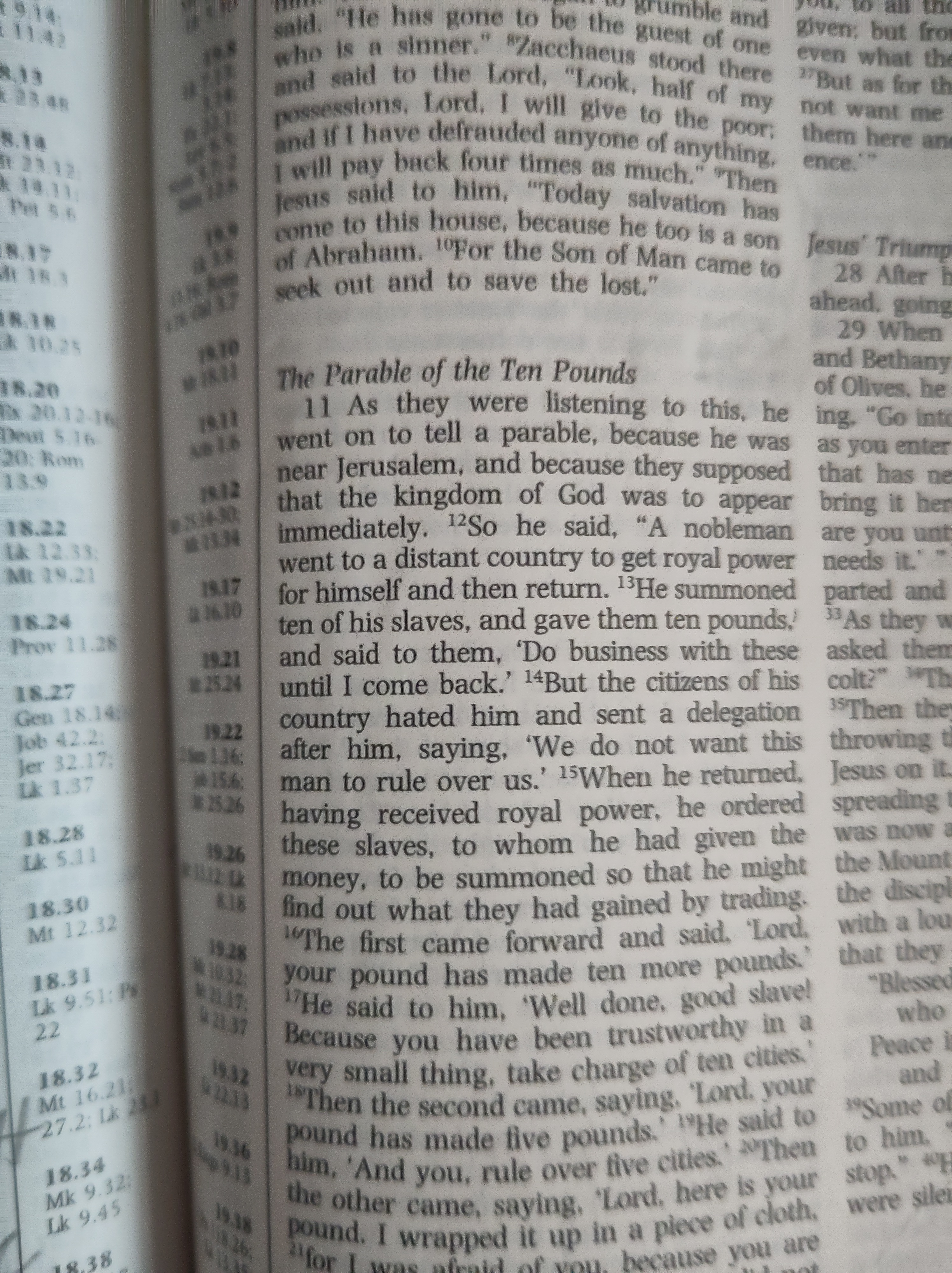
Don’t let the far-right steal Christmas

I wrote an article for yesterday’s Morning Star, encouraging readers of all faiths and none to challenge the far-right’s attempts to co-opt Christmas and Christianity to promote values that are utterly at odds with the teachings and example of Jesus.

You can read the article on the Morning Star website, but it is also reproduced below.


Britain’s best-known fascist is angry about Christmas trees.

Tommy Robinson, also known by his original name of Stephen Yaxley-Lennon, has denounced Tesco for selling plastic trees as “evergreen trees.” He insists they should use the word “Christmas.”

Robinson and his followers have been ridiculed by people suggesting that the far right are too stupid to recognise Christmas tree unless they are labelled. But while Robinson is a nasty racist bigot, he’s not stupid. He’s clever, manipulative, and knows exactly what he is doing.

In this case, he is jumping into the annual Christmas culture wars. Every year, there are people who complain about local councils using expressions such as “winter lights” or “festive markets” without the word “Christmas.”

Speaking as a Christian, I think the birth of Jesus is more important than the name that corporations give to plastic trees. Many Christians find the controversy ridiculous. Sadly some other Christians get swept up in the outrage.

These are the people who the far right are trying to recruit. They insist that Britain is a “Christian country” and that British people must observe Christmas.

In reality, nobody is trying to stop them putting up Christmas trees (a German tradition), promoting Santa Claus (based on a Turkish bishop) or celebrating the birth of Jesus (a Middle Eastern refugee).

While the British far right often claim to defend “Christian Britain,” there has been a significant shift recently. At least three things have changed.

Firstly, far-right figures are focusing more on Christianity. This may be due to Robinson’s reported conversion in prison. I can’t read his mind, so have no idea whether he genuinely had a conversion experience. It seems, however, that he doesn’t think that turning to Christ requires him to repent of racism and violence.

Secondly, a handful of far-right clergy are making themselves more visible in working with Robinson at anti-migration protests.

Thirdly, it is increasingly clear that far-right groups are not only nominally pro-Christian but that a minority of their members are active churchgoers, some in mainstream denominations.

Far-right leaders hope to see movement in the other direction also. They want to draw Christians to their cause. Some are using slick, subtle and deceptive advertising to try to draw them in.

This Saturday, an event will take place in Whitehall called “Putting Christ Back Into Christmas.” It will involve carols and prayers and is organised by “Unite the Kingdom.”

It was Unite the Kingdom – whose aim is to divide the kingdom – who organised the far-right rally in London back in September, with speakers including Tommy Robinson, along with Elon Musk by video link. Musk – who is funding Robinson’s legal fees – said “violence is coming” and urged his listeners to “fight back.”

Other speakers included Brian Tamaki, a right-wing Christian preacher who called for all non-Christian religions to be banned.

None of this would be apparent to the casual observer of the carefully constructed video made to promote this supposedly innocuous Christmas carol event on Saturday.

The video begins with a cheery hello from Christian minister Rikki Doolan, who witnessed Robinson’s conversion in prison. The video does not mention that Doolan is an Islamophobic conspiracy theorist who belongs to the far-right Advance UK party.

A homely scene features a smiling Canon Phil Harris in a jumper and clerical collar. Many viewers will have no idea that Harris is an out-and-out racist who claims that Britain is being “overrun” by migrants who “seek to subdue us.” During the racist riots of 2024, Harris described the rioters as “concerned citizens.”

Only after a succession of people with crosses and clerical collars does Tommy Robinson appear. His name is not given.

The first hint that this is about nationalism is when far-right Pentecostal pastor Chris Wickland declares that this is “a moment for believers, families and patriots.” It is then stated that the event is organised by “Unite the Kingdom” – but not everyone will know what this means. It is quite possible for someone to watch this video without realising that this will be a far-right event.

It is vital that we expose the reality.

Thankfully, a number of left-wing Christians are committed to being present in central London on Saturday to make sure that a very different message is heard.

There will be various nonviolent events to challenge fascism, involving people of many faiths and none.

It is likely, however, that local far-right groups in various parts of Britain will try to misuse Christmas and Christianity to push their vile agenda. If your local anti-racist group, or union branch, or student society or other group is resisting this sort of thing, I suggest contacting local churches – and other faith groups – and asking them to join you in speaking out against it.

Whatever you make of Christianity, the New Testament tells the story of Jesus, who became a refugee as a child, who grew up to side with the marginalised, challenge the powerful, proclaim love for all and get executed as a rebel by the brutal Roman empire. Whether or not you believe he was resurrected, it is clear that his life and message are the opposite of the far-right’s pseudo-gospel of hate. Now is the time to say so. 

_______________________________________________________________________________________________________________

My book, The Upside-Down Bible: What Jesus really said about money, sex and violence (Darton, Longman and Todd, 2015) can be bought in paperback or e-book, priced £9.99.