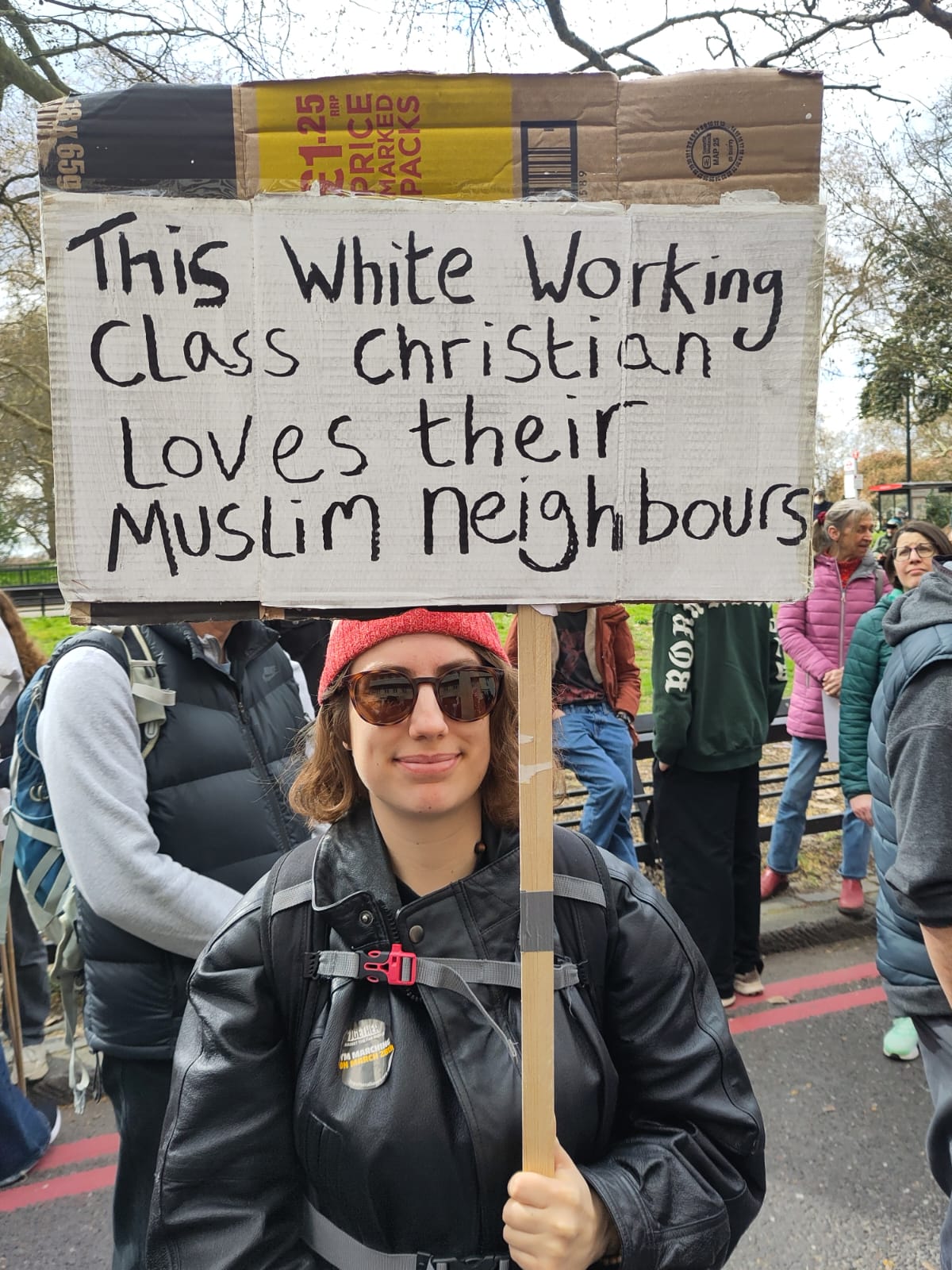
The march of Christian Nationalism (reflections on a strange day in Morecambe)

There is both good news and bad from the ‘Make Great Britain Christian Again’ conference that took place at Emmanuel Church in Morecambe this weekend.

On Saturday I joined with other concerned people to pray and witness outside this far-right event, which misused the name of Christ to peddle racist and fascist doctrines.

The bad news of course is that this far-right event went ahead at all. The Free Church of England – who insist that they own the building despite Emmanuel Church’s members splitting from them – tried to declare it cancelled. But the organisers pushed on.

Standing outside the building the far-right nature of the conference became ever clearer as time went on.
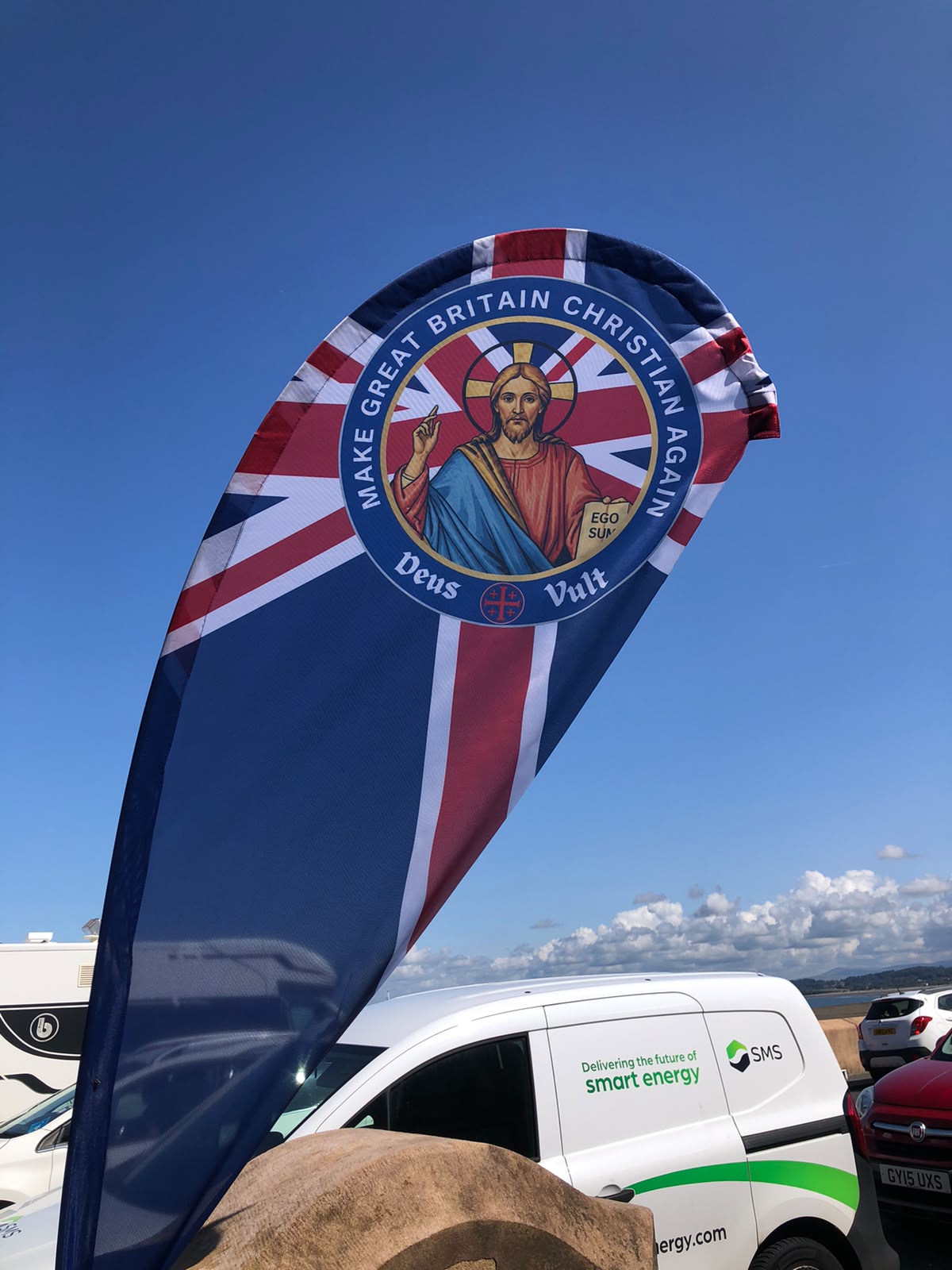
Several of the main speakers have a demonstrable history of stirring up racism  and bigotry (I can go into detail if requested!). Some of the conference attenders who engaged with us began by sounding reasonable before expressing views that were racist, authoritarian or both. Black and white people, according to one of the attenders who spoke with me, have biological differences based on “different sorts of blood”, which can cause medical problems if it is mixed. Others repeated widely discredited claims about the percentage of rapes in the UK that are committed by Muslims or migrants.

When asked to provide evidence for their claims, there were several cases of people looking vaguely at their phones and saying, “I can’t quite find it now…”.

While lots of people mentioned God, and often the Bible, there were far fewer reference to Jesus and almost none to the teachings of Jesus.

One of my most bizarre conversations was with James Renton, a student minister at Emmanuel Church. James wants to expel all Muslims from the UK. When I asked about a white British friend of mine who has become a Muslim, James said it was “especially” important to deport him because he is “a traitor to his country”.

The friend in question is one of the most compassionate and loving people I know, contributing more to British society than most people I have ever met.

Unlike the man who thought he had white blood, James was keen to say that he was concerned with religion, not race. This did not really hold up when he kept talking about protecting “the indigenous people of Britain”, saying “we have been here 1500 years”.

As news emerged of the views expressed inside the conference, it became clear that some of that was even more bigoted than what we heard outside. I will write more about then when I have had more chance to watch the videos of the conference talks.

But I have good news too!

I was pleased that quite a number of the attenders were willing to engage with us. I am not naive about this: some conversations were more worthwhile than others. But there were some genuine – if difficult – conversations. It was clear that not everyone attending the conference realised how extreme some of the speakers were. A few said that they did not believe in everything being taught there – “I don’t listen to the anti-gay stuff”, as one of them put it.

I hope our conversations may have made an impact on these people, however slight.

The other good news is that resistance to Christian Nationalism is clearly growing as it becomes more visible. There were quite a lot more people praying or protesting outside the conference than I had expected. Several were members of the Better Story network, some were local to Morecambe while others had travelled a long way – one person came from as far as Brighton to witness against Christian Nationalism. At the beginning of the day, there were also local members of Stand Up To Racism, a group that includes people of several faiths and none.

We cannot keep ignoring the far-right and hope they will go away. It is staggering that there are still people advocating this approach, despite the far-right advancing rapidly in the UK just in the last few years. Hearing churchgoing Christians spewing far-right myths this weekend, I was struck by just how much these ideas are infecting Christian churches.

We need to go further than those church leaders who speak vaguely about concern. We need to challenge this far-right distortion of the gospel very clearly, while praying that God will guide us in loving our enemies and seeking forgiveness for all, including ourselves.

To make a real difference, we need to be prepared to say that the problems that are wrongly blamed on migrants and Muslims – poverty, homelessness, unemployment – are caused by the sinful structures we have established and our failure to build society in ways that can meet everyone’s needs rather than prioritising the interests of a wealthy and privileged few.

The Christian Nationalist organisers seem to have regarded their conference as a success. They sold out their tickets and they are planning a three-day conference next year. They seem to themselves as the beginning of a new movement. One of the most extreme speakers, Dominic Muir, predicted “a bold company of men, a restoration of masculine Christianity”.

These far-right distorters of the Gospel think that their time has come. They are on the march. We cannot sit back and ignore them. We need to be bold, and proclaim the truth of God’s inclusive and transforming love. _________________________________________________________________________________________________________

My book, The Upside-Down Bible: What Jesus really said about money, sex and violence (Darton, Longman and Todd, 2015) can be bought in paperback or e-book, priced £9.99.

Why we can’t ‘Make Great Britain Christian Again’

British Christian Nationalists will hold a conference this weekend under the title ‘Make Great Britain Christian Again’.

I do not think they can make Britain Christian again – because Britain has never been a Christian country, in the sense of a country based on the teachings of Jesus. Nor has anywhere else.

Racist speakers

The conference is not merely conservative, either in a theological or political sense. It is a solidly far-right event, with speakers who are out-and-out racists with views bordering on Fascism.

Speakers include clergy from fringe right-wing denominations such as the Confessing Anglican Church. Organisers include Brett Murphy, the priest of the church at which the conference will take place – Emmanuel Church in Morecambe. Murphy says that he takes being called “far-right” as a “badge of honour”. He wants an authoritarian government that will ban LGBTQ Pride marches and the wearing of hijabs.

Other speakers include Pentecostal minister Chris Wickland, an ally of racist hatemonger Tommy Robinson. Wickland argued recently that white people are being “ethnically cleansed” in the UK. A last-minute addition to the speakers’ list is ‘Young Bob’, an infamously far-right social media influencer.

Christian heritage

When do these people think that Britain was Christian? When it was the world’s leading participant in the transatlantic slave trade? When England was conducting pogroms against Jews? When crusaders were killing innocent people in the name of Christianity, or imperial forces were stealing land while millions lived in poverty back home?

Christianity inspired many people to resist such things. Jesus was an inspiration for many people in Britain’s history who opposed the rich and powerful and brought about change.

There are many aspects of Britain of which I am proud. We are fortunate to have a degree of democracy and relative freedom of speech and religious liberty. We have these things because our ancestors campaigned for them, not because the rich and powerful kindly handed them down to us. In many cases, Jesus’ teachings have influenced British history not by forming the basis of the establishment but by encouraging grassroots movements for change.

No such thing as a Christian country

People at the conference this weekend can search their Bibles in vain for any reference to a Christan country. The Hebrew Bible – which Christians tend to call the Old Testament – includes God’s guidance to the ancient Israelites on running their country. To try to transfer this across to a “Christian country” is historically nonsensical and deeply anti-Semitic.

The New Testament tells the story of how Jesus proclaimed the Kingdom of God – a very different sort of kingdom to all the powers of this world. The authorities of the Roman Empire, who crucified Jesus, were defeated when God raised him from the dead, showing that all the powers of violence and sin and oppression cannot defeat the power of God’s love and grace. 

A different message

I am pleased to be one of a group of concerned Christians who will be praying outside the far-right conference in Morecambe at the weekend. Some are members of the Better Story network, while others belong to local churches or other groups. Members of Better Story will engage in conversation with those attending, as well as with passers-by. We will seek not to dehumanise anyone, and to remember that Jesus urges us to love our enemies. We will be on social media, to ensure that the far-right distortion of Christianity is not the only message that is heard.

In one of the earliest books of the New Testament, Paul’s Letter to the Galatians, the apostle Paul wrote, “There is no longer Jew or Gentile, there is no longer slave or free, there is no longer male and female, for you are all one in Christ Jesus” (Galatians 3,28).

It is that message of God’s inclusive, liberating love that we will be proclaiming outside this far-right conference this weekend.

________________________________________________________________________________________________________

Please feel free to add a comment or contact me if you would like more information about the issues or events mentioned above.

My book, The Upside-Down Bible: What Jesus really said about money, sex and violence (Darton, Longman and Todd, 2015) can be bought in paperback or e-book, priced £9.99.
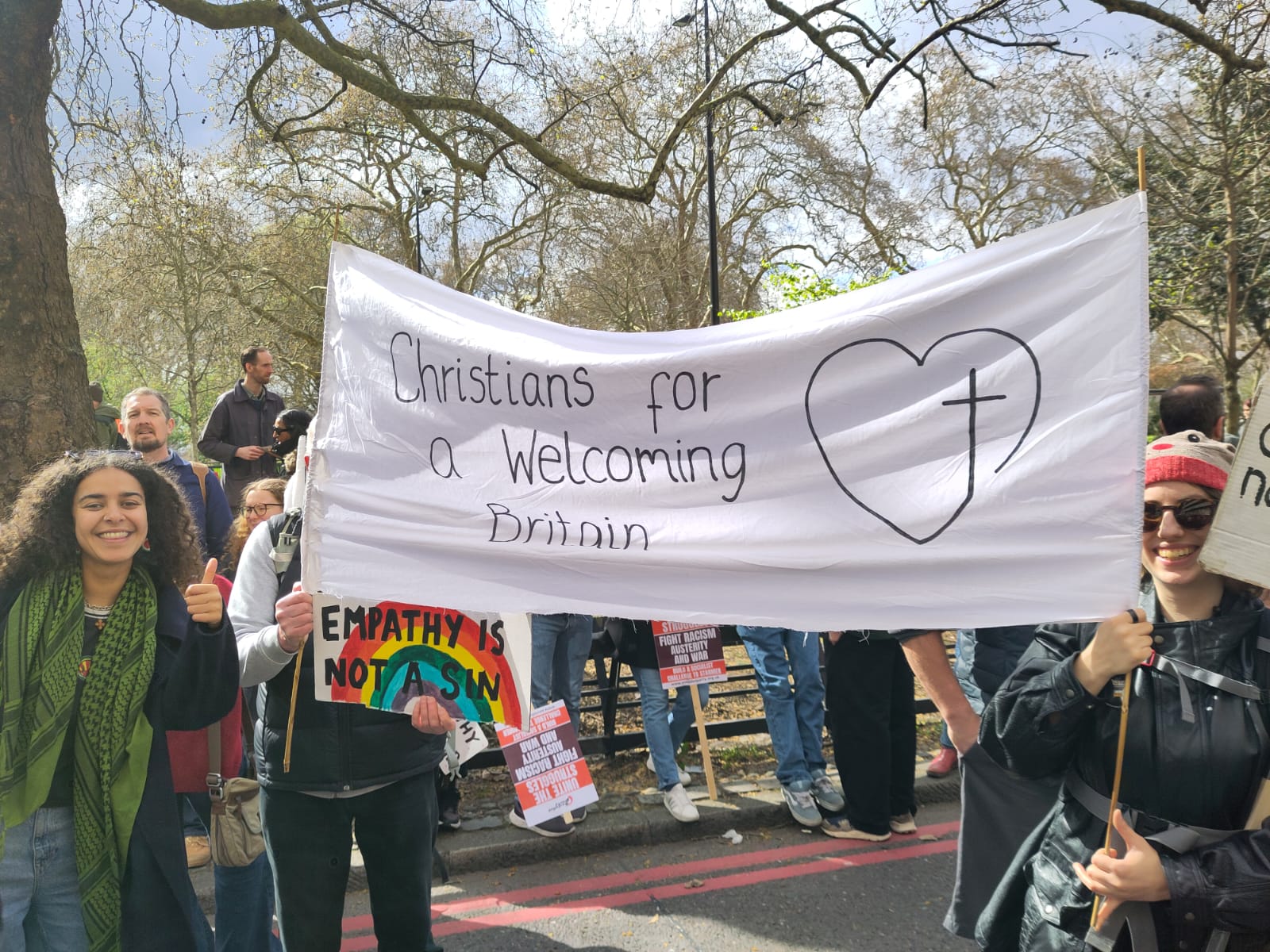
1,000-strong Christian Bloc joins Together Alliance march against the far-right

You can tell when a march is big if you’re near the back of it. It you have to wait for hours before you even start moving, it’s a good sign that there are far more marchers than were expected.

The people at the front of yesterday’s Together Alliance march in central London reportedly reached the end of the route only shortly after those of us near the back had begun to march. Organisers estimated that half a million people had taken part.

There were people of many faiths and none, of many backgrounds, ages, nationalities, sexualities and genders; students, workers, unemployed people, young people and pensioners. There were trades unions, community organisations, faith groups and campaign networks.

We were united in rejecting the racism and hatred peddled by far-right groups such as Reform UK, Restore Britain and Unite the Kingdom. We were united for an inclusive, compassionate Britain in which resources are divided fairly and minorities are not scapegoated for the actions of billionaires and the consequences of unjust structures.

Amongst the many “blocs” (loosely organised sections) of the march was the Christian Bloc.

The point of the Christian Bloc was not to divide Christians from the other marches. That would undermine the unity that the march was championing! Rather, it was to the challenge the far-right’s attempts to co-opt Christianity. Christian nationalism has been increasingly visible in the UK in the last two years or so. Far-right figures claim to be defending “Christian Britain” as an excuse to demonise Muslims, Jews, LGBTQ+ people and others. We wanted to send a clear message that these people don’t speak for Christianity. There are many British Christians ready to stand in solidarity with our neighbours of other faiths and none.

When the idea of a Christian Bloc was first talked about, I thought we might get a few dozen people – perhaps over a hundred if things went well. A few days ago, organisers from groups including Better Story and Christians for a Welcoming Britain were suggesting there would be hundreds.

But I still hadn’t quite taken it in. When friends messaged me to say they would be in the Christian Bloc, I responded by saying “See you there!” – or similar words. Christian blocs at protests are usually small enough that if you know someone else who is going, you can be fairly sure that you will bump into each other. It hadn’t occurred to me that the Christian Bloc would be so big that I would simply not see many friends or acquaintances who were also there.

My first big surprise came when I arrived at Oasis Church Waterloo for the pre-march service. There were, by my admittedly rather rough estimate, about 400 people there. They were struggling to fit more people in. The numbers increased as the Christian Bloc assembled. As we marched down Piccadilly, the Guardian estimated that there were 1,000 people on the Christian Bloc alone.

We were not of course the only Christians on the march. I know that there were other Christians in the trade union blocs, the refugee blocs, the LGBTQ+ Bloc and elsewhere. They included some who had attended the church service before the march began. Nonetheless, I am delighted that so many joined a bloc that was specifically there to challenge the far-right’s misuse of Christianity and to reject Christian nationalism.

As the Christian Bloc marched, it was great to share greetings and encouragement with others, including Jewish and Muslim groups marching near us.

Well done and thank you to everyone who took part or expressed support!

Christian nationalism may be growing in the UK. So is the resistance to it. We need to keep going!