The march of Christian Nationalism (reflections on a strange day in Morecambe)

There is both good news and bad from the ‘Make Great Britain Christian Again’ conference that took place at Emmanuel Church in Morecambe this weekend.

On Saturday I joined with other concerned people to pray and witness outside this far-right event, which misused the name of Christ to peddle racist and fascist doctrines.

The bad news of course is that this far-right event went ahead at all. The Free Church of England – who insist that they own the building despite Emmanuel Church’s members splitting from them – tried to declare it cancelled. But the organisers pushed on.

Standing outside the building the far-right nature of the conference became ever clearer as time went on.
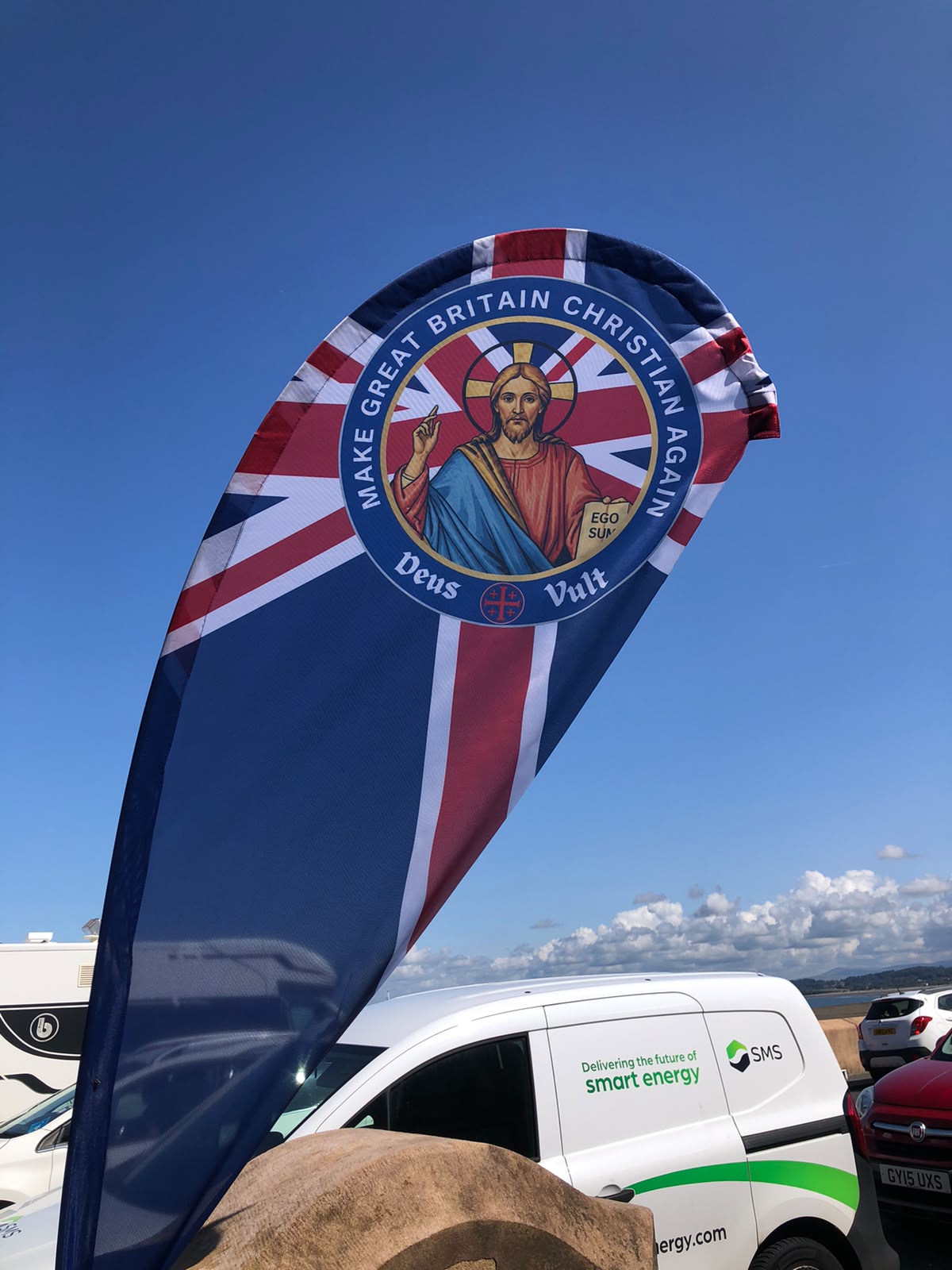
Several of the main speakers have a demonstrable history of stirring up racism  and bigotry (I can go into detail if requested!). Some of the conference attenders who engaged with us began by sounding reasonable before expressing views that were racist, authoritarian or both. Black and white people, according to one of the attenders who spoke with me, have biological differences based on “different sorts of blood”, which can cause medical problems if it is mixed. Others repeated widely discredited claims about the percentage of rapes in the UK that are committed by Muslims or migrants.

When asked to provide evidence for their claims, there were several cases of people looking vaguely at their phones and saying, “I can’t quite find it now…”.

While lots of people mentioned God, and often the Bible, there were far fewer reference to Jesus and almost none to the teachings of Jesus.

One of my most bizarre conversations was with James Renton, a student minister at Emmanuel Church. James wants to expel all Muslims from the UK. When I asked about a white British friend of mine who has become a Muslim, James said it was “especially” important to deport him because he is “a traitor to his country”.

The friend in question is one of the most compassionate and loving people I know, contributing more to British society than most people I have ever met.

Unlike the man who thought he had white blood, James was keen to say that he was concerned with religion, not race. This did not really hold up when he kept talking about protecting “the indigenous people of Britain”, saying “we have been here 1500 years”.

As news emerged of the views expressed inside the conference, it became clear that some of that was even more bigoted than what we heard outside. I will write more about then when I have had more chance to watch the videos of the conference talks.

But I have good news too!

I was pleased that quite a number of the attenders were willing to engage with us. I am not naive about this: some conversations were more worthwhile than others. But there were some genuine – if difficult – conversations. It was clear that not everyone attending the conference realised how extreme some of the speakers were. A few said that they did not believe in everything being taught there – “I don’t listen to the anti-gay stuff”, as one of them put it.

I hope our conversations may have made an impact on these people, however slight.

The other good news is that resistance to Christian Nationalism is clearly growing as it becomes more visible. There were quite a lot more people praying or protesting outside the conference than I had expected. Several were members of the Better Story network, some were local to Morecambe while others had travelled a long way – one person came from as far as Brighton to witness against Christian Nationalism. At the beginning of the day, there were also local members of Stand Up To Racism, a group that includes people of several faiths and none.

We cannot keep ignoring the far-right and hope they will go away. It is staggering that there are still people advocating this approach, despite the far-right advancing rapidly in the UK just in the last few years. Hearing churchgoing Christians spewing far-right myths this weekend, I was struck by just how much these ideas are infecting Christian churches.

We need to go further than those church leaders who speak vaguely about concern. We need to challenge this far-right distortion of the gospel very clearly, while praying that God will guide us in loving our enemies and seeking forgiveness for all, including ourselves.

To make a real difference, we need to be prepared to say that the problems that are wrongly blamed on migrants and Muslims – poverty, homelessness, unemployment – are caused by the sinful structures we have established and our failure to build society in ways that can meet everyone’s needs rather than prioritising the interests of a wealthy and privileged few.

The Christian Nationalist organisers seem to have regarded their conference as a success. They sold out their tickets and they are planning a three-day conference next year. They seem to themselves as the beginning of a new movement. One of the most extreme speakers, Dominic Muir, predicted “a bold company of men, a restoration of masculine Christianity”.

These far-right distorters of the Gospel think that their time has come. They are on the march. We cannot sit back and ignore them. We need to be bold, and proclaim the truth of God’s inclusive and transforming love. _________________________________________________________________________________________________________

My book, The Upside-Down Bible: What Jesus really said about money, sex and violence (Darton, Longman and Todd, 2015) can be bought in paperback or e-book, priced £9.99.
The God of Jesus is a God who suffers with us

Two weeks ago (Sunday 5th July 2026) I led worship at New Road Baptist Church in Oxford. I was honoured to do so; this is the church that I attended for years while living in Oxford and where I served as a deacon from 2021 to 2023. I was delighted to receive such a warm welcome there again.

Below is the text of my sermon. To be clear: this is basically the text that I wrote beforehand but in practice I deviated from the wording at times and added in a few extra comments.

The sermon followed two Bible readings:

Song of Songs 2, 8-13

Matthew 11, 16-19 and 25-30

I have the privilege of working as a university chaplain at Aston University. It is a real honour to be part of a multifaith chaplaincy team in a multicultural city. I learn so much from students of and staff of many faiths and of none. And one of the great things about being a chaplain is that I don’t know from one day to the next who I will see or what sort of conversations I will have. Some conversations will be extremely challenging, such as when students turn up in a state of considerable distress. At other times, I’m just chatting with students over cups of tea.

Then there are times when we’re talking about faith. Students of many faiths and none show a great ability to listen to each other about matters of faith and values. And I often find myself being asked questions about Christian faith, about Jesus and about the Bible.

Muslim students who want to know about Christianity often ask me, “What’s the difference between Catholics and Protestants?”. A Jewish student once asked me, “Do Christian deliberately make enemies so that they can love them?”

At times I am really saddened by how many non-religious students expect Christians to be judgemental. There are people who imagine that the Bible consists largely of lists of rules to be obeyed and sins to be condemned. And I cannot blame people for thinking this. It is not their fault. It is our fault. Well, perhaps not all of us individuals! But it is the fault of Christians. Christians have all too often given the impression that Christianity is all about condemning people.

Perhaps one reason why some people assume that the Bible is full of harsh rules and condemnations is that sometimes we don’t trust people to open the Bible and read it for themselves.

I recently experienced the surprised reaction of an atheist student who randomly opened a Bible in the Chaplaincy and found himself reading the book of Leviticus. Along with some rules that he found objectionable, he was taken aback to find a strong emphasis on justice for the poor, with rules to prevent poor people being exploited, far more radical than anything we encounter in society today. There are some parts of the Bible that even many Christians don’t talk about very often!

That leads me to the Lectionary readings for today. As we heard earlier, one of this week’s readings is from the Song of Songs, also known as the Song of Solomon. It’s not a book that appears often in the Lectionary. Are the Lectionary-compilers are nervous of letting us look at it?

Song of Songs is an erotic poem hidden in the middle of the Bible. Hidden in plain sight, there it is in every copy of the Bible but rarely quoted. It is full of comments about passionate, physical love: “The voice of my beloved! Look, he comes, leaping upon the mountains, bounding over the hills”. The two main characters express affection and enthusiasm for each other – and for each other’s bodies. The passage that we read today is one of the milder excerpts from the Song of Songs. If you want to read the harder stuff, I recommend reading the whole Song of Songs, because the 18-rated passages won’t appear in the Lectionary.

So what’s an erotic poem doing in the Bible? It is a joyful celebration of love, of healthy and godly sexual expression. The Song of Songs does not directly mention God, but it is honouring to God. God is positive about human bodies throughout the Bible. It is an outrage that in our sin we have turned our bodies into a reason to shame each other, rather than something to celebrate.

In the creation narrative in Genesis 2, the first humans are described as “naked and not ashamed”, it is only after sin comes in Genesis 3 that they become ashamed of their bodies. God’s desire is that we are at ease with our bodies. It is not human bodies that are sinful, but the misuse and mistreatment of human bodies.

Human bodies can be harmed and mistreated. Sexual expression can be abusive, selfish and dishonest. Bodies and sexuality in themselves are gifts from God.

We should not be surprised to find an erotic poem in the Bible. We should not be surprised that God joyfully celebrates us. God does not inflict suffering on us. God suffers with us.

And this relates to the second passage that we heard earlier. “Come to me who are weary and heavy laden,” said Jesus in the passage that we heard earlier from Matthew’s Gospel. Several scholars point out that the phrase “heavy laden” was used by various Jewish writers at the time to refer to the effects of poverty and oppression under the Roman Empire. As the biblical scholar Warren Carter puts it, Jesus’ listeners were afflicted by “the political, economic and religious elite, and by the control of social superiors”.

So: God is not a boss, not a tyrant inflicting suffering on us. God is with us in the midst of our suffering, celebrating our bodies, our humanity, calling us to repentance, offering forgiveness and calling us to trust in the Kingdom of God – a very different sort of “kingdom” from the powers of this world, the powers of money and military might. “Take my yoke upon you and learn from me,” says Jesus. Jesus’ yoke is not like the yoke of the Roman Empire or other oppressive forces. It is a gentle yoke for those who choose a different way.

Thus the good news of the gospel can never be cheap or easy good news. The good news that Jesus brings is much deeper than shallow reassurances. People know how horrible the world can be. You have only to switch on the radio or open a social media platform to be reminded. In a world that has enough food to feed everyone in it, if only we organised it differently, people die every day from preventable hunger. Can there be any bigger sin in the world? 

The good news of the gospel is not trite or simplistic. It is not simply telling people that everything will be okay. The gospel involves proclaiming hope in the midst of horror, love in the midst of hate, the good news of the gospel in the middle of the bad news of the world’s sin and injustice.

The God of Jesus Christ is not a god who causes suffering but a god who suffers with us. He endured one of the most unimaginably painful forms of death that human cruelty has ever invented. He was sentenced to death by the forces of the Roman Empire that were occupying Palestine.

The Roman authorities may have thought that they could easily get rid of a troublemaking Jewish peasant. They were wrong. When God raised Jesus from the dead, the victory of love over evil was assured. The forces of sin, oppression and empire were put on notice that their defeat had begun.

This does not mean that we should simply sit back, accept things as they are, and wait for God to intervene in the future. Jesus promised his followers that the Holy Spirit would be with them now. The Kingdom of God is both now and not yet, breaking into our mundane and often unjust realities even as we await its total fulfilment in the future.

Trusting in the power of God, the power of love, is an alternative to trusting in the idols that are worshipped by the powers of this world – the powers of money or markets or military might. Jesus makes clear that this will lead to negative reactions from those who prefer the status quo. In the passage we heard earlier, we saw Jesus noting this his critics attacked him for eating and drinking, despite having attacked John the Baptist for being an ascetic!

So Jesus’ followers might be smeared. They might face far worse. Earlier this year, Christian pastors in the US spoke of being detained by ICE, Trump’s deportation enforcers who are known for snatching people off the streets with very little accountability. I was struck by the words of the Anglican Bishop of New Hampshire, Rob Hirschfield, who asked his clergy to make sure their wills were written because he fears where the situation may be heading. He said, “It may be that now is on longer the time for statements, but for us, with our bodies, to stand between the powers of this world and the most vulnerable”.

We may not be in that position in Britain. However, it is very clear that the far-right is on the march in Britain, with racist riots becoming increasingly common. Some of that racist violence is carried out by people claiming to defend what they describe as Christian Britain. Perhaps we need to ask what Jesus is calling us to do to defend the good news of God’s love.

Hatred and injustice will not win. Love will triumph. This is the Gospel we proclaim. It is the gospel of Jesus. It is the gospel of love. And it is good news.  

_________________________________________________________________________________________________________

My book, The Upside-Down Bible: What Jesus really said about money, sex and violence (Darton, Longman and Todd, 2015) can be bought in paperback or e-book, priced £9.99.