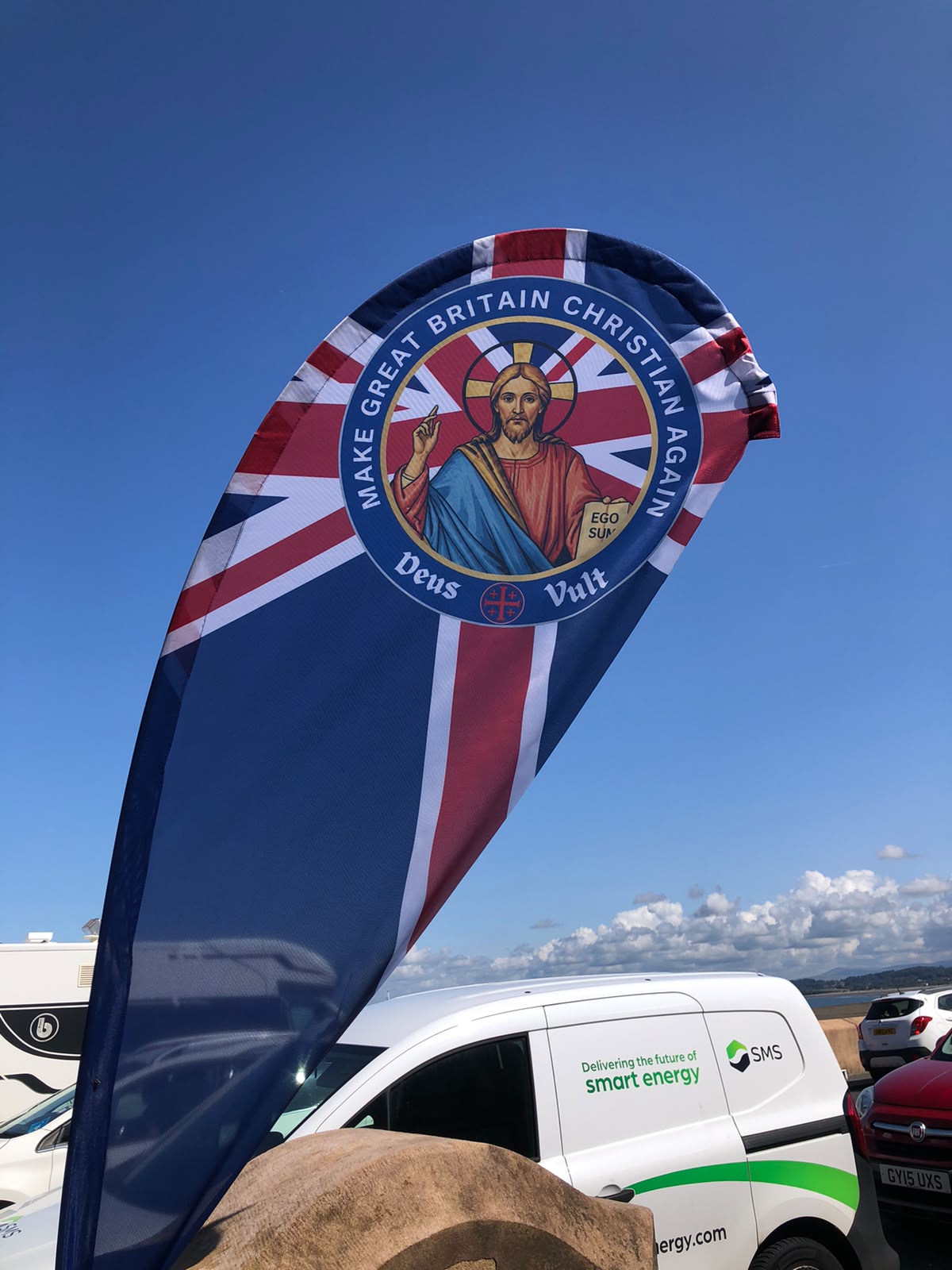
There is both good news and bad from the ‘Make Great Britain Christian Again’ conference that took place at Emmanuel Church in Morecambe this weekend.
On Saturday I joined with other concerned people to pray and witness outside this far-right event, which misused the name of Christ to peddle racist and fascist doctrines.
The bad news of course is that this far-right event went ahead at all. The Free Church of England – who insist that they own the building despite Emmanuel Church’s members splitting from them – tried to declare it cancelled. But the organisers pushed on.
Standing outside the building the far-right nature of the conference became ever clearer as time went on.
Several of the main speakers have a demonstrable history of stirring up racism and bigotry (I can go into detail if requested!). Some of the conference attenders who engaged with us began by sounding reasonable before expressing views that were racist, authoritarian or both. Black and white people, according to one of the attenders who spoke with me, have biological differences based on “different sorts of blood”, which can cause medical problems if it is mixed. Others repeated widely discredited claims about the percentage of rapes in the UK that are committed by Muslims or migrants.
When asked to provide evidence for their claims, there were several cases of people looking vaguely at their phones and saying, “I can’t quite find it now…”.
While lots of people mentioned God, and often the Bible, there were far fewer reference to Jesus and almost none to the teachings of Jesus.
One of my most bizarre conversations was with James Renton, a student minister at Emmanuel Church. James wants to expel all Muslims from the UK. When I asked about a white British friend of mine who has become a Muslim, James said it was “especially” important to deport him because he is “a traitor to his country”.
The friend in question is one of the most compassionate and loving people I know, contributing more to British society than most people I have ever met.
Unlike the man who thought he had white blood, James was keen to say that he was concerned with religion, not race. This did not really hold up when he kept talking about protecting “the indigenous people of Britain”, saying “we have been here 1500 years”.
As news emerged of the views expressed inside the conference, it became clear that some of that was even more bigoted than what we heard outside. I will write more about then when I have had more chance to watch the videos of the conference talks.
But I have good news too!
I was pleased that quite a number of the attenders were willing to engage with us. I am not naive about this: some conversations were more worthwhile than others. But there were some genuine – if difficult – conversations. It was clear that not everyone attending the conference realised how extreme some of the speakers were. A few said that they did not believe in everything being taught there – “I don’t listen to the anti-gay stuff”, as one of them put it.
I hope our conversations may have made an impact on these people, however slight.
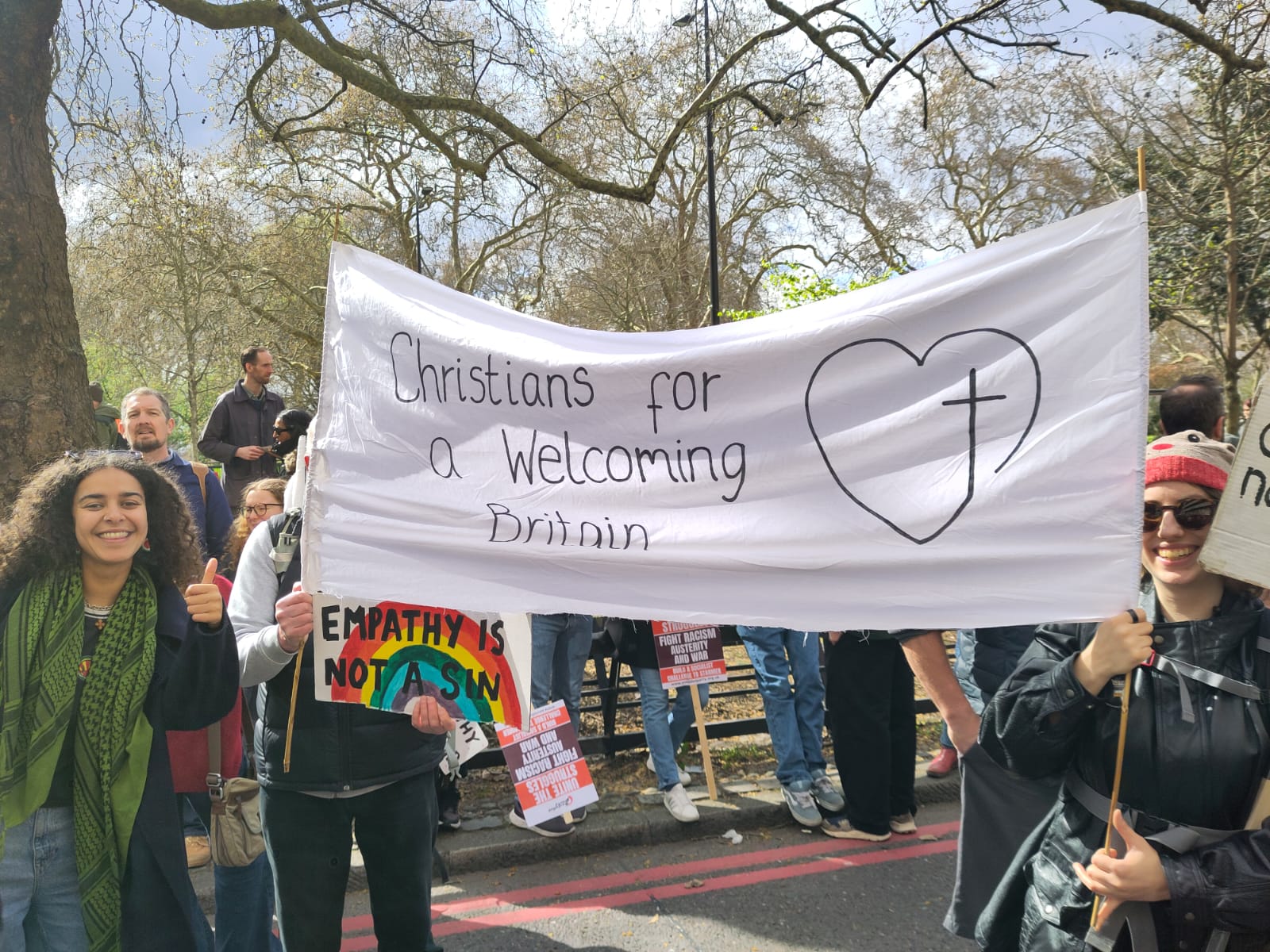
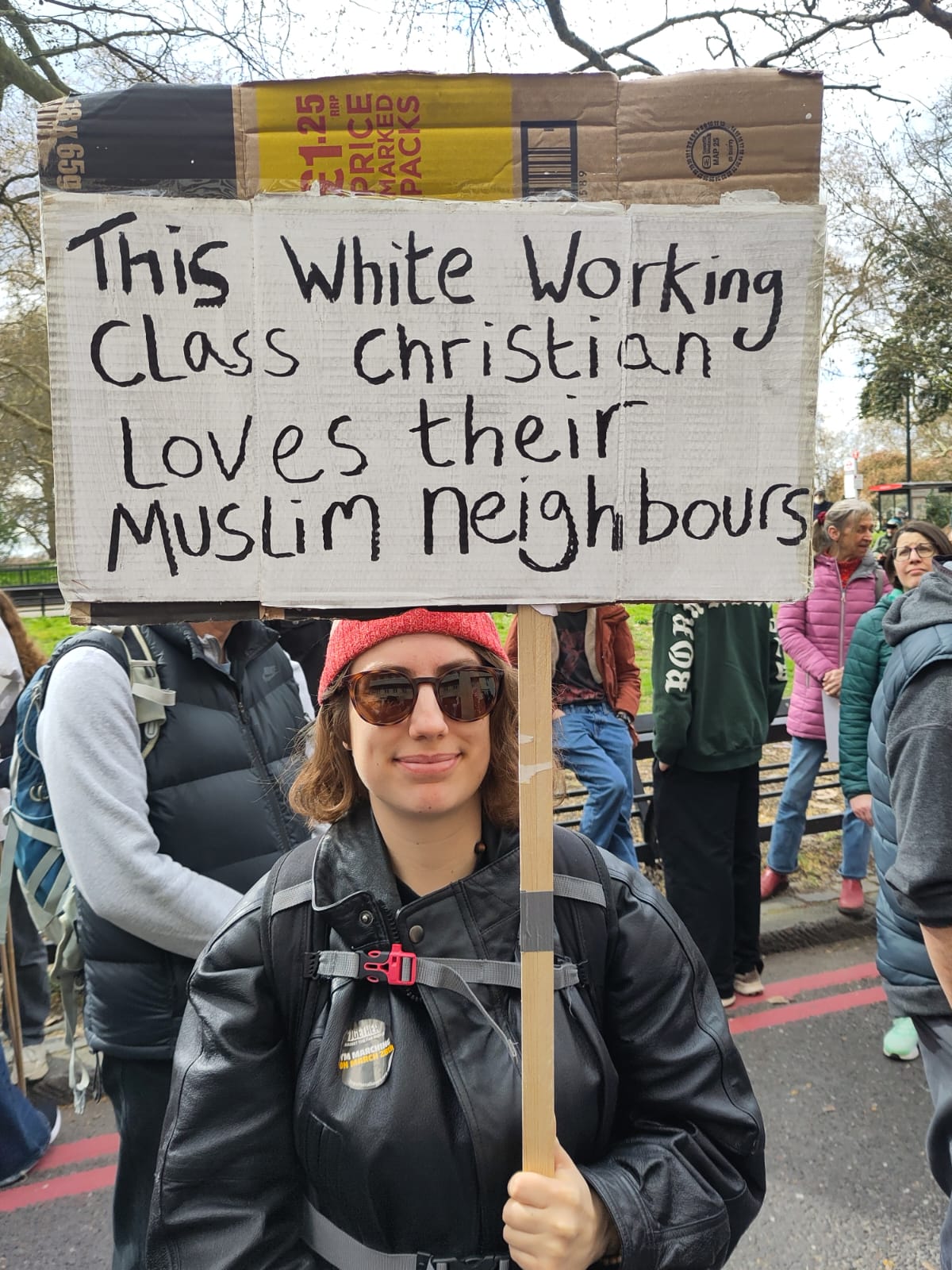
The other good news is that resistance to Christian Nationalism is clearly growing as it becomes more visible. There were quite a lot more people praying or protesting outside the conference than I had expected. Several were members of the Better Story network, some were local to Morecambe while others had travelled a long way – one person came from as far as Brighton to witness against Christian Nationalism. At the beginning of the day, there were also local members of Stand Up To Racism, a group that includes people of several faiths and none.
We cannot keep ignoring the far-right and hope they will go away. It is staggering that there are still people advocating this approach, despite the far-right advancing rapidly in the UK just in the last few years. Hearing churchgoing Christians spewing far-right myths this weekend, I was struck by just how much these ideas are infecting Christian churches.
We need to go further than those church leaders who speak vaguely about concern. We need to challenge this far-right distortion of the gospel very clearly, while praying that God will guide us in loving our enemies and seeking forgiveness for all, including ourselves.
To make a real difference, we need to be prepared to say that the problems that are wrongly blamed on migrants and Muslims – poverty, homelessness, unemployment – are caused by the sinful structures we have established and our failure to build society in ways that can meet everyone’s needs rather than prioritising the interests of a wealthy and privileged few.
The Christian Nationalist organisers seem to have regarded their conference as a success. They sold out their tickets and they are planning a three-day conference next year. They seem to themselves as the beginning of a new movement. One of the most extreme speakers, Dominic Muir, predicted “a bold company of men, a restoration of masculine Christianity”.
These far-right distorters of the Gospel think that their time has come. They are on the march. We cannot sit back and ignore them. We need to be bold, and proclaim the truth of God’s inclusive and transforming love. _________________________________________________________________________________________________________
My book, The Upside-Down Bible: What Jesus really said about money, sex and violence (Darton, Longman and Todd, 2015) can be bought in paperback or e-book, priced £9.99.
 Symon Hill