On Sunday 14th June 2026 I had the privilege of leading worship at Foleshill Road United Reformed Church in Coventry. As usual, they were very welcoming. I am sorry that I forgot to post the text of my sermon on here before now!
My sermon is below (this is basically the text that I wrote beforehand but in practice I deviated from the wording at times and added in a few extra comments).
The sermon followed two Bible readings:
Usually when I preach, I focus on the Bible passages that are set in the Lectionary. One of the great thing about using the lectionary is that it leads us to reflect more deeply on parts of scripture that we might not otherwise think about as much. And today we’ve had two intriguing passages that seem to me to be very relevant to issues that we face in the world today.
I must admit that I’ve struggled a bit with that passage from Genesis about Abraham and his three visitors. But it’s fascinating. Although there are many things that we can learn from this passage, I want to suggest that one of the main themes of this story is hospitality. As we discussed earlier, hospitality takes many forms in many cultures. In the part of the world that we now often call the Middle East, there is a massive hospitality culture.
Abraham doesn’t know these three people, or anything about them, but his main desire when they come near his home is to give them food. I was recently discussing this passage with a Jewish friend who pointed out to me that it is not actually Abraham himself who prepares the food for his guests. It is Sarah who does the cooking and it is a servant boy who kills the calf. Though to be fair Abraham seems to serve the food.
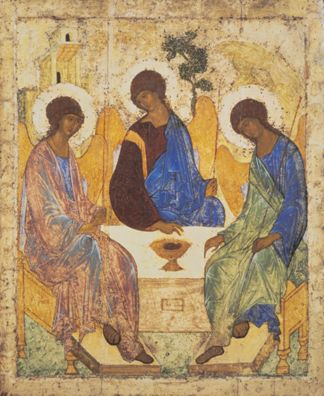
We could spend a lot of time discussing who the guests are. People have spent centuries upon centuries reflecting upon the guests’ identity and discerning possible answers. The idea that they were in some sense divine, or at least messengers from God, goes back long into Jewish tradition, while within Christian tradition, there is long tradition of associating these visitors with the Trinity. Glimpses of God are partial, messages are mysterious and yet in offering hospitality to these apparently random passers-by, Abraham, Sarah and their household are able to encounter something of God. They would not have done so if Abraham had not run to greet them. I think it is crucial to note that it is hospitality, an openness to the other, that leads to this encounter with the divine.
The second passage – from Matthew’s Gospel – is also about hospitality. Now I admit that we don’t have time to go into as much detail with this passage as I would like to – but then I often don’t have time to go into passages as much as I would like to! In this passage, Jesus tells his disciples to focus on taking his message to Jews rather to Gentiles and Samaritans, but this is clearly a stage in a process; later in the same Gospel, in Matthew, Jesus tells his followers to take the gospel to “all nations”.
In the Genesis passage, Abraham and his household offer hospitality. In the Matthew passage, Jesus tells his followers to expect hospitality.
He tells them to take no gold, silver or copper, no extra tunics or sandals because “workers deserve their food”. Jesus seems to say that we should prepared not only to offer hospitality but to receive it, to assert our rights as well as to respect those of others. This may come as a surprise to some people. So I must go back to something we discussed earlier: the hospitality culture in the Middle East, still there now let alone in the time of Jesus.
Of course the form that hospitality takes varies from culture to culture. But hospitality has always been central to Christianity, whatever cultural forms Christianity takes. The Letter to the Hebrews declares, “Do not neglect to show hospitality to strangers, for by doing that some have entertained angels without knowing it.” St Benedict, founder of the Benedictine order of monks, told his monks to greet ever visitor to the monastery as if they were welcoming Christ himself.
Hospitality to strangers is not an invitation to naivety. We have to be careful about what today we call safeguarding. But being careful does not mean distrusting people just because they are strangers, or different to us. They, like us, are made in God’s image. God loves them just as God loves us.
The apostle Paul teaches in Galatians that “There is no longer Jew or Gentile, there is no longer slave or free, there is no longer male and female, because you are all one in Christ Jesus”. The love of strangers, the love across barriers of difference, is central to the gospel of Jesus Christ. That is why it is so appalling to see people on far-right marches, with racist messages, claim that they are defending “Christian values”. They are doing the opposite.
With the coming of Jesus, divisions of nationality, class, gender and status are overcome by the Kingdom of God. This is a central aspect of the gospel that we as Christians proclaim!
However, I suspect that most of us exclude people far more than we like to think we do. We may often do so unconsciously. When I started a new job a few years ago, I was shown round by two colleagues who said they would introduce me to “everyone” who worked there. At one point, we passed the cleaners as they went about their work. I paused uncertainly as my colleagues carried on walking. It was clear that “everyone” did not include the cleaners.
What does it really mean to be hospitable? I work as a chaplain in a multi-faith chaplaincy team at Aston University. I would like to tell you about a student who I met a couple of years ago. I’m going to call him Matthew. That’s not his real name, but I want to respect his privacy. Matthew was a postgraduate student from Nigeria.
Matthew turned up at the Chaplaincy one day in a state of considerable sadness. It was only a few weeks after he had arrived in Britain. His parents back home in Nigeria had discovered that he was gay. They had immediately broken off contact with him. On top of the unimaginable distress that this caused him, they had withdrawn financial support and stopped paying his tuition fees, meaning Matthew faced destitution and removal from his course.
If Matthew returned to Nigeria, he would be arrested for the crime of having sex with another man. More than that, he could be murdered, a not uncommon fate for gay people in his community.
I thank God that my colleagues and I were able to help Matthew to access some short-term financial support, and to introduce him to a church locally that welcomed him and did not condemn him for his sexuality. He decided to apply for asylum in the UK and I did what I could to introduce him to people who could advise him on the process. He was welcomed by a group of LGBT+ asylum-seekers, most of whom are Christians or Muslims, who gave him a sense of community and encouragement.
But then one day when Matthew came to see me in the Chaplaincy he had an awkward question. Despite the heartbreaking split with his family and the fears for his future, he had felt uplifted in the UK by the welcome and support he had encountered from the church he attended and from the LGBT+ asylum-seekers’ group. Up until that point he had not paid much attention to the British media. But now he had started to do so. He saw with alarm the way that asylum-seekers were described in many mainstream British newspapers. He was baffled by coverage that implied that life was easy for asylum-seekers when he knew from experience that the process of proving the need for asylum was tough, confusing and humiliating. Why, he asked, did so many British people seem to hate asylum-seekers?
I sat there facing him, and I was ashamed. Ashamed that parts of the British media, and parts of Britain, had descended to this. Ashamed that one of the richest countries in the world, with one of the highest military budgets in the world, claimed to be unable to meet the basic needs of its population as well as to welcome those fleeing persecution. But also I was ashamed of myself, and of the Christian Church, that we have not done more to stand up to the sort of narrative, to these sort of attitudes.
Now of course, there are many important debates to be had about migration, about asylum, about the right policies to adopt for different situations. I am sure that those of us in this church, like Christians generally, will disagree with each other about which party to vote for and which policies to endorse. And that’s a good thing. I don’t trust churches whose members all agree with each other! However, I suggest that hospitality, support for people in distress, refusal to demonise groups of people, rejection of lies – these should be principles that all Christians can stand for. And that means challenging the anti-migrant, anti-asylum-seeker and frankly racist narratives that are gripping much of the UK.
How did we arrive at the point in which it is normal to imply that all asylum-seekers and migrants are murderers and rapists because a tiny percentage of individual murderers and rapists happen to be asylum-seekers or migrants? One of the surest signs of prejudice against a group is to hold all its members responsible for the actions of individuals.
We cannot pretend that these things are not happening. Nor can we as Christians ignore the Bible’s consistent emphasis on the need to welcome the stranger. Take Leviticus 19,34: “The foreigner residing among you must be treated as your native-born. Love them as yourself, for you were foreigners in Egypt. I am the Lord your God.” This is not simply a one-off quote but typical one.
It would be a lot easier for me not to preach about this subject. But faced with lectionary readings on hospitality in the midst of racist riots, it would have been bizarre to avoid it.
Nonetheless, I am conscious of the danger of hypocrisy. If we criticise anti-migrant protesters for demonising others, do we risk demonising them? Do we risk talking of all of them as if they are all the same? The New Testament does not teach us to pretend we have no enemies. But it teaches us to love everyone, to love our enemies even though they are our enemies. It teaches us to recognise our own sin, and our own complicity in the sins of others.
So as we challenge exclusion, and racism, and prejudice, and the denial of hospitality, let us have the courage to ask ourselves. Who are we excluding? To whom are we failing to show hospitality? In the church, in our politics, or simply in our everyday lives, who do we demonise, overlook or simply leave out?
The reading that we heard from Matthew’s Gospel finishes with some challenging advice from Jesus: he urges his followers to be “wise as serpents and innocent as doves”. I think that’s a good phrase to reflect on as we think about how to live, how to operate in a world that increasingly seems to be dominated by hatred, bigotry and racism. We are called to be “wise as serpents and innocent as doves”.
That is very different to the attitudes that we often encounter in the world. There are people who cynically maintain that to be realistic we must water down our principles and take what we can for ourselves. Some give the impression that anyone who acts compassionately is unrealistic and naïve. But Jesus teaches us that we can be realistic about the horrors of the world – wise as serpents – while remaining compassionate and principled – innocent as doves.
Confronting hatred and racism is not easy. The situation we face may get worse before it gets better, and churches may have a tough part to play in the struggles ahead. So let us be prepared to be wise as serpents and innocent as doves, striving to love our enemies and recognising that hospitality is central to biblical faith. As the Letter to the Hebrews says, in showing hospitality to strangers, we may entertain angels unawares. Or at the very least, we may entertain human beings, created in the very image of God.
_________________________________________________________________________________________________________
My book, The Upside-Down Bible: What Jesus really said about money, sex and violence (Darton, Longman and Todd, 2015) can be bought in paperback or e-book, priced £9.99.

