The pope’s right: of course sex is a gift from God

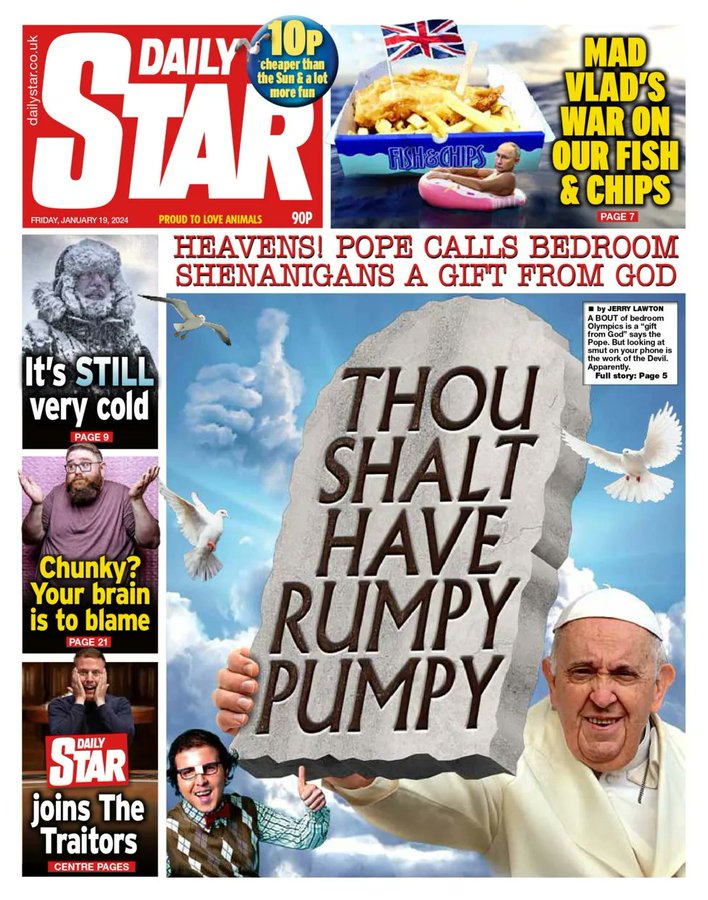
“Thou shalt have rumpy-pumpy” declared the front page of the Daily Star last week, along with a picture of Pope Francis. They returned to the theme on the front page yesterday.

Their story concerned the pope’s comments that sex is a gift from God (does anyone who is not a tabloid journalist actually refer to sex as “rumpy-pumpy”?). This really should not be news. Many church leaders have been saying for years – and in some cases centuries – that sex is a sacred gift.

Admittedly, the pope has made the comments in the context of a controversy over a book written by a Roman Catholic cardinal, which makes it a bit more newsworthy. However, I doubt the Daily Star is especially interested in internal Catholic squabbles. What really makes it newsworthy is the reality that mamy readers will find it surprising, because so many people expect Christians to be negative about sex.

As a Christian, I think we’ve only got oursevles to blame for this perception. The Christians who tend to speak loudest in public and media debates are those who want to condemn same-sex relationships and sex outside marriage. If pushed, the tend to say that sex is a gift from God if rightly used, but such additional comments are rarely much heard. Those Christians who disagree with them have rarely done a good job of speaking up as clearly as we should do.

The Bible is positive about sex. Of course there are a few more negative attitudes in certain parts of it – it’s a vast collection of books – but I maintain that the Bible is on the whole sex-positive (I recommend the Song of Songs, an erotic poem found in the middle of the Bible). There’s not space here to go into debates about particular biblical passages (though I readily do so elsewhere!), but I suggest that sex-negative interpretations of scripture are influenced by centuries of negative attitudes that did not really begin until some time after the Bible was written.

Chrisitanity in western Europe really became negative about sex from around the fourth century onwards. Augustine of Hippo developed the doctrine of Original Sin, arguing that sin is passsed on by sex and that babies are born guilty. This doctrine was rejected by some (but sadly not all) Protestants from the time of the Reformation in the sixteenth century.

It’s notable that Augustine was writing shortly after the Roman Empire had effectively stifled Christianity by domesticating it and turning it into the imperial religion. Wheras Christian theologians had previously challenged violence and imperial rule, they began instead to defend them. Augustine himself played a major role in developing Just War Theory, which replaced early Christian nonviolence.

As Christianity moved from challenging empire to upholding it, the focus of discussions about sin moved from violence, oppression and poverty to concern for individuals’ sexual behaviours. For Christians, being negative about sex has often gone along with being positive about power, wealth and war.

So for left-wing and inclusive Christians today, positivity about sex shold naturally go along with seeking to demonstrate the solidarity with the marginalised that is displayed in the New Testament.

I am not of course saying that we should support all sex! Christians should be at the forefront of condemning sexual abuse, sexual violence, violations of consent and sex entered into for selfish reasons or with disrespect for others. These things are sinful. They are sinful not because they involve sex, but because they involve the intrusion of sins such as violence and inequality into what should be loving and Godly activity.

So let’s get out there and start championing the good things about sex. Just as long as we don’t have to call it “rumpy-pumpy”.

A knightood for Bates would undermine what the sub-postmasters have fought for

I wrote this article for the ‘i’ paper, who published it online on 11th January, with a shorter version in the print edition the next day.

The statistics are shocking enough – more than 700 innocent sub-postmasters were wrongly prosecuted in the Horizon IT scandal – but it is the personal horror stories that really hit home. Seema Misra in Ashford, sentenced to prison while pregnant, who gave birth wearing an electronic tag. Sathyan Shiju in London, who tried to take his own life after being accused of stealing £20,000. Christopher Head in Newcastle, unable to secure another job after being sacked and told to pay £88,000 that he did not have.

It would be an insult to suggest that any amount of money could adequately compensate these people.

Meanwhile, Rishi Sunak seems to be practising government by TV drama, talking seriously about compensation only since the ITV broadcast of Mr Bates vs the Post Office, which depicted former sub-postmaster Alan Bates decades-long fight to expose the Horizon system scandal.

Now there are calls to give Alan Bates a knighthood. He and the others who challenged these outrageous convictions should certainly be celebrated, but the calls for an honour will do nothing to stop something like this from happening again. It just papers over the cracks.

There is a long tradition of using titles and honours to buy people off, or as an easy way to superficially endorse a popular person or cause. The reverse is also true. Former Post Office boss Paula Vennells has returned her CBE. She is no longer a Commander of the Order of the British Empire.

It has been reported that Vennells earned over £400,000 in her final year at the head of the Post Office. This is not true. She was paid over £400,000, whether she earned it is a different question. It is perhaps easier to return a CBE than to pay back an unimaginably large salary. It is also much easier for the Government to give Mr Bates a knighthood than to address the root causes of the problem.

It would also seem that Alan Bates, too, believes this. Speaking about turning down an OBE, he told Good Morning Britain last week: “It would have been a slap in the face to the rest of the group because Paula Vennells, the CEO for many years of Post Office, received a CBE for her services to Post Office. Well, what service has she actually done?”

Worryingly, the highest honour that some people can imagine is to kneel before an hereditary head of state and be tapped with a weapon. It is a ceremony that upholds and entrenches inequality. The irony is that inequality was one of the causes of the Post Office scandal in the first place.

True, the initial cause was a faulty computer system. When one or two sub-postmasters were convicted, senior managers may have assumed they were indeed guilty. But when the number of convictions rose to the hundreds, why did the people in charge not ask questions. Did they really think it likely that 700 sub-postmasters were all simultaneously corrupt?

Part of the answer has been revealed by whistleblowers and Freedom of Information requests. In a document from 2008, Post Office investigators used a racial slur to describe suspects. An Indian sub-postmaster has also revealed that a member of Post Office staff had said that “all the Indians” were defrauding the Post Office. Such comments go beyond unconscious bias. They represent out-and-out up-front racism.

The failure of senior people at the Post Office to question the convictions starkly demonstrates another problem rooted in inequality: the tendency of senior people not to trust their workers or to listen to more junior people. In a hierarchical business, what chance did workers on the ground have of influencing policy?

Until we have democratic, egalitarian workplaces based around mutual respect and co-operation, injustices such as the Horizon scandal will continue. Instead of focusing on knighthoods and CBEs, the best way to honour the victims of the Post Office scandal is to change the way we work.

Justin Welby conflates submission to the state with the service of God

The Archbishop of Canterbury has used his New Year’s Day message to promote militarism and armed force even while Palestinian Christians continue to criticise his position on Gaza and Israel.

Justin Welby’s message comes only days after two Christian pacifists were arrested for pouring fake blood on the gates of Downing Street in protest at the UK government’s complicity in genocide in Gaza.

There are times when I gladly defend Justin Welby. I think he does a better job than many Archbishops of Canterbury have done – though I admit that’s a low bar. He has spoken out about poverty and the rights of refugees. Sadly, when it comes to armed force and monarchy, he is fully in tune with the values of the establishment.

Welby began his New Year message by talking about Charles Windsor’s coronation last year. He said that “our” military were at “the centre of the celebrations”.

This of course is true – monarchy has always been closely tied to militarism. However, Welby claims that the armed forces had such a major role because:

“… they, like many, many others in the country, embodied the theme of the coronation: service”.

Membership of the armed forces is often spoken of in terms of “military service”. The question that Welby did not address was who or what the armed forces are serving.

In a tweet yesterday, Welby went so far as to apparently equate military service with the sacrificial life of Jesus. He wrote:

Going to @RAFBrizeNorton to film my New Year Message, I met servicemen and women there who embody the spirit of service, following the example of Jesus, who came ‘not to be served, but to serve’ (Matthew 20,28).”

This equation of two very different lifestyles is both outrageous and dangerous. Jesus embodied nonviolent resistance – even in the face of the brutal Roman Empire, which he mocked, challenged and resisted but did not take up arms against.

Whatever view you take of the ethics of violence, it is surely obvious that not everyone who is dedicated to “service” is serving the same person or the same thing. But early in his New Year message, Welby said:

They [armed forces personnel] promised to be faithful, and to observe and obey all orders.. .Forces personnel are living out that oath every day.”

This is surely different to Jesus’ example of serving God and his neighbours. Members of the armed forces are obliged to obey orders given in the monarch’s name by their officers and NCOs.

However well-intentioned individual armed forces personnel may be (and I don’t doubt that many of them are), they are required to serve the state, not God or humanity. They must obey orders without reference to their own conscience or faith. Recent years have seen a string of British armed forces personnel imprisoned for refusing orders that go against their conscience. Examples include Michael Lyons, Joe Glenton and Malcolm Kendall-Smith.

I don’t for a moment claim to be a better Christian than those Christians who join the armed forces. I frequently fail to follow Jesus’ teachings, to love my neighbour as myself and to seek God’s guidance. I cannot begin to understand how seeking to follow Jesus is any way compatible with joining an organisation – any organisation – whose members are required to obey orders without question, for no authority should trump our loyalty to the Kingdom of God.

The rest of Welby’s four-and-a-half-minute message is little more than a puff piece for the UK armed forces. The archbishop rightly champions their work providing humanitarian relief, but fails to point out that this is not their central purpose or to ask why this cannot be done by a civilian force. In an outrageously misleading moment, Welby claimed that British troops are:

“…supporting civilians in the midst of conflict, in places like the Middle East”.

Welby must surely know that UK armed forces provide military training and support to the forces of countries such as Israel and Saudi Arabia, which are engaged in the systematic killing of civilians (in Palestine and in Yemen respectively).

Far from supporting civilians in the Middle East, the UK government’s troops are complicit in the killing of civilians in the Middle East.

Thankfully, Welby spoke about “the human cost of war”. He added:

Jesus Christ tells us to stand with those suffering because of war, and to seek to make peace. And we trust in God, who promises peace with justice.”

I agree with Welby on that one. That’s precisely why I cannot share his enthusiasm for an organisation that does not make peace but perpetuates and justifies war.

The archbishop seems to be conflating service of God with service of the state and the monarch.

Welby’s words are likely to cause further dismay for Palestinian Christians, who have been highly critical of the failure of the leaders of many western churches – including the Church of England – to call for an immediate ceasefire and to condemn genocide in Gaza. Many church leaders have rightly condemned Hamas’ vile attack on Israeli civilians on 7 October, but have waffled or made excuses instead of condemning Israeli forces’ equally vile killing of Palestinian civilians.

Munther Isaac, a Lutheran pastor in Bethlehem, challenged church leaders internationally in his Christmas sermon, accusing them of providing “theological cover” for genocide and thus “compromising the credibility of our gospel message”. He insists that “Jesus is under the rubble in Gaza”.

Three days before Welby’s New Year message was broadcast, two British Christians were arrested in Downing Street. Virginia Moffatt and Chris Cole poured fake blood over the gates in protest against the UK government’s military and political support for Israeli forces. They were arrested.

I have been honoured to campaign alongside Virginia and Chris in the past. As it happens, they are both Catholics. They frequently act alongside other Christian pacifists from different traditions, as well as with many other war resisters of various faiths and none. If Jesus is under the rubble in Gaza, then Virginia and Chris were acting in solidarity with him.

The archbishop’s New Year message and the nonviolent action at the gates of Downing Street provide two very different examples of British Christian responses to war. I know which one of them reminds me more of Jesus and the prophets.

We need a referendum on the monarchy

Early in December, I wrote an article for the ‘i’ paper calling for a referendum on the monarchy. This followed weeks of arguments and revelations about Omid Scobie’s new book on the royal family. More importantly, it followed a poll showing declining support for the monarchy as an institution.

Although you can read the article on the ‘i’ paper’s website, I forgot to post a copy of it on here (I need to get bettter at remembering to do this!). The article is below.

One of the most frequently heard arguments for royalty is that they unite the country. Supporters of monarchy say the British public will rally behind a king or queen in a way they never will for a politician or political movement.

This is a bizarre claim for a family that cannot even keep themselves united, producing brothers so disunited that they feel the need to live in separate continents.

We have had another week of scandals about the personal feuds and jealousies of Britain’s favourite dysfunctional family. Amid all the gossip about the private lives of the super-privileged, the views of voters have rarely been mentioned.

So you might not have heard that opposition to the monarchy has reached a record high.

A Savanta poll has put support for retaining a monarchy at 52 per cent of the British population.This compares to 62 per cent in a YouGov poll only three months ago. The number backing an elected head of state now exceeds a third of the population, at 34 per cent (the remainder are “don’t knows”). Among adults under 35, supporters of monarchy are outnumbered by those wanting to elect a head of state, by 43 per cent to 38 per cent.

Royalists can of course point out that 52 per cent is still more than half. What they cannot reasonably claim is that the monarchy unites Britain.

It is impossible to hear the figure of 52 per cent without thinking of the Brexit referendum. In the wake of the vote, Leave voters emphasised that 52 per cent is a majority. Yet not even the world’s greatest optimist would claim that Brexit is an issue on which the British population is united.

This is why we need a referendum on the future of the monarchy.

On the surface, royalists have good grounds to welcome a referendum. Looking at the polls, they may well expect to win. They would have the backing of most of the media – including the sort of newspapers that could be relied on to launch vicious personal attacks on their opponents.

The problem for royalists in a referendum would be that both sides would be expected to be open to challenges and questions. But barring Harry and Meghan’s celebrity-style interviews, the Windsors almost never answer questions, let alone difficult ones. The Dutch translation of Omid Scobie’s book Endgame identified Charles Windsor and Kate Middleton as the two royals alleged to have made prejudiced comments about the appearance of Harry and Meghan’s son Archie. But they are not expected even to respond to this accusation. Whether or not the allegation is true, any other public figure would be expected to comment if accused of racism. Yet they can seemingly ignore it.

Such arrogance would be painfully on display in a referendum campaign. Andrew’s infamous Newsnight interview gives a clue as to how well royals might cope if they were subjected to serious questioning. Alternatively, they would hold themselves aloof from the debate and be seen to treat the rights of voters with contempt.

A referendum would expose the reality that monarchy and democracy don’t mix.

As pro-royal commentators rush to condemn Scobie and Endgame, the focus on family feuds risks missing the main point. Scobie’s premise is that this could be the “endgame” not just for Charles or William but for the British monarchy itself.

Scobie describes the royal family as “debilitatingly out-of-touch, even expendable, with an increasing percentage of the public”. That’s just in Britain. Countries such as Belize and Jamaica – where William and Kate travelled through the crowds standing up in a Land Rover like colonial conquerors – are likely to ditch the monarchy before Charles has got the throne warm.

In light of the latest revelations and polling figures, it’s time people in the UK were allowed to make a decision: do we want a system in which we bow down to our supposed superiors because of an accident of birth, or do we trust ourselves to run society together as equals?

How the Sunday Express accidentally celebrated an anti-war protester

Today’s Sunday Express has denounced “extremists from left and right” who protested in London yesterday, contrasting them with the “dignity” of people observing two minutes’ silence at the Cenotaph. But the photo they chose for their front page shows how mistaken they are in their assumptions about what protesters look like.

The paper illustrated the “dignity” of Remembrance with a picture of a medal-wearing vicar bowing his head at the Cenotaph. What they almost certainly did not realise was that the medal-wearing vicar in question attended the anti-war march calling for a ceasefire in Gaza after he left the Remembrance ceremony.

The man was Tim Daplyn, a Church of England priest in Bristol. Had they realised that he was an anti-war protester – with a history of climate activism – the Express would surely have attacked him, or at least ignored him, rather than used him to illustrate the “dignity” in which they claim to believe.

Along with the Daily Mail, the Daily Express spent last week warning that there could be “violence” at the Cenotaph, with anti-war protesters “dishonouring” Remembrance Day. When it came to it, it was the far-right counter-protesters who violently attacked police near the Cenotaph, thus dishonouring Remembrance Day.

It must have been difficult for certain editors to know how to respond to the violence that their newspapers had fuelled.

The Sunday Express went with the headline “Dignity and Dishonour”, adding, “As the nation remembers our war dead, extremists from the left and right march for hate”.

They thus equated a peaceful march of hundreds of thousands of people calling for a ceasefire with a group of far-right thugs attacking police officers. The anti-war protest was not a march of left-wing extremists. The small minority who voiced support for Hamas or anti-semitism were indeed disgusting; it is misleading to suggest they were representative. Nor as it happens are they “extremists from the left”: Hamas is a right-wing group.

One one side of the Sunday Express front page is a masked protester, on the other is a man in a clerical collar with medals pinned to his chest, bowing his head. He looks exactly like the sort of person of whom the right-wing press would normally approve.

But as soon as I looked at the front pages this morning, I noticed that the man in question was wearing a white poppy as well as a red one. The Express may have overlooked this: they are usually very negative about white poppies (and the Mail attacked people wearing white poppies at Saturday’s march).

When I posted about this on Twitter, I received a response from Ed Bridges, who I know through the Peace Pledge Union. He directed me to a BBC News clip interviewing the man in question – who explained why he was going from the Cenotaph to the anti-war march.

With a bit more digging – and some much-appreciated help from a few people on social media – I discovered that the gentleman’s name is Tim Daplyn and he is a Church of England priest in Bristol. He is a British army veteran who was stationed in Northern Ireland.

He is also a member of Christian Climate Action and has protested alongside Greta Thunberg.

He told the BBC, “It’s been termed a pro-Palestinian demonstration, I think it’s a pro-peace demonstration.”

He added, “That is what it’s all about – old soldiers on Armstice Day calling for armstice. And there can’t be anything wrong with that… So much was got wrong in the past, in past conflicts and past warfare. So much is going wrong today. It’s up to us, and we owe it to those who went before, that we do better.”

You can watch Tim Daplyn’s BBC interview here.

Given how much effort the Express puts into smearing anti-war protesters, climate protesters and left-wingers generally, it might well be that their own prejudices led them to assume that protesters are scruffy people in hoods or masks. Their prejudices seem to have backfired on them. Sometimes protesters are medal-wearing vicars.

Why Christians should back calls for a ceasefire in Gaza and Israel

I wrote this article for Premier Christianity, who published it on their website on Monday 6 November 2023.

Where is God?”. It is a question asked by many people watching the horrifying events in Israel and Palestine.

Munther Isaac, Pastor of the Evangelical Lutheran Church in Bethlehem, offers an insightful answer: “God is under the rubble in Gaza”.

God is with those who are suffering, siding with the victims, the dying, the traumatised – whatever their nationality.

Jesus told his most famous parable in response to the question, “Who is my neighbour?”. The Samaritan was a neighbour to the Israelite attacked on the road (Luke 10:25-37). I have been asked whose “side” I am on. I think we should all be on the side of innocent children who have been killed, and their traumatised families. This means opposing their killers – whether Hamas or the Israeli military. It means siding with the many Palestinians and Israelis who are working for peace.

“Both Hamas and Israel are treating civilians as insignificant,” writes Richard Sewell, Dean of St George’s Anglican College in Jerusalem. The Orthodox Church in Jerusalem pointed out last week that “the Israeli military has targeted 19 places of worship, including mosques and churches, in Gaza during the past three weeks.”

Nearly all Christian leaders in Palestine and Israel are demanding a ceasefire. “The call for a ceasefire comes from the simple fact that we are pro-life,” writes Palestinian Christian journalist Daoud Kuttab.

Some argue that a ceasefire would allow Hamas to prepare further violence. This overlooks the reality that the Israeli military are committing atrocities. The more they do this, the more Hamas can gain support by presenting themselves as defenders against aggression. 

As Christians who value all life, let us call for a ceasefire as a vital step in a longer journey of peace, justice and reconciliation. This should go along with a demand for the release of hostages by Hamas and political prisoners in Israel (including conscientious objectors). And we must be very active in resisting anti-Semitism and Islamophobia on our own streets.

Evangelical organisations from various parts of Asia and Africa have published a joint statement calling for a ceasefire. Twenty Christian leaders in the UK recently signed a Christian Aid statement backing an immediate ceasefire. They include the Moderator of the Church of Scotland, the President of the Methodist Church, the General Secretary of the Baptist Union of Wales and the Primus of the Scottish Episcopal Church, along with Quaker, Pentecostal and United Reformed Church leaders.

The Archbishops of Canterbury and York are absent from the list of signatories, as are British Roman Catholic leaders.

Justin Welby has issued heartfelt pleas for humanitarian aid but has not condemned Israeli attacks. The Church of England has now produced a staggeringly one-sided statement on the war. They rightly condemn Hamas and their indiscriminate killings. They then add, “We must also reflect on the actions that Israel has taken in response”. Condemnation for the atrocities of one group, “reflection” for the atrocities of another. This is an outrageous case of double standards.

Like many Palestinian Christians, Munther Isaac expressed his dismay with the Church of England statement for “only shyly mentioning” Israeli war crimes. Last week, a group of Palestinian Christian theologians urged Western church leaders to “repent” of their failure to challenge Israeli military aggression in Palestine. Church leaders who have rightly condemned Russian atrocities in Ukraine are failing to oppose similar atrocities in Gaza.

Condemnation of indiscriminate killing is meaningless if it does not apply to all indiscriminate killing. Love of neighbour is undermined if we love only neighbours on one side. Calls for aid are feeble if they rely on a “humanitarian pause” followed by a continuation of the killing.

Hundreds of thousands of people are marching in British cities calling for a ceasefire. Despite Home Secretary Suella Braverman’s ludicrous description of such demonstrations as “hate marches”, the vast majority of participants strongly oppose Hamas and anti-Semitism. There have been several Jewish-led protests calling for a ceasefire. To assume that all Jews support the Israeli government is to view Jews as an homogenous unthinking mass. It is assumptions such as this that are truly anti-Semitic.

These protests have thankfully included Christian peace groups such as the Fellowship of Reconciliation and Cymdeithas y Cymod. But imagine if they included speeches by Christian leaders proclaiming that all human lives are valued in the Kingdom of God and that God is “in the rubble” with people who are suffering. It would be an act of practical service, as well as a powerful witness to Christ.

If there is a peace vigil or ceasefire demonstration in your area, why not contact the organisers and ask how your church can play a part? Perhaps you could join a march with a church banner, or offer practical assistance by making tea and coffee for the participants. If national church leaders fail to take the lead, Christians at the grassroots can show the way.

Which British church leaders have backed calls for a ceasefire? And why haven’t the others?

A number of Christian leaders in Britain and Ireland have signed a Christian Aid statement calling for an immediate ceasefire in Palestine and Israel.

This is encouraging me, but what worries me is the number of names that are not on the list.

The Archbishops of Canterbury and York (the two most senior members of the Church of England) do not appear to have signed. Nor does the Catholic Archbishop of Westminster, who leads the Roman Catholic Church in England and Wales.

I am pleased to see that the leaders of the Church of Scotland, Methodists, United Reformed Church and Quakers have signed. As a member of a Baptist church, I am disappointed that the President of the Baptist Union of Great Britain does not appear on the list, although I am encouraged to see that the General Secretary of the Baptist Union of Wales has added her signature.

As usual when it comes to opposition to war, more church leaders in Scotland and Wales have signed up than church leaders in England.

Mark Strange, the Primus of the Scottish Episcopal Church (that is to say, the Anglican church in Scotland) has added his name, despite his English opposite numbers failing to do so. So has the Catholic Archbishop of Glasgow, William Nolan. They are joined – as already mentioned – by the Moderator of the General Assembly of the Church of Scotland, Sally Foster-Fulton, as well as the Scottish leaders of the Quakers and United Reformed Church.

When it comes to Wales, signatories include Jeff Williams, President of the Union of Welsh Independents (a Welsh-speaking Congregationalist denomination with a strong history of standing up for peace). He is joined by Judith Morris, General Secretary of the Baptist Union of Wales; by Mary Stallard, the Anglican Bishop of Llandaff, and by two Welsh Methodist leaders.

The only Irish signatories are two archbishops from the Anglican Church of Ireland, John McDowell and Michael Jackson.

Other signatories include representatives of Britain-wide denominations: Gill Newton and Kerry Scarlett, who are President and Vice-President of the Methodist Church in Britain; Tessa Henry-Robinson, Moderator of the General Assembly of the United Reformed Church; and Paul Parker, Recording Clerk of Quakers in Britain.

I am pleased to see that Mike Royal, a Pentecostal Bishop and General Secretary of Churches Together in England (a body about which I have not always been enthusiastic) has also signed the statement.

The remaining signatories are representatives of charities and campaigning groups, such as Cafod, the Amos Trust and the Fellowship of Reconciliation.

So what’s the reason for the missing signatories? I dare say some church leaders just didn’t get back to Christian Aid in time. I appreciate it must have been a rush to get the statement published.

But it is likely that others chose not to sign the statement. Justin Welby, the Archbishop of Canterbury, made headlines just after the Hamas attack on 7 October by calling for the protection of civilians in Gaza. Why will he not go further and call for a ceasefire? Now is the time for Christians to speak out against violence and especially against attacks on civilians – whoever is committing them.

You can sign Christian Aid’s statement yourself at https://www.christianaid.org.uk/get-involved/campaigns/emergencies/middle-east-crisis-action

Let’s oppose the killing of children – whatever their nationality

In 2012, I realised whose side I was on in the Israel-Palestine conflicts.

I was standing next to a pile of rubble in a village in the West Bank. Nearby a man who was staring blankly into space. He was not just shocked. He was in a state of severe shock. That is why he simply stared ahead, not rushing to help his wife, who was crying as she comforted their two children, also crying.

The pile of rubble had been their house. It had just been destroyed by the Israeli authorities.

They had built the house without a permit. This is because the authorities often withhold building permits – and then send in bulldozers to destroy the houses.

Other villagers gathered around, trying to comfort this desperate family.

I watched those children crying, clutching their mother and their neighbours, their world destroyed in a matter of moments. And I realised whose side I needed to be on. I needed to be on the side of those children.

Not by any possible interpretation of history, not by any stretch of the imagination, not by any political theory or religious belief could those children be blamed for the fact that they had lost their home.

I resolved then that I would not be on “Palestine’s side” or “Israel’s side”. I would be on the side of children who had nowhere to sleep.

This involves caring about victims at the point when they are under attack. It also means enquiring into the causes of their suffering. It involves challenging injustice as well as supporting those who suffer from it. It requires a concern with both causes and consequences.

Like the vast majority of people, I was sickened by Hamas’ attack on Israeli civilians, including children. I grieved for the people killed and prayed for the people left alive. This is not because the victims were Israelis, or because the killers were Palestinians. It is because in any situation of murder, I want to be on the side of the victims, not the murderers.

For exactly the same reason, I grieve and pray for innocent people in Gaza now suffering from the aggression of the Israeli government and the Israeli “Defence” Forces (IDF). Not only are children and other innocent people being repeatedly bombed by Israeli forces, but those same forces are cutting off electricity and food supplies. Many, many civilians will die in Gaza – are dying in Gaza – by bombing, by starvation, by the lack of medical care available in hospitals without electricity.

Let’s take the side of innocent people killed by Hamas and take the side of innocent people killed by the IDF.

Killing children is wrong – whether you kill them with knives, bombs or starvation. If you condemn the killing of children by Hamas but condone the killing of children by Israel’s bombs and blockade, you are not really against killing children at all. You are simply valuing people of one nationality over people of another.

Whether in Palestine, Israel or anywhere else, let’s seek to take the side of people whose humanity and human rights are attacked or denied, and to take sides against those who are attacking or denying them.

In some situations, people whose rights are denied are members of a particular group – a nationality, ethnicity or religion, for example. Backing the people who are under attack may involve backing this group – but I back them because they are under attack, not because of their identity per se.

Therefore I support the Black Lives Matter movement because Black people continue to be denied equality and their human rights are frequently denied. Contrary to what their critics suggest, Black Lives Matter campaigners insist that everybody’s life matters. They emphasise that Black lives not because they don’t care about other lives but because Black lives are under attack.

Similarly, I support Palestinians in objecting to Israeli occupation, a viciously oppressive reality that is itself a denial of human rights to millions of people. I applaud the many acts of nonviolent resistance to occupation that many Palestinians engage in every day, and the Israelis who speak out against occupatoin or refuse to fight in Israel’s army. This does not mean that Israelis cannot be victims too – victims of their own government’s policies, but also, as we saw so disturbingly last week, victims of Hamas.

Decades of Israeli aggression cannot justify Hamas’ attacks on Israeli civilians. Israeli children cannot possibly be responsible for the actions of the Israeli government and armed forces – just as children in Gaza cannot be responsible for the actions of Hamas.

Siding with children, siding with innocent people, siding with people attacked, killed, threatened and denied human rights – this means opposing the IDF and Hamas. It means opposing the armed forces sent by any country to support either the IDF or Hamas – including the Royal Navy and RAF units that Rishi Sunak has just promised to send in.

If our distress at the killing of children is genuine, we will oppose the killing of children whatever their nationality, ethnicity or religion. The choice is between supporting innocent victims and supporting killers – not between backing one group of killers over another.

If you think Calvin Robinson is bizarre, look at his supporters

Even the most bizarre and controversial public figures are not as bizarre and controversial as their followers on social media.

I was reminded of this following the suspension of Calvin Robinson from GB News yesterday for his attitude to misogyny. In addition to his job as a GB News presenter, Robinson is a deacon in the so-called Free Church of England.

Some of Robinson’s supporters on social media are claiming that he has been suspended for standing up for the Gospel. I am not sure which gospel they are reading. Perhaps one in which Jesus defends powerful men who make misogynistic and sexually explicit abusive comments about women in public.

If so, this is not the Gospel of Jesus Christ.

Megan Basham, a right-wing Christian author, responded to Robinson’s suspension by writing, “Daring to believe clear orthodox Christian doctrine out loud means you will no longer be welcome to share your views in secular media”.

Aaron Edwards, a right-wing evangelical whose main preoccupation seems to be attacking feminism, tweeted his support to Robinson, saying, “Well done, brother. Speaking the truth truly means doing so when it is inconvenient to do so.”

Perhaps the award for most bizarre comment on the whole issue should go to the person with the Twitter handle @alexrubner. He responded to Robinson’s suspension by tweeting the pope.

He wrote, “Dear @Pontifex this is intolerable. An offence against the memory of the Martyrs against the Church against all that is holy. Please Father intervene”.

However, the first person to respond to Robinson’s tweet saying he had been suspended was Father John Naugle, a priest in the US. He wrote “Rejoice and be glad, for your reward will be great in heaven. Thus they persecuted the prophets who were before you.” This is a quote from Jesus in reference to his followers being persecuted. Robinson tweeted back, “Amen”.

Ginna Cross, an anti-abortion activist in the US – whose Twitter profile is full of denunciations of divorce, trans people and left-wing Christians – tweeted to Robinson, “Praying for you. God will bless your boldness.”

A generous view might be to suggest that most of these sort of comments on Twitter are made by Catholics in the US who may not be following British news and may be unaware of the realities of the case. However, a significant number appear to be from people in the UK. And not it is not difficult for anyone to find out the true details, even from the other side of the world.

As is well known now, the controversy began with comments by far-right posh boy Laurence Fox on Thursday evening. He said, “I can say this, because we’re passed the watershed”. Perhaps he thinks it’s a watershed for misogyny rather than a watershed for adult content. He then launched into a vicious, personal, sexually explicit attack on the journalist Ava Evans, saying that nobody would want to have sex with her – or, to use his revolting words, “to shag that”.

Presenter Dan Wootton looked slightly awkward but smiled and chuckled. Ava Evans was erroneously described as a “hard left commentator” and inaccurately accused of dismissing concerns about men’s suicides.

When GB News’ flailing bosses suspended Fox and Wootton, Calvin Robinson responded by defending Wootton in particular, saying “Standing up for Dan is standing up for the very idea of GB News. If he falls, we all fall.”

Robinson is a deacon in the Free Church of England, a bizarre denomination that is neither part of the Church of England nor a “free church” in the usual sense. It was formed by people who think the Church of England – a bastion of institutional homophobia – is not homophobic enough.

I have no reason to doubt the sincerity of Robinson’s faith. God can see into his heart; I cannot. God will judge both him and me. This doesn’t stop me opposing Robinson’s anti-LGBT, anti-refugee, pro-monarchy views. He has now crossed another line in defending misogynistic and sexually explicit verbal abuse.

Robinson, Wootton and Fox like to talk about free speech. As far as I am aware none of them have responded to the arrests of peaceful protesters by speaking up for free speech. I certainly did not hear from them when I was arrested last year for peacefully voicing opposition to the monarchy. The free speech that they love to champion is the free speech of influential men such as themselves to insult and abuse people.

If free speech means anything, it means the right of all people to be heard, not the right of powerful people to have their own TV programmes regardless of how they use their influence and who gets hurt.

The right-wing Christians leaping to Robinson’s defence have exposed the hollowness of their usual claims. These are the same sort of people who like to talk about sexual morality, who say that same-gender relationships are sexually unethical and who try to claim that supporting trans rights is harmful to women.

Now these guardians of sexual morality are defending the “right” of a man to publicly talk discuss a woman with whom he disagrees by saying that he wouldn’t “shag that”. And the right of another influential man to respond by laughing at the “joke” on air.

Open the New Testament and you will find in Jesus a man who challenged the conventions of his day, spoke with women with a respect that society found shocking, criticised the sort of divorce that allowed men to throw women into poverty, and told men to take responsibility for how they look at women.

Calvin Robinson has not been suspended by GB News because he stood up for these values. He stood up for people who oppose them.

Jeremy Hunt’s plans will demonise people with mental health problems

The Tories never run out of scapegoats. They will blame Britain’s problems on refugees, trans people, climate activists or any other group except for those who actually have much power.

This looks set to continue when Jeremy Hunt gives his Autumn Statement in November, if a front page story in the Financial Times this weekend is anything to go by.

According to the FT, “Chancellor Jeremy Hunt plans to use the Autumn Statement to tackle the sharp rise in people unable to work because of mental health issues”. The article of full of figures about the amount of money spent on sickness and disability benefits, and money supposedly lost to the economy by people being unable to work.

The Daily Express reports that such costs have led Hunt to decide to prioritise plans to “help” people with mental health problems.

What is completely missing from these reports is any information about how he will help them. The Financial Times states that Mel Stride, the Work and Pensions Secretary, is considering “using tax breaks and subsidies for workplace occupational health services”.

There is no suggestion that ministers are considering increasing funding for mental health services, nor any detail about what “workplace occupational health services” will provide.

All of which suggests that we’re back to the tired old tactic of demonising people on benefits rather than actually supporting people with mental health problems or helping them to recover.

There are clear hints of this in the story that appeared in the FT. It reports that Hunt wants to keep people “in jobs and off benefits”. An anonymous government source is quoted, claiming that, “People are currently being channelled into the benefit system when the reality is lots of them could work”.

This is nonsense. It sets up “benefits” and “work” as opposites and alternatives, an inaccuracy encouraged by almost everyone who attacks people who receive benefits. The truth is that many people in receipt of benefits are also in employment. This includes benefits related to disability and health, such as Personal Independence Payments (PIP). This is a benefit that is supposed to be based on recognition of the extra costs of being disabled: it is not about whether or not you are working. While Jeremy Hunt and his press officers may have an interest in fudging this reality, reporters on the Financial Times should be well-informed enough to have pointed it out. .

Applying for PIP is a tortuous, demeaning and extremely stressful process that some people abandon despite being entitled to it. Anyone who manages to complete the application process in the midst of mental distress should be given a medal, let alone an entitlement to benefits.

Mental health services are woefully and dangerously underfunded throughout the UK, particularly in England, where they are the direct responsibility of the UK government. As someone with mental health problems, I have been delighted to see the growth in awareness of mental health issues in the last 20 years – and dismayed to see mental health services being cut at the same time. In recent years, I have seen friends with severe mental health problems unable to access the support that they desperately need.

Hunt is right about one thing: mental health is massively important issue and mental health problems affect an alarming number of people. But tackling Britain’s mental health crisis would mean acknowledging and addressing its causes. This is something that Hunt and his colleagues won’t do – because many of their own policies have contributed heavily to the problem. High levels of mental distress are hardly surprising in a context of spiralling poverty, the legacy of austerity policies, the effects of the pandemic and the reality of NHS underfunding and excessive waiting lists.

We need to address mental health problems if we are to be a compassionate society, and because life is better for all of us when we support each other. This, rather than the economic costs of time off work, is the most important reason for tacking mental health seriously.

However, even by the Tories’ own logic, the underfunding of mental health services is bad economics, given that it means more people taking time off working, or not being employed, because of poor mental health. But for all Hunt’s economic talk, there is no sign that Hunt is going to provide any more funding for mental health services, and certainly not to the degree that is needed or anywhere near it.

This policy bears all the signs of an attempt to apportion blame rather than to solve a problem.

Disabled benefit recipients, including people with mental health problems, were among the favourite scapegoats of the Cameron government from 2010 onwards, as they talked about cutting the deficit and in effect demanded that the poorest people in society, rather than the richest, should pay the price for doing so.

But with the Tory government’s popularity plummeting and with greater understanding of mental health issues in society at large, I am not sure it will work again. Of course there are still people who will lap up right-wing newspaper claims about benefit recipients stealing their money, but I suspect Hunt will be disappointed if he thinks that demonising people with mental health problems will be as easy as it was a decade ago. Nonetheless, we must be ready to speak out to stand in solidarity with each other and to say that the best way to tackle mental health problems is to change the policies and structures that fuel them.