Which British church leaders have backed calls for a ceasefire? And why haven’t the others?

A number of Christian leaders in Britain and Ireland have signed a Christian Aid statement calling for an immediate ceasefire in Palestine and Israel.

This is encouraging me, but what worries me is the number of names that are not on the list.

The Archbishops of Canterbury and York (the two most senior members of the Church of England) do not appear to have signed. Nor does the Catholic Archbishop of Westminster, who leads the Roman Catholic Church in England and Wales.

I am pleased to see that the leaders of the Church of Scotland, Methodists, United Reformed Church and Quakers have signed. As a member of a Baptist church, I am disappointed that the President of the Baptist Union of Great Britain does not appear on the list, although I am encouraged to see that the General Secretary of the Baptist Union of Wales has added her signature.

As usual when it comes to opposition to war, more church leaders in Scotland and Wales have signed up than church leaders in England.

Mark Strange, the Primus of the Scottish Episcopal Church (that is to say, the Anglican church in Scotland) has added his name, despite his English opposite numbers failing to do so. So has the Catholic Archbishop of Glasgow, William Nolan. They are joined – as already mentioned – by the Moderator of the General Assembly of the Church of Scotland, Sally Foster-Fulton, as well as the Scottish leaders of the Quakers and United Reformed Church.

When it comes to Wales, signatories include Jeff Williams, President of the Union of Welsh Independents (a Welsh-speaking Congregationalist denomination with a strong history of standing up for peace). He is joined by Judith Morris, General Secretary of the Baptist Union of Wales; by Mary Stallard, the Anglican Bishop of Llandaff, and by two Welsh Methodist leaders.

The only Irish signatories are two archbishops from the Anglican Church of Ireland, John McDowell and Michael Jackson.

Other signatories include representatives of Britain-wide denominations: Gill Newton and Kerry Scarlett, who are President and Vice-President of the Methodist Church in Britain; Tessa Henry-Robinson, Moderator of the General Assembly of the United Reformed Church; and Paul Parker, Recording Clerk of Quakers in Britain.

I am pleased to see that Mike Royal, a Pentecostal Bishop and General Secretary of Churches Together in England (a body about which I have not always been enthusiastic) has also signed the statement.

The remaining signatories are representatives of charities and campaigning groups, such as Cafod, the Amos Trust and the Fellowship of Reconciliation.

So what’s the reason for the missing signatories? I dare say some church leaders just didn’t get back to Christian Aid in time. I appreciate it must have been a rush to get the statement published.

But it is likely that others chose not to sign the statement. Justin Welby, the Archbishop of Canterbury, made headlines just after the Hamas attack on 7 October by calling for the protection of civilians in Gaza. Why will he not go further and call for a ceasefire? Now is the time for Christians to speak out against violence and especially against attacks on civilians – whoever is committing them.

You can sign Christian Aid’s statement yourself at https://www.christianaid.org.uk/get-involved/campaigns/emergencies/middle-east-crisis-action

Let’s oppose the killing of children – whatever their nationality

In 2012, I realised whose side I was on in the Israel-Palestine conflicts.

I was standing next to a pile of rubble in a village in the West Bank. Nearby a man who was staring blankly into space. He was not just shocked. He was in a state of severe shock. That is why he simply stared ahead, not rushing to help his wife, who was crying as she comforted their two children, also crying.

The pile of rubble had been their house. It had just been destroyed by the Israeli authorities.

They had built the house without a permit. This is because the authorities often withhold building permits – and then send in bulldozers to destroy the houses.

Other villagers gathered around, trying to comfort this desperate family.

I watched those children crying, clutching their mother and their neighbours, their world destroyed in a matter of moments. And I realised whose side I needed to be on. I needed to be on the side of those children.

Not by any possible interpretation of history, not by any stretch of the imagination, not by any political theory or religious belief could those children be blamed for the fact that they had lost their home.

I resolved then that I would not be on “Palestine’s side” or “Israel’s side”. I would be on the side of children who had nowhere to sleep.

This involves caring about victims at the point when they are under attack. It also means enquiring into the causes of their suffering. It involves challenging injustice as well as supporting those who suffer from it. It requires a concern with both causes and consequences.

Like the vast majority of people, I was sickened by Hamas’ attack on Israeli civilians, including children. I grieved for the people killed and prayed for the people left alive. This is not because the victims were Israelis, or because the killers were Palestinians. It is because in any situation of murder, I want to be on the side of the victims, not the murderers.

For exactly the same reason, I grieve and pray for innocent people in Gaza now suffering from the aggression of the Israeli government and the Israeli “Defence” Forces (IDF). Not only are children and other innocent people being repeatedly bombed by Israeli forces, but those same forces are cutting off electricity and food supplies. Many, many civilians will die in Gaza – are dying in Gaza – by bombing, by starvation, by the lack of medical care available in hospitals without electricity.

Let’s take the side of innocent people killed by Hamas and take the side of innocent people killed by the IDF.

Killing children is wrong – whether you kill them with knives, bombs or starvation. If you condemn the killing of children by Hamas but condone the killing of children by Israel’s bombs and blockade, you are not really against killing children at all. You are simply valuing people of one nationality over people of another.

Whether in Palestine, Israel or anywhere else, let’s seek to take the side of people whose humanity and human rights are attacked or denied, and to take sides against those who are attacking or denying them.

In some situations, people whose rights are denied are members of a particular group – a nationality, ethnicity or religion, for example. Backing the people who are under attack may involve backing this group – but I back them because they are under attack, not because of their identity per se.

Therefore I support the Black Lives Matter movement because Black people continue to be denied equality and their human rights are frequently denied. Contrary to what their critics suggest, Black Lives Matter campaigners insist that everybody’s life matters. They emphasise that Black lives not because they don’t care about other lives but because Black lives are under attack.

Similarly, I support Palestinians in objecting to Israeli occupation, a viciously oppressive reality that is itself a denial of human rights to millions of people. I applaud the many acts of nonviolent resistance to occupation that many Palestinians engage in every day, and the Israelis who speak out against occupatoin or refuse to fight in Israel’s army. This does not mean that Israelis cannot be victims too – victims of their own government’s policies, but also, as we saw so disturbingly last week, victims of Hamas.

Decades of Israeli aggression cannot justify Hamas’ attacks on Israeli civilians. Israeli children cannot possibly be responsible for the actions of the Israeli government and armed forces – just as children in Gaza cannot be responsible for the actions of Hamas.

Siding with children, siding with innocent people, siding with people attacked, killed, threatened and denied human rights – this means opposing the IDF and Hamas. It means opposing the armed forces sent by any country to support either the IDF or Hamas – including the Royal Navy and RAF units that Rishi Sunak has just promised to send in.

If our distress at the killing of children is genuine, we will oppose the killing of children whatever their nationality, ethnicity or religion. The choice is between supporting innocent victims and supporting killers – not between backing one group of killers over another.

If you think Calvin Robinson is bizarre, look at his supporters

Even the most bizarre and controversial public figures are not as bizarre and controversial as their followers on social media.

I was reminded of this following the suspension of Calvin Robinson from GB News yesterday for his attitude to misogyny. In addition to his job as a GB News presenter, Robinson is a deacon in the so-called Free Church of England.

Some of Robinson’s supporters on social media are claiming that he has been suspended for standing up for the Gospel. I am not sure which gospel they are reading. Perhaps one in which Jesus defends powerful men who make misogynistic and sexually explicit abusive comments about women in public.

If so, this is not the Gospel of Jesus Christ.

Megan Basham, a right-wing Christian author, responded to Robinson’s suspension by writing, “Daring to believe clear orthodox Christian doctrine out loud means you will no longer be welcome to share your views in secular media”.

Aaron Edwards, a right-wing evangelical whose main preoccupation seems to be attacking feminism, tweeted his support to Robinson, saying, “Well done, brother. Speaking the truth truly means doing so when it is inconvenient to do so.”

Perhaps the award for most bizarre comment on the whole issue should go to the person with the Twitter handle @alexrubner. He responded to Robinson’s suspension by tweeting the pope.

He wrote, “Dear @Pontifex this is intolerable. An offence against the memory of the Martyrs against the Church against all that is holy. Please Father intervene”.

However, the first person to respond to Robinson’s tweet saying he had been suspended was Father John Naugle, a priest in the US. He wrote “Rejoice and be glad, for your reward will be great in heaven. Thus they persecuted the prophets who were before you.” This is a quote from Jesus in reference to his followers being persecuted. Robinson tweeted back, “Amen”.

Ginna Cross, an anti-abortion activist in the US – whose Twitter profile is full of denunciations of divorce, trans people and left-wing Christians – tweeted to Robinson, “Praying for you. God will bless your boldness.”

A generous view might be to suggest that most of these sort of comments on Twitter are made by Catholics in the US who may not be following British news and may be unaware of the realities of the case. However, a significant number appear to be from people in the UK. And not it is not difficult for anyone to find out the true details, even from the other side of the world.

As is well known now, the controversy began with comments by far-right posh boy Laurence Fox on Thursday evening. He said, “I can say this, because we’re passed the watershed”. Perhaps he thinks it’s a watershed for misogyny rather than a watershed for adult content. He then launched into a vicious, personal, sexually explicit attack on the journalist Ava Evans, saying that nobody would want to have sex with her – or, to use his revolting words, “to shag that”.

Presenter Dan Wootton looked slightly awkward but smiled and chuckled. Ava Evans was erroneously described as a “hard left commentator” and inaccurately accused of dismissing concerns about men’s suicides.

When GB News’ flailing bosses suspended Fox and Wootton, Calvin Robinson responded by defending Wootton in particular, saying “Standing up for Dan is standing up for the very idea of GB News. If he falls, we all fall.”

Robinson is a deacon in the Free Church of England, a bizarre denomination that is neither part of the Church of England nor a “free church” in the usual sense. It was formed by people who think the Church of England – a bastion of institutional homophobia – is not homophobic enough.

I have no reason to doubt the sincerity of Robinson’s faith. God can see into his heart; I cannot. God will judge both him and me. This doesn’t stop me opposing Robinson’s anti-LGBT, anti-refugee, pro-monarchy views. He has now crossed another line in defending misogynistic and sexually explicit verbal abuse.

Robinson, Wootton and Fox like to talk about free speech. As far as I am aware none of them have responded to the arrests of peaceful protesters by speaking up for free speech. I certainly did not hear from them when I was arrested last year for peacefully voicing opposition to the monarchy. The free speech that they love to champion is the free speech of influential men such as themselves to insult and abuse people.

If free speech means anything, it means the right of all people to be heard, not the right of powerful people to have their own TV programmes regardless of how they use their influence and who gets hurt.

The right-wing Christians leaping to Robinson’s defence have exposed the hollowness of their usual claims. These are the same sort of people who like to talk about sexual morality, who say that same-gender relationships are sexually unethical and who try to claim that supporting trans rights is harmful to women.

Now these guardians of sexual morality are defending the “right” of a man to publicly talk discuss a woman with whom he disagrees by saying that he wouldn’t “shag that”. And the right of another influential man to respond by laughing at the “joke” on air.

Open the New Testament and you will find in Jesus a man who challenged the conventions of his day, spoke with women with a respect that society found shocking, criticised the sort of divorce that allowed men to throw women into poverty, and told men to take responsibility for how they look at women.

Calvin Robinson has not been suspended by GB News because he stood up for these values. He stood up for people who oppose them.

Jeremy Hunt’s plans will demonise people with mental health problems

The Tories never run out of scapegoats. They will blame Britain’s problems on refugees, trans people, climate activists or any other group except for those who actually have much power.

This looks set to continue when Jeremy Hunt gives his Autumn Statement in November, if a front page story in the Financial Times this weekend is anything to go by.

According to the FT, “Chancellor Jeremy Hunt plans to use the Autumn Statement to tackle the sharp rise in people unable to work because of mental health issues”. The article of full of figures about the amount of money spent on sickness and disability benefits, and money supposedly lost to the economy by people being unable to work.

The Daily Express reports that such costs have led Hunt to decide to prioritise plans to “help” people with mental health problems.

What is completely missing from these reports is any information about how he will help them. The Financial Times states that Mel Stride, the Work and Pensions Secretary, is considering “using tax breaks and subsidies for workplace occupational health services”.

There is no suggestion that ministers are considering increasing funding for mental health services, nor any detail about what “workplace occupational health services” will provide.

All of which suggests that we’re back to the tired old tactic of demonising people on benefits rather than actually supporting people with mental health problems or helping them to recover.

There are clear hints of this in the story that appeared in the FT. It reports that Hunt wants to keep people “in jobs and off benefits”. An anonymous government source is quoted, claiming that, “People are currently being channelled into the benefit system when the reality is lots of them could work”.

This is nonsense. It sets up “benefits” and “work” as opposites and alternatives, an inaccuracy encouraged by almost everyone who attacks people who receive benefits. The truth is that many people in receipt of benefits are also in employment. This includes benefits related to disability and health, such as Personal Independence Payments (PIP). This is a benefit that is supposed to be based on recognition of the extra costs of being disabled: it is not about whether or not you are working. While Jeremy Hunt and his press officers may have an interest in fudging this reality, reporters on the Financial Times should be well-informed enough to have pointed it out. .

Applying for PIP is a tortuous, demeaning and extremely stressful process that some people abandon despite being entitled to it. Anyone who manages to complete the application process in the midst of mental distress should be given a medal, let alone an entitlement to benefits.

Mental health services are woefully and dangerously underfunded throughout the UK, particularly in England, where they are the direct responsibility of the UK government. As someone with mental health problems, I have been delighted to see the growth in awareness of mental health issues in the last 20 years – and dismayed to see mental health services being cut at the same time. In recent years, I have seen friends with severe mental health problems unable to access the support that they desperately need.

Hunt is right about one thing: mental health is massively important issue and mental health problems affect an alarming number of people. But tackling Britain’s mental health crisis would mean acknowledging and addressing its causes. This is something that Hunt and his colleagues won’t do – because many of their own policies have contributed heavily to the problem. High levels of mental distress are hardly surprising in a context of spiralling poverty, the legacy of austerity policies, the effects of the pandemic and the reality of NHS underfunding and excessive waiting lists.

We need to address mental health problems if we are to be a compassionate society, and because life is better for all of us when we support each other. This, rather than the economic costs of time off work, is the most important reason for tacking mental health seriously.

However, even by the Tories’ own logic, the underfunding of mental health services is bad economics, given that it means more people taking time off working, or not being employed, because of poor mental health. But for all Hunt’s economic talk, there is no sign that Hunt is going to provide any more funding for mental health services, and certainly not to the degree that is needed or anywhere near it.

This policy bears all the signs of an attempt to apportion blame rather than to solve a problem.

Disabled benefit recipients, including people with mental health problems, were among the favourite scapegoats of the Cameron government from 2010 onwards, as they talked about cutting the deficit and in effect demanded that the poorest people in society, rather than the richest, should pay the price for doing so.

But with the Tory government’s popularity plummeting and with greater understanding of mental health issues in society at large, I am not sure it will work again. Of course there are still people who will lap up right-wing newspaper claims about benefit recipients stealing their money, but I suspect Hunt will be disappointed if he thinks that demonising people with mental health problems will be as easy as it was a decade ago. Nonetheless, we must be ready to speak out to stand in solidarity with each other and to say that the best way to tackle mental health problems is to change the policies and structures that fuel them.

A shallow rebrand can’t save the monarchy

I wrote the following article for the ‘i‘ newpsaper, who published it on Tuesday 22 August 2023.

It can hardly have been a great week for the Windsor family’s reputation. They have shown how out of touch they are after William Windsor failed to turn up at the Women’s World Cup to support the Lionesses in person – despite being president of the Football Association – during the same weekend a string of media stories were released about the Windsors’ cringeworthy attempts to improve their image.

According to an exclusive in The Mirror, King Charles plans to call a summit to discuss the future of the royal family and to counter “growing republicanism”.

It won’t work.

The centrepiece of Charles’ plan is reportedly a focus on the Commonwealth and a series of royal tours involving William and Kate. If this is Charles’ grand scheme for defeating republicanism, then at the very least, he needs new public relations advisers. Royal tours have done more to fuel republicanism in Commonwealth countries than any anti-monarchy campaign. William and Kate’s disastrous Caribbean tour last year involved protests, criticism from Jamaican politicians and photos of the royal couple shaking the hands of black children through a wire fence.

Charles will surely be the last monarch of former colonies such as Jamaica and Belize, where calls to ditch the monarchy have reached such a level that it would barely be worth William and Kate unpacking their bags before they are sent packing again.

So what can the Windsors do that would really improve their reputation?

Personally, nothing could ever convince me to believe in monarchy, or to think it right that one person should bow to another because of an accident of birth. Nontheless, I admit there are some actions the Windsors could take that would at least increase my respect for them as individuals.

So here are my three suggestions for them.

Firstly, start giving proper interviews. Any interviews that the likes of Charles and William give are carefully choreographed. My respect for Charles would multiply several times over if he were to allow himself to be asked challenging questions on Newsnight or the Today programme. If his brother Andrew’s experience is anything to go by, such interviews would expose Charles’ distance from most people’s everyday lives. But at least Charles would have recognised that a head of state is accountable to his people.

Secondly, engage with your critics. Few people have high regard for those who refuse to talk with people who disagree with them. The royals seem to be exempt from this principle. Charles has never held a public debate with republicans – or, as far as I know, even a private discussion. When a member of the public in Cardiff asked him a challenging but polite question about the cost of the coronation, he turned away and declined to answer. A 16-year-old in Bolton was threatened with arrest if he turned up with an anti-monarchy placard while Charles was in the town. When I was arrested in Oxford for objecting to the proclamation of Charles as king, Andrew Marr suggested that Charles himself would disagree with the arrest of peaceful anti-monarchy protesters such as me. I have no idea whether Charles disagrees with these arrests or even if he is aware of them, as he has said nothing at all about them. Can we really respect someone who apparently cannot cope with the mildest criticism?

Thirdly – and this is the one that would make a real difference – call for a referendum on the future of the monarchy. Royalists often insist that republicanism is a marginal position – ignoring opinion polls that show that even in the UK a significant minority of people want a republic, with much larger numbers in some of the other countries over which Charles claims the right to reign. Could the monarchy survive the scrutiny that a referendum campaign would bring, with members of the Windsor family either subject to real questions or conspicuously avoiding them? If Charles, William and the royalist lobby are so confident of public support, it’s about time they had the guts to put it to the test.

There was violence at the coronation protests – but not from the protesters

For weeks, the Mail on Sunday and similar papers have warned that “republican fanatics” were planning violent disruption at the coronation.

There was undoubtedly violence at the coronation yesterday. But it was not carried out by republicans. The only people behaving violently were the police and a minority of ultra-royalists who attacked peaceful republican protesters.

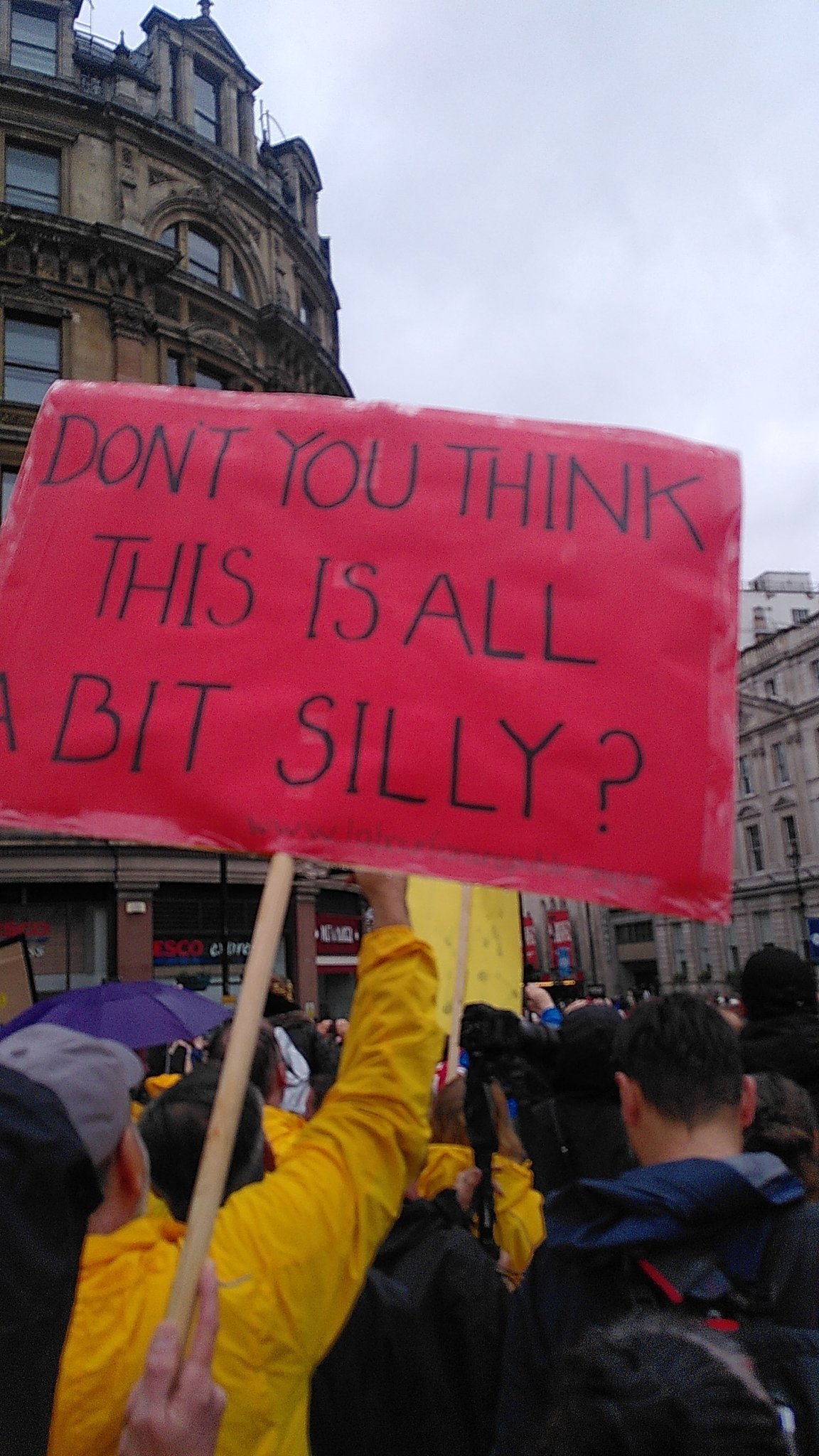
At one point fairly early in the morning, as we stood peacefully in the rain in Trafalgar Square, holding placards and chanting, several police officers suddenly pushed their way through us to grab hold of a particular activist who they wanted to search. They dragged the person in question away, pushing other peaceful protesters to the side, grabbing a banner from someone who they later claimed was in the way, and violently shoving people so forcefully that they fell into each other. I happened to be standing near a family with young children. I had to push back against some of the people falling onto me to stop them falling onto the children, as the parents scooped up the frightened toddlers. The police later claimed that all this was necessary to search Patrick – on whom they found nothing suspicious.

A bit later, a policeman told me I was upsetting people. I had been having a fairly calm conversation with a royalist who had come to Trafalgar Square to celebrate the coronation, and had found himself near the republican protest that I had joined. But the police officer clearly thought that it was dangerous for two people who disagreed to talk with each other, and he had come over to tell us to stop.

He then told me that I had upset people because I had sworn in front of children. I replied that I had not sworn all day and certainly not in front of children. He seemed inclined to believe the royalists who had made this accusation rather than to acknowledge that there were competing factual statements. He asked me to move away from the area. I insisted on my right to continue demonstrating where I was standing, next to lots of other republicans. To be fair, he didn’t try to come up with some excuse to arrest me – as his colleagues had done with many other coronation protesters.

As has now been widely reported, police arrested almost the entire staff of Republic at around 7.00am when they turned up to set up for the demonstration. As Graham Smith of Republic had pointed out many times, he and his colleagues had negotiated with police for months and had been repeatedly told that their peaceful, lawful protest would be allowed to go ahead.

But police swooped on the Republic organisers on their arrival in what looks very much like a pre-planned move to arrest the organisers of the protest. It seems they had decided to arrest them and were prepared to use whatever threadbare grounds they could for doing so. They also confiscated their van, full of placards and other entirely lawful materials, and threatened to arrest anyone with a loudhailer. Graham and his colleagues were released late last night, but the police kept their phones.

Often, the police seem to have a very hierarchical understanding of the world. I have several times seen police confused as they ask who is the leader of a campaign or protest that has been organised by people working together as equals. Given this outlook, they may even have thought that by arresting the organisers, they could stop the protest going ahead. They failed. We continued to demonstrate peacefully and vocally, against the coronation and what it represented.

Despite the arrests and outrageous policing, there was a good atmosphere on the demonstration. I’m told this was true of other protests at other sites along the route of the procession. There was a strong feeling of solidarity among republicans of varied views, backgrounds and ages, and we were further encouraged by all the supportive messages sent on social media by people who could not be there in person. I came across other Christian anti-royalists, many of them expressing delight at not being the only Christian at the protest. I was pleased to meet many people who I had previously been in touch with only remotely, including Paul Powlesland and Patrick Thelwell (pictured below), who were both arrested or threatened with arrest for their resistance to monarchy, not long after my own arrest in Oxford last year.

The police crackdown was made easier by the new Public Order Act that had been rushed through and come into force only three days earlier. Amongst other things, it has given the police the power to stop and search people at protests without giving a reason – a power several of them were clearly enjoying exercising for the first time yesterday. As well as 52 people arrested, there were many more people searched.

A police sergeant, trying to insist that they were applying the law fairly to everyone, told me that a royalist had been arrested for assaulting republicans. I am pretty sure he was the only one, despite other assaults by royalists. Later in the day, a royalist tried to pour water over me and another republican, mostly missing – and also missing the point that it was raining and we were already soaked. Some royalists chanted “hang the traitors”, in our direction. It was far more violent and abusive than our peaceful chants of “Not my king”, “Down with the crown” and “He’s just a normal man”.

Only days before, Graham Smith had encouraged me not to worry too much about being arrested. He considered that the police would stick to their agreement with Republic. After being released last night, however, Graham tweeted, “Make no mistake. There is no longer a right to peaceful protest in the UK.”

When they crowned him yesterday, Charles Windsor promised to protect our “liberties”. If he does not even question the arrests of peaceful protesters, he will already have broken his promise. Royalists like to talk of their pride in British history – about which they tend to be carefully selective. But the British traditions of free speech, for which our ancestors struggled so hard, seem to be of little concern to some of them.

Police have of course been abusing the right to peaceful protest for years. They have exceeded their legal power and broken their own laws. Their abuse of power is now aided, however, by a piece of legislation that imposes the greatest restrictions on freedom to protest in the UK since the Second World War. And yesterday has made clear how they will use it.

Future historians will study yesterday’s events. It may be that 100 years into the future, 6th May 2023 will be mentioned frequently in history books. If it is, it will be remembered not because of the antiquated coronation of a mediocre monarch, but because it was the day that the right to peaceful protest died in Britain

Why I’m protesting at the coronation

I wrote this article for the ‘i’ paper before the coronation. They ran it online on Friday, with an edited version in print on Saturday, the morning of the coronation.

The absurdity of monarchy is clearly on display. Nothing could illustrate it better than the bizarre stories and speculation emerging in the run-up to the coronation.

It’s not just the golden carriage, recycled throne or the idea of a monarch rewarding a grateful populace by giving them a recipe for quiche. It’s the growing attempts to justify over-the-top policing by talking up possible threats that range from the fairly unlikely to the virtually impossible.

If you believe certain newspapers, “republican fanatics” are planning to throw rape alarms into the procession to scare horses and cause maximum disruption.

I’m fairly sure that I fit an enthusiastic royalist’s idea of a “republican fanatic”. Neither I, nor any other anti-monarchist I have ever known, would want to cause distress to animals and put people at risk by trying to make horses run amok in crowded streets. The only time I have seen horses run into crowds in London, they were ridden by police. It is not a scene I am keen to replicate.

Along with other members of Republic, the anti-monarchy movement, I will protest in Trafalgar Square as the coronation procession goes past. I will have a placard reading, “Charles Windsor is my equal”. Monarchy sets the tone for an unequal society, justifying the idea that one person should bow to another and that some people’s lives are more important than others.

Charles is not being crowned king because he is anointed by God, because he’s especially suited to the role or because anyone has chosen him. He has the job because his ancestors violently fought off other claimants to the throne. This is both obviously true and rarely mentioned.

The coronation will celebrate values of hierarchy and subservience. It will involve 7,000 troops – a reminder that British armed forces personnel swear allegiance to the monarch. When the Archbishop of Canterbury places the crown on Charles’s head, he will give the impression that Christianity is about upholding the establishment – despite the reality that Jesus was sentenced to death by representatives of the Roman Emperor – and that there will be Christians like me among the protesters.

I also have another reason for protesting – to assert my right to do so. In September, I was arrested in Oxford after I objected during the official proclamation of Charles as king and “rightful liege lord”. In essence, I was arrested for expressing an opinion in public – at the back of a crowd, with no loudhailer, swear words or personal insults. On the same day that I was bundled into a police van in Oxford, a woman in Edinburgh was arrested simply for holding an anti-monarchy placard. I was preparing to face trial under the Public Order Act until the Crown Prosecution Service dropped the charges in January, admitting that they were unlikely to secure a conviction.

The police have form when it comes to using monarchy to justify the denial of the right to protest. In 2002, 41 anti-monarchists were arrested after a peaceful protest – some of them while sitting in the pub after the event. Others were arrested pre-emptively ahead of the royal wedding in 2011.

More people than ever are becoming aware of the huge institutional problems with police forces – including the racism, misogyny and homophobia identified by the Casey Report. Yet this is the moment that the UK Government has chosen to give the police even more power and less accountability.

Since last year, the Police, Crime Sentencing and Courts Act has given the police new powers to restrict protests on a level not seen since the Second World War. Even this isn’t enough for Rishi Sunak and Home Secretary Suella Braverman, whose new Public Order Bill, which has just been rushed into law, goes even further.

We face a toxic combination of anti-protest laws, unaccountable police and scurrilous scaremongering about “disruptive” republicans. It all adds up to a recipe for draconian and heavy-handed policing on coronation day.

Royalists on social media are accusing protesters of trying to “spoil” the day. I fear for anyone who finds their day is spoiled whenever they hear an opinion they disagree with. They seem to think that republicans don’t want to celebrate or have fun. But as we reject monarchy, we can champion equality, democracy, freedom to protest and the dignity that comes with refusing to bow down to our equals. So republicans will be celebrating on Saturday after all.

Christians owe no loyalty to Charles Windsor

I wrote the following article for the Church Times, who published it on 28 April 2023. Apologies for not posting on it here sooner.

Featuring all the paraphernalia of monarchy and militarism, the coronation sends a clear message that some people are more important than others — because of their ancestry. At the same time, the coronation is technically an act of Christian worship. It makes me sad to see the language of Christianity used to bless what is, essentially, a celebration of inequality.

To bow down to another human being, to address him as “Your Majesty”, to grant him privileges on grounds of his family background — all this seem at odds with the radical love for all people inherent in the gospel of Jesus Christ. How can I love my neighbours as myself if I do not treat them as equals? To treat someone as my inferior or superior is to deny the reality that we are all created in the image of God, equal in God’s sight, and called to bow down to God alone.

The prayers and Bible readings for the coronation ceremony have been carefully selected, not least because of the Bible’s ambivalent attitude to monarchy. As Margaret Benn, a former president of the Congregational Federation, put it, much of the Bible is a story of conflict between the kings and the prophets.

The early Israelites viewed Yahweh as their king. When they asked for a king “like other nations”, God told Samuel that “they have rejected me from being king over them.” Samuel linked monarchy with militarism and inequality, telling the Israelites that a king would conscript their sons to fight or make weapons, and their daughters to be servants (1 Samuel 8.4-18).

Coronations do not, of course, include quotes from passages such as this. For centuries, coronations have relied on the attitudes that dominate in later chapters, in which Israelite kings such as Saul and David are described as anointed by God. What possible grounds can there be for believing that Charles Windsor (or any other British monarch) is anointed by God? He owes his position to the reality that his ancestors violently fought off other claimants to the throne. It is a wilful denial of truth to pretend otherwise.

When it comes to the New Testament, you have to dig around for a long time to find passages that can be seen as supportive of earthly monarchs. Right at the beginning, we are presented with a choice of kings. Matthew tells us that King Herod, the tyrant who ruled Palestine on behalf of the Roman Empire, was “frightened” — of a baby (Matthew 2.3). The baby, Jesus, was described as “King of the Jews” by the Magi. Herod’s violent response makes clear that he feels threatened by this new claimant to his title. Yet this is a very different sort of king, born in obscurity and relative poverty, who grew up to associate with outcasts and break down barriers.

I am not trying to equate Charles with Herod or Roman emperors. Rather, my point is that faithfulness to the Kingdom of God requires rejection of the kingdoms of this world. I cannot understand how a ceremony of subservience can be compatible with Jesus’s kingdom, in which all are brothers, sisters and mothers to each other, and where those who want to be greatest must be servants (Mark 3.35; 10.43).

Our deeply unequal society desperately needs to hear about the value and dignity of all people, equal and loved by God. As Christians, we should be the first people to seek to live out this principle as we proclaim the salvation offered in Christ. Instead, we seem determined to ensure that people connect Christianity with privilege and pomposity.

Some say that the coronation is an opportunity for evangelism. This is spectacularly naïve. The coronation is an act of counter-evangelism: it conveys the message that the Christian faith is for millionaires in military uniforms or medieval robes, not for people who are worrying about paying the bills, or struggling on apparently endless waiting lists for surgery or mental health treatment.

I am not questioning the sincerity of church leaders who are taking part in the coronation. But I think that they are severely mistaken. I am one of many Christians who will join people of other religions and none in the protest outside Westminster Abbey organised by Republic, a group that campaigns for an end to monarchy. When churches around the UK pray for Charles Windsor the next day, I hope that many clergy will have the courage to avoid speaking of him as somebody to whom we owe loyalty.

We cannot promote the gospel by bowing before our equal human being. Let’s champion the value of all people and proclaim the kingdom of God, in which we are called to live as equal siblings in Christ. We can uphold the gospel not by celebrating the oronation, but by protesting against it.

Ploughing more money into the British army won’t make us safer – quite the opposite

I wrote this article for the ‘i‘ newspaper, who published it online today, Sunday 26th February.

Over the last month, a string of army generals and politicians have warned that British “defence” spending is too low. You don’t need to be a conspiracy theorist to notice these warnings are appearing in the run-up to the Budget on 15 March.

Defence Secretary Ben Wallace claimed on Thursday that Britain is likely to be involved in a major war by 2030. Head of the British Army Patrick Sanders wants more tanks to replace the ones sent to Ukraine. And Keir Starmer has called for a larger army.

From the tone of these discussions, you would never guess that the UK had the fourth highest military expenditure in the world in 2021 and that in November 2020, as Britain and the world wrestled with the Covid pandemic, Boris Johnson announced the biggest increase in British military spending since the Cold War.

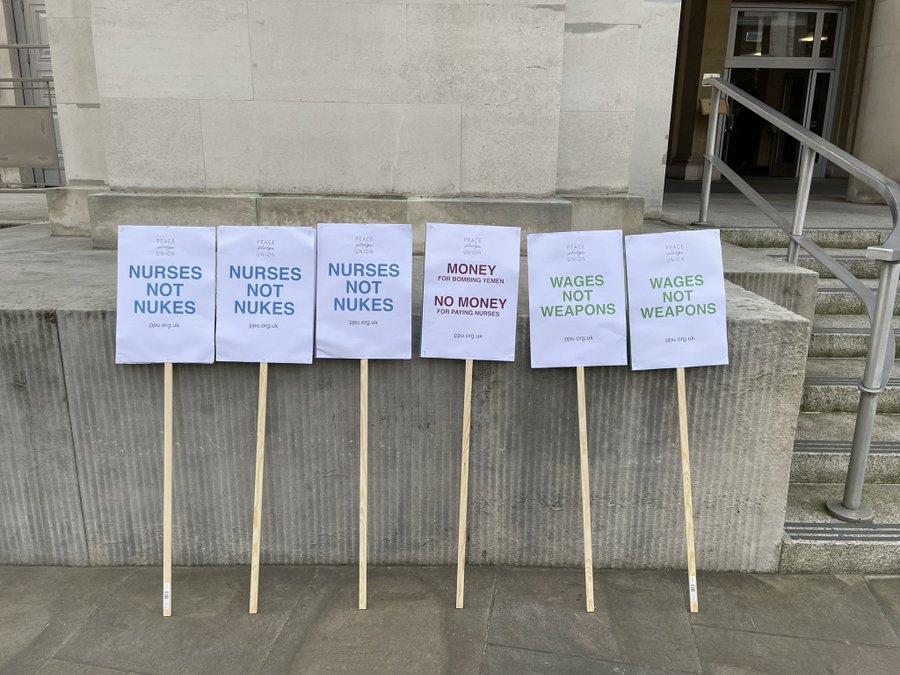
Placards ready for a Peace Pledge Union protest at the UK Ministry of Defence, 10th February 2023

Looking at Putin’s atrocities in Ukraine, many people in the UK naturally worry about the need to resist aggression, but we must not allow the militarist lobby to exploit this instinct and push for ever more military spending without even bothering to explain how it can help. Nato governments have been sending more weapons and troops into eastern Europe for several years, but this failed to prevent Putin’s vile attack on Ukraine. As a strategy for deterring aggression, high military spending has already failed.

Tory MP and chair of the defence committee Tobias Ellwood claimed that a bigger British Army is needed in case of a war with Russia. But instead of worrying about winning a war, we should be putting all our efforts into preventing one – especially between nuclear-armed states. A build-up of weapons on all sides only makes it more likely that the war in Ukraine could spill over into a global conflict.

Meanwhile, the UK Government and other nuclear-armed powers are refusing to sign the Treaty on the Prohibition of Nuclear Weapons. Nobody could “win” a nuclear war, in which the number of soldiers on each side would be largely irrelevant.

The backdrop to all this is that people are dying in the UK because of poverty, heating costs and an underfunded NHS. These are real deaths happening now. To increase military spending while doing little to tackle the cost of living crisis would mean prioritising hypothetical threats to life in the future over real threats to life in the present.

Equating security with preparations for war is misguided. For many people, “security” means enough to eat, a warm and safe home, the love of family and friends, a reliable health service and not having to worry about whether they can afford the bills.

The UK Government’s own defence reviews in 2010, 2015 and 2018 identified security threats including natural disasters, climate change, epidemics, pandemics and terrorism. The prospect of war or invasion appeared as one possible threat among others. But when the Covid pandemic came, it was ventilators, not missiles, that were in short supply.

Poverty, pandemics and climate change continue to be global threats, yet calculations by Scientists for Global Responsibility reveal that the British Government already spends £7.45 on preparations for war for every pound spent on cutting carbon emissions.

This is not about being isolationist or neglecting the needs of people in Ukraine. General Mark Milley, chair of the US Joint Chiefs of Staff, said last week that the war in Ukraine will likely end through negotiation and that it is unrealistic to think that either side can achieve a military victory. It’s a naivety that both Conservative and Labour politicians in Britain seem happy to encourage. History will not judge them kindly if thousands or millions more people in Ukraine are killed, wounded, bereaved or traumatised by the time a settlement is negotiated.

It would be hypocritical to give even more billions to the armed forces on the grounds of defending democracy or human rights. The Ministry of Defence admitted in 2020 that British armed forces are providing training to regimes with appalling human rights records, including Saudi Arabia and Bahrain. Thus while ministers rightly condemn the Russian killing of civilians in Ukraine, UK troops train Saudi forces who are bombing civilians in Yemen.

Despite the euphemistic name, “defence” spending doesn’t make us safer. There are still people who like to say, “If you want peace, prepare for war”. History has shown time and again that if you prepare for war, you are likely to get what you have prepared for.

Conspiracy theories and the road to Fascism (Or: a strange day in Oxford)

If you had wanted to visit a parallel universe today, you could have walked down Broad Street in Oxford. Hundreds of demonstrators had temporarily created a world in which Covid is not real, climate change is a hoax and the biggest threat to human freedom is a proposal to introduce some minor restrictions on which roads you can drive a car in Oxford. In that world, you can also stand next to someone with a placard reading “Keep Britain white” while claiming that you are not allied with racists.

The protest was supposedly about the traffic-calming policies of Oxford City Council and Oxfordshire County Council. Low-traffic neighbourhoods (LTNs) have become a controversial issue in Oxford. I’m broadly in favour of them, while having some objections to the details, but I’m happy to hear the views of people who disagree. There are legitimate concerns about who is most effective and how they can slow down buses by pushing more cars onto main roads.

I also broadly support proposals to limit the number of days on which cars can be used in certain parts of the city, but I can respect people who disagree with this policy. I’ve got less time for people who talk as if driving a car were a human right. They accuse the councils of reducing “freedom of movement” as if driving a car were the ony way of moving about. I think it’s important that (for example) blue-badge holders are exempt, and possibly people who need a car for certain jobs. This is completely different from confusing freedom of movement (which is a right) from freedom to drive a car (which is not).

But even most of the “right to drive” crowd would seem moderate compared to the hundreds of people who descended on Oxford today. It was clear that few of them were actually from Oxford. From their banners and leaflets, and from conversations with them, it was clear that many of them had little knowledge of Oxford or of the background to the LTN controversy (or that they knew that none of the anti-LTN candidates who stood in last year’s City Council elections had managed to win any seats).

By Carfax Tower in central Oxford was a group from the Heritage Party, the organisation set up by far-right posh boy Laurence Fox. They waved union flags and placards denying the reality of climate change. One of them shouted insults about refugees. A Jewish speaker at the counter-protest reported that when she had spoken to the Heritage Party people, they had come out with an anti-semitic conspiracy theory within a minute of the conversation beginning. No wonder that she said she was frightened by what was happening in Oxford today. I was sad to see far-right banners waved on the streets of our beautiful, diverse, welcoming city.

Fascists groups such as so-called Patriotic Alternative had encouraged people to attend today’s protest. Several anti-LTN campaigners in Oxford, after initially backing the protest, had withdrawn their support after realising who was involved.

I was repelled but not surprised by the far-right placards and the anti-LTN leaflets. What was less expected was the huge number of placards and leaflets promoting Covid conspiracy theories. I had optimistically hoped that at least a few people on the protest were local people with genuine concerns about LTNs who may not have realised the agenda of many of the groups there. But as I tried to talk with people in Broad Street, it became apparent that many – perhaps most – of the protestors were part of Covid-conspiracy and climate-denial groups. While they denied being racist and said they did not belong to groups such as Patriotic Alternative, they mostly seemed unconcerned when I pointed out the fascist banners around them.

The conspiracists held placards objecting to things that are not even happening. They were against “climate lockdowns” – as if not being able to drive in certain areas on certain days is the same as not being allowed to move about at all. They objected to people being forced to stay in their own area of the city – it is a complete fantasy to suggest that anybody will be. These ludicrous claims actually prevent any serious debate about the rights and wrong of particular traffic reduction measures, just as Covid conspriacy theories undermined attempts to call for fairer Covid regulations.

When I spoke to a group of people with such placards and pointed out that the council is not proposing such things, they responded by saying “well, not yet” and “they say they won’t”.

It’s a baffling approach. You hold a banner saying that something is happening. You admit when challenged that it isn’t. You then say that it might happen at some point, so you’re going to protest against it anyway. I could perhaps have held a placard reading “Stop Oxford City Council allowing hippopatumuses to rampage down Cowley Road!”. If someone pointed out that the council were doing no such thing, I could have responded, “Well not yet they’re not!”. They worrying thing is that some of the people there today might actually have taken this seriously.

Determined not to be intimidated into avoiding the centre of my own city, I walked down the middle of Broad Street, through the ranks of fascists, conspiracists and car-worshippers. When I politely pointed out an inaccuracy on a placard, I found two people pretty much shouting in my face.

Almost straight away, they moved from talking about cars to talking about Covid. When I drew their attention to the far-right groups involved, they looked really suprised, as if they hadn’t noticed the banners around them. They both insisted that climate change is not real. One of them described herself as a “socialist” and said she was “Jeremy Corbyn’s number one fan”. She also said she worked in a hospital and didn’t believe in Covid vaccines. Her friend told me to listen to her because “she works in a hospital”. I mentioned that one of my best friends is a nurse.

“And what does she say about it?” he asked.

“Why do you say ‘she’?” I asked.

“Well, you assume, don’t you?” he said.

“Do you?” I asked.

Before we wondered too far from the point, I asked why, if he wanted me to listen to his fellow-demonstrator because she works in a hospital, I should not listen to the many other hospital workers who believe in Covid vaccines. Because any nurse or doctor who said anything different must be lying, he said.

By this sort of logic, you can prove anything: it’s all a conspiracy, anyone who says otherwise is part of the conspiracy, anyone who disagrees is lying. On this basis, you can prove that circles are square and that the Moon is made of Irish cheese.

This is why there is nothing progressive about conspiracy theories. Conspiracists claim to be challenging the powerful, but they typically talk in vague terms about “elites” without offering any sort of structural analysis. People in Oxford today attributed the presure on the NHS to Covid vaccines, rather than to years of Tory underfunding. They claimed that climate change is a hoax to benefit the powerful. In reality, most powerful people are doing little or nothing to address the climate emergency and are only acknowledging it at all because of years of campaigning and pressure from below. Despite the lip-service of the fossil fuel corporations, it would be much easier for their profits if we all believed the people marching in Oxford today.

The far-right typically claim to be on the side of the working class, while usually being led by well-off people such as Nigel Farage and Tommy Robinson. They divide the working class, through stirring up hatred of migrants, Muslims, Jews, trans people or whoever their target of the moment may be. They divert attention from the responsibliities of the wealthy by claiming that left-of-centre policies promote the interests of the elite. And they undermine attempts to acheve structural change by pushing simplistic explanations that easily fall apart.

More often than not, injustice and inequality are visible and obvious. Most of the world’s wealth and power is in the hands of a tiny number of people. We don’t need conspiracy theories to notice this.

Conspiracists are not challenging the powerful. Often, they are indireclty helping the powerful. Conspiracists are not marching against injustice. They are walking along the road to Fascism.