Christians must stand up for Muslims’ right to pray in public

For the first time that I can remember in my lifetime, there are MPs calling for an end to freedom of religion in the UK.

Nick Timothy, little-known Tory front-bencher and Shadow Justice Secretary, last week attacked an entirely peaceful public iftar that had taken place in London’s Trafalgar Square. This Muslim event, which involves sharing food and includes prayer, was open to people of all faiths and none.

It was the sixth time it had happened, but perhaps Timothy had only just noticed it. The more likely explanation is that racist dog-whistling has become more politically acceptable than it was five years ago.

Writing in the Daily Telegraph on Thursday, he attacked “the domination of public spaces”. Apparently with no sense of irony, he described this peaceful event that was open to all as an “act of domination and division”.
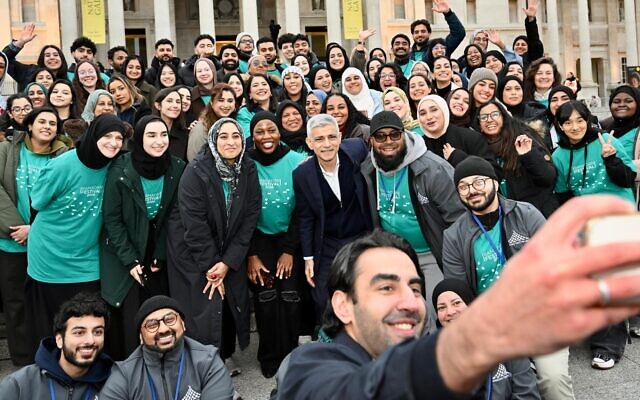
Nigel Farage – perhaps alarmed that far-right hatemongering was going on without him getting any headlines out of it – quickly joined in. In his usual style, he went further, and called for Muslim public prayer to be banned.

I cannot recall a previous case of a party leader (at least not the leader of a party mainstream enough to be in Parliament) calling for members of a particular religion not to be allowed to worship as a group in public.

Tory leader Kemi Badenoch has shamefully backed Nick Timothy, although they seem a bit vague about Farage’s “ban” call.

To their credit, some other Tory MPs have disassociated themselves from Timothy’s vile remarks, most notably Emma Best, the Tories’ deputy leader on the London Assembly. All the centrist and left-wing parties have thankfully condemned Timothy and Farage’s comments.

The controversy exposes the hypocrisy of right-wingers who like to condemn what they call “cancel culture” and who claim to be proud of Britain. Surely one of the greatest reasons to be proud of Britain is British traditions of freedom of religion and civil liberties. We have these rights because our ancestors struggled for them, often in the teeth of opposition from monarchs, militaries and – at times – religious leaders.

I am pleased to have seen a number of people of other faiths stand up for the right of Muslims to practise their religion.

 As a Christian, I am glad to see Christians challenging Farage and Timothy and speaking up for religious liberty. At the same time, however, I am disappointed. Christians as a whole, particularly Christian leaders, need to be far more vocal in showing solidarity with our Muslim neighbours.

As Christians we need have no fear of religious liberty. The Gospel of Christ advances by love and compassion, not by coercion and proscription. Many other religions such as Islam and Judaism share our trust in the God of love, even while we disagree about important matters such as the divinity of Jesus.

It is not other religions that pose the biggest threat to Christian faith. It is the destructive idols that we have created. These are the idols of money and markets and military might – and the idols of nationalism and sectarianism.

Most of the people who struggled for religious freedom in British history were themselves Christian history. As a Baptist I am proud that Baptists have always rejected state control of religion.

The first book calling for freedom of religion of Muslims and Jews in England was written in 1612 by Thomas Helwys, one of the first British Baptists. Helwys declared that, “The king is a mortal man, and not God, therefore he hath no power over the mortal soul of his subjects to make laws and ordinances for them and to set spiritual Lords over them”.

Calling for religious liberty was outrageously radical when Helwys wrote those words. In the 21st century, I would have thought that rejecting religious liberty would been far outside acceptable political debate. But far-right rhetoric has now become so mainstream that this is no longer the case.

Christians in general and church leaders in particular must speak up in support of Muslims who are under attack for peacefully praying. This is partly a matter of loving our neighbours as ourselves. It is partly a working out of Jesus’ teachings about breaking down barriers and recognising that those who are different to us are indeed our neighbours.

It is also a matter of self-interest. Every time that someone’s rights are suppressed, the restriction of the rights of others becomes more likely.

As the Jewish News put it on Thursday, “If you think that could not happen here, you are kidding yourselves. Uphold religious rights for all – you’ll never know when you’ll be glad that you did.”

_________________________________________________________________________________________________________

There will be a Christian bloc at the Together march on Saturday 28th March 2026 in central London. The march unites people of all faiths and none, including trades unions, migrant groups and community organisations, in challenging the far-right. Join us!
Palestine Action arrests threaten all our rights

I wrote the following article for the Church Times, who published it on 29th August 2025.

The Vice-President of the United States, J. D. Vance, has reiterated his claim that free speech is under threat in the UK. Any valid points that he might have about the policing of abortion protests are undermined by his failure to mention that hundreds of people are being arrested for supporting Palestine Action (PA).

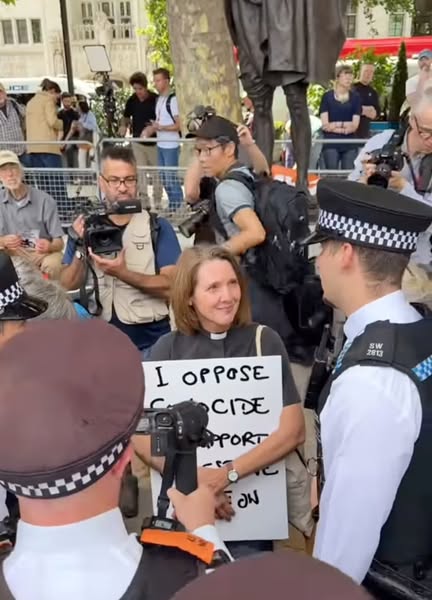
The banning of Palestine Action under the Terrorism Act had only just come into force last month when footage went viral of the arrest of the 83-year-old priest the Revd Sue Parfitt at a protest. After less than two months, the number of those arrested in connection with PA has exceeded 700. Among them are clergy of at least four denominations.

PA was banned after its members broke into RAF Brize Norton to damage weapons. But the people accused of entering Brize Norton have been arrested under existing laws, as have other PA members. The ban does not target PA’s activists, but those who publicly agree with them. It criminalises opinions.

Most people who have been arrested so far have carried signs that read “I oppose genocide. I support Palestine Action.” I wonder whether I would be arrested for a sign that read “I broadly support Palestine Action, but think some of their tactics are misguided.” I easily could be. The first five words are illegal.

The Home Secretary, Yvette Cooper, has doubled down. She claims that many PA supporters do not understand the nature of the group. So, why criminalise such apparently ignorant people? She says that court restrictions prevent her revealing “the full nature of this organisation”. In other words: trust the people with power: they know more than you do. I doubt whether this sort of request will work.

 PA was founded in 2020, when I was on the staff of the Peace Pledge Union (PPU), Britain’s leading pacifist group. One of PA’s two founders is a PPU member. Impeding the arms industry has been the core of PA’s activity. The group’s critics label its members as violent. But, whatever the rights or wrongs of destroying property, the word “violent” surely refers to harming a living being. To describe the destruction of weapons as violent is to give property the same value as people.

Only the most grotesque priorities can lead ministers to condemn damage to weapons while continuing to supply those weapons to regimes that bomb children.

It is when they have deviated from targeting arms production that PA’s members have lost support. When they daubed paint and scrawled graffiti on Rico House in Manchester, protesting against Israeli landlords, their target was far from obvious to people working in rented offices there, many from the mostly Jewish local area. Whatever their intention, PA gave the impression that they were targeting Jews rather than genocide. This deterred potential Jewish supporters, and led to criticism from PA sympathisers who were keen to combine opposition to Israeli aggression in Gaza with resistance to anti-Semitism.

When it comes to targeting weapons, however, widespread revulsion against genocide in Gaza has increased support for PA just as they have been banned.

Nonetheless, it is possible to disagree completely with PA, even to want its activists imprisoned, and still to oppose the group’s proscription under the Terrorism Act. Mass arrests for expressing opinions are a threat to all our rights

“I was there to bear witness to the call of Jesus to stand with those who are being silenced,” said the Revd Dr Sally Mann (pictured), a Baptist pastor arrested in London on 8 August. Passionately opposed to British arms sales to Israel, she said that she would be just as opposed to arming Hamas.

Like several other clergy, Dr Mann received support from her congregation. The morning after the Roman Catholic priest Fr John McGowan was arrested, he was applauded at mass; but, when he had arrived at the demonstration the day before, he heard someone calling out “Where are the church leaders? Why aren’t they saying anything?”

Several bishops and denominational leaders have condemned the supplying of arms to Israel, but have avoided mentioning the ban on PA.

Among non-churchgoers, the reaction is quite different. Look at social-media footage of Ms Parfitt’s or Dr Mann’s arrests and you will see comments from people saying that their perception of Christianity has improved. They have heard people speaking of Jesus as their reason for standing against genocide and risking arrest.

If this discovery leads them to attend a church, will they find the same enthusiasm for justice and peace?

Sixty people already face trial for supporting PA. More than 300 prominent British Jews have called for the PA ban to be reversed. The Liberal Democrats, the Green Party, Plaid Cymru, and several politicians, are backing Amnesty International and Liberty in calling for a review of terrorism legislation.

Silent bishops and denominations will face a choice as their own members stand trial for their beliefs. They can ignore one of the biggest issues facing us today; or they can bless those who hunger and thirst for righteousness. As Dr Mann puts it, “It is costly, but we need to call out genocide and war crimes no matter who commits them. Jesus shows us how to do this.”


My book, The Peace Protestors: A history of modern day war resistance (Pen & Sword, 2022) can be bought online from the Church Times Bookshop.