I was recently asked to preach on the theme of economic justice at Wakefield Baptist Church. They are a very welcoming and active church and I was honoured to be invited to preach there.
The service was on St David’s Day, 1st March 2026. It was just after US and Israeli forces had begun bombing Iran and the congregation of Wakefield Baptist Church includes a large number of Iranian Christian refugees. The format of the service was changed a bit at the last moment, with members of the church’s leadership team speaking about Iran before and after I delivered my sermon. I also made some comments about Iran before preaching my sermon as planned. Below is basically the text that I wrote beforehand but in practice I deviated from the wording at times and added in a few extra comments.
The sermon was based on two Bible readings:
Jesus wants us to think. If he didn’t want us to think, he would simply have issued lists of rules and sets of instructions. But he talked in parables. He told stories. He almost never gave a direct answer to a question. He often responded to a question by asking another question and he came at issues sideways on. This is not the behaviour of someone who wants us to accept things without thinking about them. Parables invite us to reflect, to ponder, to work things through.
Now not all churches are comfortable with this. Some churches give the impression that they prefer rules to questions. Sadly this has left many people with the impression that Christianity is about being told what to think. Personally I really enjoy sharing passages of Jesus’ teachings with people who are not used to reading them – because they are often very surprised to see how Jesus talked.
It can also be a surprise to see the topics that Jesus talked about. When church leaders talk about poverty, or war, or immigration, they are often told to “stay out of politics”, which is an odd idea given that faith involves the whole of life. But it is assumed that church leaders will comment on issues such as marriage and sexuality and so-called “family values”. So some people get the impression that Jesus spent his time talking about such things. It can come as shock to discover that Jesus said far more about money than he said about marriage, sexuality or “family values”. Reading the New Testament, it’s clear that money, poverty and inequality are among the topics that Jesus mentions most often, especially in the Gospel of Luke.
Now of course parables can have lots of different meanings. That’s one of the wonderful things about a parable! It can continue to provide more and more meanings. Nonetheless, I think that when Jesus’ original hearers heard him talking about money, they were hearing something that was relevant to their own everyday lives. Jesus lived in a deeply unequal society, impoverished by the brutal exploitation of the Roman Empire. Jesus’ listeners really responded well to a teacher, to a leader, who talked, among many other topics, about the reality of inequality and injustice.
Of course, our society is in many ways different to the society in which Jesus lived. We have many rights that were denied to the poorest people in Jesus’ day. We have these rights because our ancestors campaigned for them, often inspired by their faith in Jesus.
Nonetheless, the world remains hideously unequal. The world has enough food to feed everyone in it. Yet in our sin we have distributed food so badly that some starve while others hoard their wealth. Oxfam report that the richest four individuals in the UK own as much as the poorest 20 million people in the UK. That’s nearly a third of the population, owning as much as four people. You don’t mean to tell you that internationally, the inequality is even greater.
Last week it was reported that Elon Musk, the world’s richest person, is close to become the first ever trillionaire. How many noughts are there in a trillion? There are 12 noughts in a trillion. A trillion is a million million. According to Oxfam, Elon Musk’s wealth would be enough to pay off the entire public debt of 31 of the world’s poorest countries.
And so we come to the reading we heard earlier from Luke 12, Jesus’ Parable of the Rich Fool. It’s about a man who is so arrogant about his own wealth that he builds bigger barns to store it in, not knowing that he won’t live to see them completed. The man in the parable can control his money, he can control his buildings, but he can’t control his span of life. His wealth leads him to overestimate his own power.
This man has a conversation. Who is the conversation with? It’s with himself! He speaks with his own soul! He says, “Soul, you have ample goods laid up for many years”. The theologian Ched Myers says this story is a sort of cartoon. It’s about a rich man who is so unconcerned about other people than even when he has a conversation it’s with himself. He doesn’t seem to have a relationship with others who might benefit from his possessions, or with those whose labour has helped to produce his possessions. He doesn’t even seem to have much of a relationship with God. The only relationship he seems to have is with his wealth.
This man who thinks he has everything is impoverished in terms of both companionship and insight. And then he loses his life. It’s quite a sad story.
How has he gained all his possessions? Well, we’re not told. However, historians report that in Jesus’ time it had become common for landowners to increase their wealth by taking over the land of indebted small-scale farmers who could not pay their debts. This may have been the sort of wealthy landowner who Jesus’ listeners had in mind.
The problem is not simply that the man is too attached to his possessions. Anyone who needs to build bigger barns to store things for himself is stopping others from using them – others who may be in greater need.
In the Bible, almost every reference to storing food is negative – unless it refers to storing food to share with others. You may remember that in the book of Exodus, when the Israelites were wandering in the wilderness on the way to the promised land, they were fed with manna from heaven. They collected manna but people who tried to take more than their share found that the extra that they took went rotten.
According to Exodus 16,18, “The one who gathered much did not have too much, and the one who gathered little did not have too little. Everyone had gathered just as much as they needed.”
This is the Bible’s economic vision! We find it in Jesus’ parables. If instead we trust in the accumulation of wealth, we put our faith in something unreliable and temporary, instead of in the living God. As Jesus puts it in this parable, “So it is with those who store up treasures for themselves but are not rich towards God.”
Today of course, the super-wealthy do not need big barns. In Jesus’ day, most wealth consisted of physical possessions such as grain or gold. Nowadays even most money does not exist as coins or notes. Wealth today mostly consists of numbers on screens. It has meaning only because we all believe that the numbers on screens mean something. If we all stopped believing in the numbers on screens, the system would fall apart.
It is important to note that Jesus does not encourage us to hate rich people, even those with excessive wealth and power. Also in Luke’s Gospel, we read of Zacchaeus, an exploitative and fraudulent owner of a privatised tax-collection business. After meeting Jesus, Zacchaeus gave away half his wealth and paid back those he had defrauded four times over. Zacchaeus seems to have been welcomed into the community of Jesus’ followers, many of whom seem to have shared their property in common.
Following Jesus and challenging injustice is not about judging and demonising people. We need to recognise our own complicity in sin and ask God to send his Holy Spirit to empower us to live differently. Despite all the problems caused by inequality, we constantly hear people simplistically blaming social and economic problems on groups who they want to demonise. They blame migrants, or refugees, or Muslims, or Jews, or trans people, or benefit recipients, or whoever this week’s scapegoat happens to be. Let’s not sink to that level. We are called to love our neighbours, even to love our enemies, as we work for change and ask God to guide us.
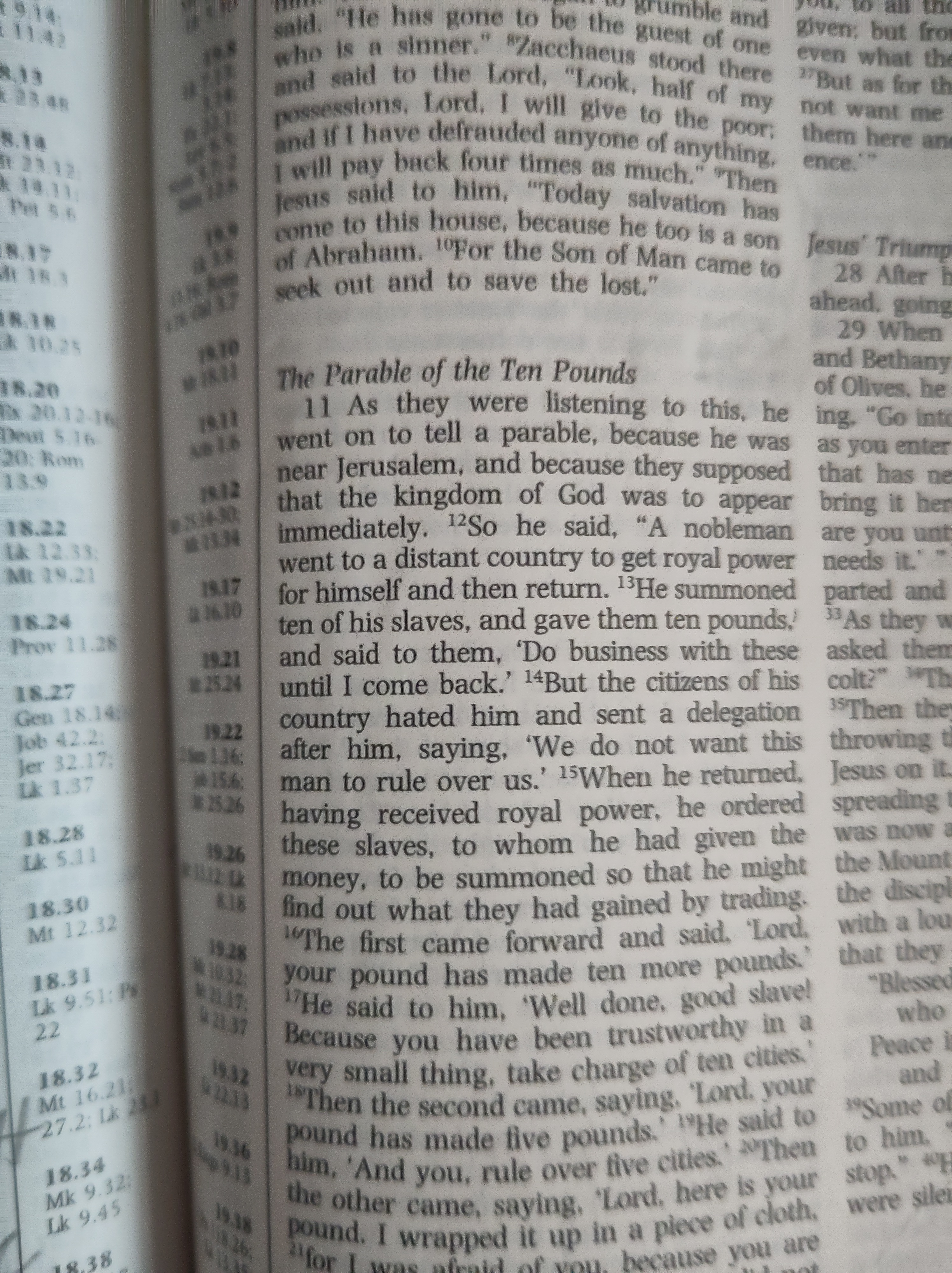
What are we to make then of the second passage that we read? It’s a famous passage, although this is Luke’s version of the story. The version in Matthew’s Gospel is probably better known. Matthew’s version is often known as the Parable of the Talents, because the rich man gives each of the three servants, or slaves, a unit of currency known as a talent. In Luke’s version the currency is different, so depending on the translation, he gives them a mina, or a pound. But this isn’t a pound as we think of it in Britain today. It is much more than that!
Basically, without getting too much into the maths and the language, the rich man is giving each of the three servants a stonking amount of money. As we saw, he rewards the first two for making more money, and is angry with the third servant for not doing so. And in Luke’s version of the story, he then has his enemies killed in front of him.
So I’ve got a question for you: when you read this story, or when you hear this story, which of the characters do you most identify with? Honestly, with which of the characters do you most empathise, or sympathise?
(Members of the congregation then offered their answers to this question).
Have you heard sermons about this passage before? I had heard lots of sermons about this passage, and it had always worried me until I started to think about it differently. I had always been told that the rich man represents God. This bothered me a lot. It bothered me because the rich man in this story is a bully and a tyrant. He angrily punishes someone who says he is frightened of him and he casually has his enemies killed.
Why – why on earth – do we think that such a character represents God? What does that say about our perception of God? The God revealed in Jesus Christ is not a bully and a tyrant. It’s true that in some of Jesus’ parables there may be a character who represents God, but in many others there is not. Why do we assume that someone must represent God in this parable? What if nobody in this parable represents God?
I want to suggest that the more we think about it, the more this makes sense. Luke’s Gospel is full of challenges to the rich. Jewish people rejected lending money at interest. Yet in this parable the rich man says that a servant could have made money by investing money and gaining interest. It seems highly unlikely that a Jewish teacher such as Jesus would have encouraged such a thing.
Once we recognise that, the parable suddenly opens up! There are lots of fresh possibilities!
What if the rich man in the story is not somebody to be admired but someone to be challenged? Well, who is it who challenges him? It’s the third servant! Although I’m not entirely convinced that everything that the third servant says is true. He says to the rich man, “I was afraid of you”. “I was afraid of you”. But he doesn’t sound afraid, does he? Because he then goes on to say, “You are a harsh man; you take what you did not deposit, and reap what you did not sow.” He speaks this to a rich and powerful man who is the sort of person who orders his enemies to be killed in front of him. And here’s his servant telling him to his face that he’s a harsh man and reaps what he does not sow!
The third servant is speaking truth to power. The third servant is the hero of the story.
The parable finishes with a summary of the reality of economic injustice: “To all those who have, more will be given; but from those who have nothing, even what they have will be taken away”.
This isn’t a description of how things should be. It’s a description of how things are. It’s a description of an unequal world – a sinful world.
Jesus’ parables expose the realities of economic injustice today as they did 2,000 years ago. But now, as then, Jesus calls us to challenge that injustice. This isn’t simply about political protest. It’s about trusting in the God of love and justice rather than in the idols of money and earthly power. Luke’s Gospel gives us a clue about this in this parable – but it’s very brief and we could easily miss it! So let’s go back and have a quick look again.
Just before Jesus tells the parable about the rich man and the three servants, Luke tells us that Jesus told the parable because his disciples “supposed that the Kingdom of God was to appear immediately”. In other words, the Kingdom of God was not going to appear immediately, but the parable had something to say about that.
It seems to me that Jesus’ parable made clear that injustices and sins such as economic inequality would continue for now as the Kingdom was not going to appear straight away. At the same time, the parable showed the third servant challenging injustice. Thus the parable shows that it is possible to live in loyalty to the Kingdom of God even though the Kingdom has not yet been fully realised.
Throughout the New Testament, the Kingdom of God is shown to be both now and not yet. The Kingdom of God is not simply a dreamy hope for a distant future. Nor is it simply a fluffy personal feeling. The Kingdom of God is an alternative to the powers that dominate this world, an alternative in which all God’s children and all God’s creation are loved and cared for. The Kingdom of God is a reality that breaks into the present even as we hope for its total fulfilment in the future. From small moments of kindness to global campaigns for justice, the Kingdom of God breaks in. When we reach out across boundaries, when we take the risk of loving our neighbours, when we trust in God and defy the idols, we are serving the Kingdom of God.
The life, teachings, death and resurrection of Jesus call us back to trust in the Kingdom of God when we are tempted to trust in the world’s priorities instead.
At times the idols of money and markets and military might seem so much stronger. No doubt the Roman authorities who crucified Jesus thought that they could easily get rid of this troublemaking Jewish peasant. But Jesus died for us, and the troublemaking Jewish peasant rose from the dead: all the powers of death could not hold him. All the forces of sin and oppression and empire were put on notice that their days were numbered. We can have confidence that it is the Kingdom of God that will triumph.
In that faith let us continue to follow Jesus. Let us be inspired by the third servant in the parable, ready to speak out for truth and love in the face of injustice.
_________________________________________________________________________________________________________
My book, The Upside-Down Bible: What Jesus really said about money, sex and violence (Darton, Longman and Todd) can be bought in paperback or e-book, priced £9.99.
 Symon Hill