Backlash continues over police raid on Quaker Meeting House

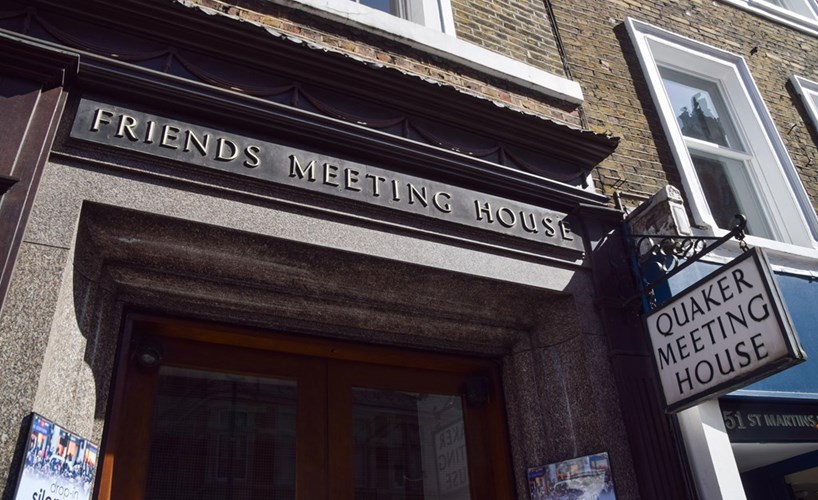
Churches Together in England (CTE) have become the latest organisation to criticise the police raid on Westminster Quaker Meeting House.

CTE are a bit late to the party, given that a full two weeks passed between the raid on 27th March and the CTE statement on 10th April. Nonetheless, given that CTE includes Christians with such a range of views, and that as a body it’s not exactly known for progressive positions, the statement is very welcome.

CTE have asked for a meeting with the Metropolitan Police and called for “an appropriate review by the police and its accountability structures”. While police “accountability structures” are weak to the point of barely existing, it would be interesting to see what comes out of a meeting between CTE, the Quakers and the Metropolitan Police.

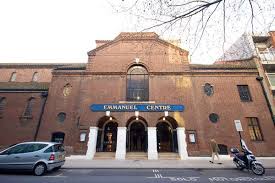
If you’re not yet aware of this incident: at least 20 police broke down the door of Westminster Quaker Meeting House on the evening of 27th March. They swarmed through the building and arrested six young women attending a welcome talk by the nonviolent protest group Youth Demand.

Police also entered the other rooms in the building, including a room being used by a life drawing class and – staggeringly – a room hosting a private counselling session.

Youth Demand is not a Quaker group. However, they share with many Quakers a commitment to nonviolent direct action, in this case over climate change and war in Gaza.

Quaker Meetings were frequently broken up by the authorities in the seventeenth century. Now as then a place of worship has been attacked by violent representatives of the state seeking to stop peaceful people from acting on their conscience.

There has been coverage of the Meeting House raid in many places, including on the front page of the Sunday Times on 30th March. Personally I have written about it for the Morning Star and for Premier Christianity.

Other critics of the police raid on the Meeting House include Christian Aid, the Green Party, several MPs and members of the House of Lords and even Jacob Rees-Mogg.

The much shorter list of people who have refused to condemn or even question the raid includes Yvette Cooper, the Labour Home Secretary.

After Starmer’s disabilty benefit cuts, I would rather saw off my own arm than vote Labour again

There was a time when governments might have been more subtle about cutting support for disabled people in order to spend more money on weapons. Keir Starmer’s government are not even trying to frame it differently. They’re celebrating their increase in “defence” spending at the same time as they’re boasting about making disability-related benefits even harder to claim.

This bizarre decision reveals a class-based clash over what terms such as “security” and “defence” refer to.

For some people, these terms are simply about preparations for war. Indeed, even some opponents of increased military spending have fallen for the euphemism and talk about “defence” expenditure. But if you’re queueing at a food bank, unable to access mental health support or facing discrimination when applying for jobs, then security means much more than not facing a Russian invasion.

As your livelihood is snatched away, are you meant to rejoice that at least you’re being harmed by Keir Starmer rather than Vladimir Putin? As you shiver in the cold because you can no longer afford heating bills, should you celebrate at the thought you’re being impoverished and frozen by rich people in London instead of rich people in Moscow?

The expenditure on weapons seems to be based on the unquestioned assumptions that violence makes us safe and that spending more on violence makes it more effective. In reality, the combined military spending of NATO governments has been much higher than Russia’s for years. This failed to deter Putin’s vile invasion of Ukraine. I have yet to hear a journalist ask Keir Starmer why he thinks that throwing even more money at the military will somehow deter Putin when that has failed to work up until now.

Meanwhile, US troops whose Commander-in-Chief is Donald Trump are stationed at various bases around the UK. There is almost no media discussion of the presence of the troops of a dangerously erratic far-right regime in Britain.

Sadly, many of the opponents of benefit cuts seem unwilling to criticise military spending levels.

Thankfully, however lots of them have clearly framed the cuts as a political choice and presented meaningful taxation of the super-rich as an alternative. This is a message that can really hit home and that we need to keep repeating: the government is choosing to cut support for some of the poorest and most disadvantaged people in the UK rather than take even slightly more from the millionaires. They are taking millions from people with nothing, and nothing from people with millions.

Ministers are benefitting from misunderstandings that they seem happy not to correct. Anyone with an even basic knowledge of disability benefits knows that Personal Independence Payment (PIP) is not an out-of-work benefit. It is to help with the extra costs of being disabled. Many recipients of it are already in work. For some, cutting this benefit will make it harder for them to work. For example, it can help with costs of transport or assistance that may for some disabled people be more expensive but which enable them to get to work. The number of disabled people in work will not go up if PIP is cut. In reality, it will almost certainly go down.

Yet someone casually glancing at the media would easily get the impression that PIP is given only to disabled people who don’t work. I can hardly blame people for thinking this, given the way it is often presented. But I can blame the ministers and right-wing journalists who know very well that this assumption is factually untrue, yet seem happy to benefit from it all the same.

Even if a minister somehow misguidedly believes in the benefit cuts that they are proposing, nothing can excuse their willingness to benefit from the lies, half-truths and uncorrected misconceptions that are being used to encourage support for their cuts. There has been a spate of stories in newspapers such as the Daily Mail demonising disabled people. Such stories are only going to get worse and more numerous in the coming days and weeks. Ministers are able to gain support for their agenda at the cost of encouraging prejudice and hatred of a large group of people.

Anyone who thinks that PIP is too easy to obtain has almost certainly never gone through the process of applying for it, or supporting someone who has. Having supported friends to apply for PIP, I find myself thinking that anyone who manages to complete the contorted and degrading application process in the midst of mental ill-health should be given a medal and celebrated as a hero, let alone getting a benefit.

While the government may have decided that they will cope without the support of people who receive PIP, they may have overlooked the reality that a significant percentage of the population know somebody who receives PIP (or other disability-related benefits). They thus know that these lies are not true. And the message “tax the rich instead of cutting things for the poor” is a straightforward proposal that is simple as well as realistic. Thus I am not convinced that austerity and attacks on disabled people will work as well for this government as they did for the Cameron-Clegg cabinet 15 years ago.

Groups such as Disabled People Against Cuts (DPAC) have done great things in the last 15 years in challenging austerity. I’m now planning to contact them and similar campaigns to find out what I can do to join the resistance to Starmer’s evil policy.

It is a long time since I voted Labour. While I tend to vote Green, I have tended to hold out the possibility that I could vote Labour in certain circumstances in the future. But now we have a Labour government with a domestic economic policy worse than anything that I can remember even Tony Blair doing. They are demonising and impoverishing disabled people, including people with mental health problems, while increasing military spending and letting the rich off the hook.

I will never vote Labour again. I would rather saw off my own arm. Although I dare say that Starmer’s new friends in the Daily Mail would accuse me of only sawing it off in order to gain benefits – and then they would deny them to me anyway.

Why Christians should back free speech – and not believe J.D. Vance

I wrote the following article for Premier Christianity, who published it on their website on Thursday 13th March 2024. As I was writing for a Christian audience I focused on the faith that I share with them, although (as I hope all my writing makes clear), I believe passionately in working alongside people of many faiths and none.

Two and a half years after I was put in the back of a police van, my hands cuffed behind my back, Thames Valley Police have admitted that I was unlawfully arrested. 

I am acutely aware that most people who are wrongly arrested receive little or no publicity and are not in a position to take legal action against the police. 

I was able to take legal action only because of Liberty, whose excellent lawyers advised and represented me. I was helped, practically and emotionally, by a wide range of friends, comrades and strangers. They included fellow Christians, along with people of other faiths and of none.  

My arrest took place in September 2022, shortly after I left church in Oxford. I found myself amid crowds of people trying to negotiate their way around town as roads were closed for a ceremony declaring Charles Windsor to be king. 

I remained silent as the High Sheriff of Oxfordshire read out expressions of grief for Elizabeth Windsor. But then he declared Charles to be our king, stating that we owe him “obedience”. I had just been in church, celebrating King Jesus. Unlike earthly kings, Jesus calls us to choose to follow him. He does not demand our obedience based on accidents of birth. 

I find it hard to stomach the description of Charles Windsor as our “rightful liege lord”. To me, it seems to be demeaning to God’s image to expect one sinful human being to bow down to another.  

I called out: “Who elected him?” 

A couple of people told me to shut up. I said that a head of state was being imposed on us without our consent. 

I might well have left it there. But three security guards came over and told me to be quiet. When I asserted my right to speak, they began to push me backwards. 

The police intervened – not to arrest the security guards for assaulting me, but to arrest me. I was led away and handcuffed. 

I will forever be grateful for two complete strangers who followed us down the road, asking the police why they were arresting me. They said that while they didn’t agree with my opinion, they thought Britain was a “free country.” 

Several other people were arrested around the same time, for similarly minor acts of dissent. A woman in Edinburgh who prefers to remain anonymous was arrested while peacefully holding a republican placard. 

Three months later, I was charged with breaking the Public Order Act 1986 through behaviour likely to cause “harassment, alarm or distress.” I had not harassed, threatened or insulted anybody. Two weeks later, the Crown Prosecution Service dropped the charges, saying there was little prospect of conviction. 

After my arrest, I was taken aback by the level of media interest. I received hundreds of supportive messages, dozens of abusive ones and a few death threats. I have also heard from many other people who had been wrongly arrested.  

Anti-protest legislation introduced by the Conservative government – which Labour has failed to repeal – has been used against non-violent anti-war and climate campaigners. But it is not only legislation that is the problem, but the culture within the police force.  

I have lost count of the number of times I have attended protests at which Black and Asian people are the first to be questioned or arrested. Police ignorance about free expression has been highlighted by clumsy attempts to enforce buffer zones where abortions take place. While it is reasonable to prevent intimidation or aggression, this should not be confused with quiet and respectful praying.   

Unfortunately, those who talk loudest about free speech seem to be uninformed about whose free speech is being denied. JD Vance recently undermined his own argument about Britain’s lack of free speech with an outrageous untruth about people in Scotland being prevented from praying in their homes. 

Meanwhile, various celebrities claim that they are being “cancelled” when voluntary organisations such as Students’ Unions decide not to invite them to speak. 

But it is not the rich and powerful whose free speech is threatened. Free speech is at risk in the UK because police are arresting people for nonviolent protest and expressing their opinion. Unlike Vance and the supposedly “cancelled” celebrities, most have limited power to do much about it. 

As Christians we believe that all people have value and worth, and that Christ died for us all. The voice and dignity of one person is as valuable as those of any other. Called to love our neighbours – whatever their faith or lack of it – we cannot call for our rights to be respected without recognising the rights of others.  

This is why I urge all Christians to uphold freedom of expression and principles of equality. This means urging Keir Starmer’s government to repeal the anti-protest laws that Tory ministers put in place. It also means calling for a major overhaul of policing. 

In calling for our rights to freedom of speech, we are asserting the value, dignity and equality of every human being, made in the very image of God.  

Royalists failed to silence me – but free speech remains in danger

I wrote the following article for the Morning Star, who published it in today’s issue (11th March 2025).

Two and a half years after throwing me in the back of a police van for opposing the monarchy, Thames Valley Police have admitted that I was wrongfully arrested.

I am pleased and relieved of course. But I am also acutely aware that most people who are unlawfully arrested receive little or no publicity and are not in a position to take legal action against the police.

I was able to do so only because of Liberty, whose excellent lawyers advised and represented me. I was helped, practically and emotionally, by a wide range of friends, comrades and strangers.

But this is not about me. It never was.

It is about the rights of all people to speak out, to express themselves, to challenge the powerful, to refuse to bow down, to assert the dignity and equality of all humans.

Leaving church in September 2022, I found myself amid crowds of people trying to negotiate their way around town despite roads being closed for a ceremony declaring Charles Windsor to be king.

I remained silent as the High Sheriff of Oxfordshire read out expressions of grief for Elizabeth Windsor.

But then he declared Charles to be our king and “rightful liege lord.” I called out “Who elected him?”

A couple of people told me to shut up. I said that a head of state was being imposed without our consent.

I might well have left it there. But three security guards came over and told me to be quiet. With no sense of irony, they stood menacingly right in front of me and said they were asking me “nicely” not to express my views.

When I asserted my right to speak, they began to push me backwards. I briefly feared that I would be knocked over.

The police intervened — not to arrest the security guards for assaulting me, but to arrest me for expressing my views. I was forcibly led away and handcuffed.

I will forever be grateful for two people — complete strangers to me — who followed us down the road. They repeatedly asked the police why I was being arrested. They said they didn’t agree with me but they thought Britain was a “free country.”

The police contradicted themselves several times about which law I had been arrested under.

I was called back for a police interview and told that one of the security guards had alleged that I had assaulted him. This was a reversal of the truth.

Three months after my arrest, I was charged with breaking the Public Order Act 1986 through behaviour likely to cause “harassment, alarm or distress.”

Two weeks later, the Crown Prosecution Service dropped the charges, saying there was little prospect of conviction.

On the same day that I was arrested, a 22-year-old woman in Edinburgh — who has preferred to remain anonymous — was arrested while peacefully holding an anti-monarchy placard. Shortly afterwards, Paul Powlesland was threatened with arrest in London if he wrote “not my king” on a piece of paper.

When it came to the coronation, Graham Smith and other staff at Republic were arrested as they arrived to set up for a lawful demonstration. The police used powers that had been rushed into law less than a week earlier.

After my arrest, I was taken aback by the level of media interest. I received hundreds of supportive messages, dozens of abusive messages and a few death threats. Andrew Schraeder, a Conservative councillor in Basildon, tweeted that I should be sent to the Tower of London.

I also heard from many other people who had been wrongly arrested, or otherwise mistreated by the police, who had received far less publicity than me.

Several anti-monarchists were arrested at the royal wedding in 2011. We all know how anti-protest legislation has been used against nonviolent anti-war and climate campaigners. And I have lost count of the number of protests I have attended in which black and Asian people have been the first to be questioned or arrested.

Certain cases of appalling police behaviour at least make the news, such as the vile police assault on a vigil mourning Sarah Everard in 2021. At other times, police behaviour receives little attention. A homeless woman in Oxford told me of how she had been beaten up in the back of a police van. She did not, of course, have the resources to take legal action.

Yet it is rightwingers — including some on the extreme right — who misleadingly present themselves as defenders of free speech.

This claim reached the heights of absurdity when JD Vance criticised Britain for a lack of free speech, with an outrageous lie about people in Scotland being prevented from praying in their homes.

Similar claims about the suppression of free speech are made by Nigel Farage — a far-right multimillionaire who receives excessive media coverage in inverse proportion to the coherence of his arguments.

Far-right types on social media claim to be upholding “free speech” when they want an excuse to peddle racism, misogyny, homophobia, transphobia and other doctrines that demonise their fellow human beings.

Meanwhile, various celebrities claim that they are being “cancelled” when voluntary organisations such as students’ unions decide not to invite them to speak.

Vance, Farage and their gang do not of course mention the arrests of peaceful people resisting war, monarchy or climate change. The excessive prison sentences for Just Stop Oil and Palestine Action campaigners receive no criticism from them.

It is not the rich and powerful whose free speech is threatened. Free speech is under threat in Britain because police are arresting and charging people for nonviolent protest and the expression of opinions. Unlike Vance and Farage, most people have limited power to do much about it.

But as every socialist and trade unionist knows, we all have more power when we act together. Now is a vital time for the left to seize the narrative and take back the cause of free speech from the hatemongers.

In demanding our rights to freedom of speech, we assert the reality that we have equal value to the kings, presidents, generals and billionaires who are so keen to be heard while expecting the rest of us to shut up. Let’s make sure they know that shutting up is the last thing we will be doing.

The Church of England has not even reached the starting-point

The General Synod of the Church of England have raised their weapons, taken aim and shot themselves in their collective feet.

They voted yesterday to improve the Church’s safeguarding procedures, handing parts of the process over to an independent body.

This in itself is a good thing. It’s an improvement on the current situation, and there’s no doubt that many grassroots Anglicans are working hard to prioritise safeguarding (even if others are not).

But what they have voted for is less than what we were led to expect.

Faced with two options for improving safeguarding, the Synod voted for the weaker option (“Model 3”). The proposal to fully hand over safeguarding to an independent body (“Model 4”) was not passed.

Some who voted for the partial measure had understandable reasons for doing so. As the Church Times reports, there were fears that full independence would take too long to implement, leading some to suggest that partial independence would be a better option as it would get things changing more quickly.

This seems to me to miss the point that the Church of England must act far more quickly than it has usually done in the past. Moving at their usual speed should not be an option, whatever the details of new systems and procedures.

At least as important as the new procedures themselves is the message that was sent, however inadvertently, to victims, survivors and the public in general. Most survivors who were involved in the issue were calling clearly for fully independent safeguarding to be introduced.

To choose the weaker of two alternative systems is not only – as the journalist and anti-abuse campaigner Andrew Graystone put it – a “punch in the gut” for victims of survivors of church-based sexual abuse. As Joanne Grenfell, Bishop of Stepney and lead bishop for safeguarding, said after the vote, “The Church has missed a huge opportunity to send a message to victims and survivors that we hear their concerns about trust and confidence.”

This is another step in turning large chunks of the British population away from churches.

The abuse crises are not affecting the Church of England only. Those of us in other churches have no right to complacency. This is not only because of our own safeguarding failings but because much of the public no longer distinguish between one Christian denomination and another. Far fewer people know about the distinctions between churches than was once the case (and why should we expect them to?).

Today, the General Synod have reaffirmed in many people’s minds the impression that Christian churches are not on the side of victims.

This is utterly contrary to the teachings of Jesus, who sided with the poor, the marginalised and other victims of injustice and kept his harshest words for the rich and powerful and religious leaders.

He said we should love our enemies. He did not say that the perpetrators of injustice should not be our enemies.

There is an alternative for churches in the UK now. Radical changes to safeguarding systems should be only a starting-point.

Beyond this, we could address the cultural and structural problems that lead to abuse. As Jonathan Gibbs, the Bishop of Rochester, pointed out in yesterday’s debate, the recent abuse crises in the Church of England were due to less to poor procedures and more to a culture whose workings are “so supple and so powerful that at times we don’t even realise it is happening”.

We could ask God to guide us in the painful and challenging work of changing the culture of our churches, overhauling our power structures, centring the voices of victims and affirming our solidarity with the people with the least power. We could signify our repentance by voluntarily giving up our privileges, such as opt-outs for faith schools and bishops in the House of Lords. We could show our willingness to stand in solidarity with people of all faiths and none as we recognise our own failings and stand against abuse, injustice and sin.

The Church of England’s General Synod have indicated now that they have not even reached the starting-point.

It’s not peaceful anti-royalists like Lidia Thorpe who are disrespectful – it’s those who want us to bow down to an unelected king

I wrote the following piece for the ‘i’ paper today following Lidia Thorpe’s protest in the Australian Parliament. (My article in the ‘i’ has been edited slightly so there are some minor differences with the wording below).

Charles Windsor gave no answer. He never does.

As he finished his speech to the Australian Parliament, Senator Lidia Thorpe walked towards Charles, calling out that he was not her king and challenging him over his family’s treatment of First Nations people in Australia.

The unelected head of state did not respond. He simply waited for the elected senator to be forcibly removed from her own Parliament.

On social media, Thorpe was immediately accused of being “disrespectful”.

But how else is Thorpe to express her views to Charles? She cannot stand against him in an election – he is elected by nobody. She cannot debate him on television – he rarely gives serious interviews and is never properly challenged.

I was one of several people in the UK who was arrested for voicing opposition to monarchy when Charles was declared king in September 2022. After a long-winded process, I was charged with a breach of the Public Order Act, charges which were dropped two weeks later with little explanation.

Alongside hundreds of supportive messages and a few death threats, I received messages saying that I was “disrespectful”. It seems to be royalists’ favourite accusation.

In reality, it is not democratic republicans such as Senator Thorpe and me who are disrespectful. It is Charles and his allies.

Charles showed his disrespect for democracy and debate in Australia before the royal tour had even begun, when he turned down a polite request to meet with the Australian Republic Movement (ARM).

Rejecting the invitation, the monarch’s spokespeople said that he respected the Australian people’s right to decide for themselves whether to keep the monarchy. This is disingenuous. Charles and Camilla have travelled to Australia just as support for a republic is growing there. While ARM compare the royal visit to a farewell tour by ageing rock stars, Australian royalists are making no secret of their hope that the visit will whip up support for monarchy. At present no referendum on the issue is planned, but pressure is growing and it is likely that one will be held within the next few years.

Members of the Windsor family consistently avoid any encounter, however calm and polite, with opponents of monarchy. Charles has never met any republican group. He does not appear on Newsnight or the Today programme to answer difficult questions. When meeting members of the public in Cardiff in 2022, he could not even bring himself to respond to someone who calmly asked him about the cost of the coronation.

But it is people who object to this sort of behaviour who are described as “disrespectful”.

The police routinely go to ludicrous lengths to protect the royals from even having to see or hear republicans. In Bolton last year, a 16-year-old with a republican placard was threatened with a dispersal notice and arrest if he did not leave the area in which Charles was due to arrive.

Of course it is the police and the government, not the Windsor family, who must bear most of the blame for this sort of behaviour. But the royals cannot wash their hands of it. An intervention from Charles, let alone a public comment, would make a considerable difference to police behaviour.

Like many people, I will continue to challenge monarchy not because I am disrespectful but because I believe that all human beings are entitled to dignity and respect. This can only really happen in a society in which we treat each other as equals and make decisions democratically – whether in communities, in workplaces or in the appointment of a head of state.

Bowing down to your equal human being is what really shows disrespect for humanity.

Reform UK’s MPs are ready to justify violence – whether it’s carried out by the police or used against them

It has not taken long for the five MPs from Reform UK to reveal themselves as a gang of far-right thugs in suits.

Nigel Farage has spent much of the last two days denying that he stoked up the racist violence in Southport on Tuesday. The reality is that Farage recorded a video only hours before the violence began in which he challenged the police’s statement that the murders of children were “not terror-related”.

Farage told his viewers:

“I just wonder whether the truth is being withheld from us. I don’t know the answer to that.”

Farage is right about one thing: he does not know the answer to that. He knows no more about this horrendous attack than most of us do – which is very little. He also knows that despite saying he does not, know, his comments were likely to be heard as strongly implying that the truth is indeed being withheld from us.

Yesterday, he defended himself on GB News, claiming that the police should have been clearer about the identity of the murderer. Disgracefully, Farage claimed:

“That’s what led to the riots last night. That’s what led to people being outside that mosque in Southport. You know, sometimes just tell the public the truth and you might actually stop riots from happening.”

If Farage is implying that people would not have attacked a mosque if they had known the murderer was not a Muslim, then he is in effect suggesting that it would have been acceptable to attack a mosque if the killer were a Muslim.

Reform UK leader’s reluctance to believe police statements contrasts remarkably with Reform UK’s attitude when a police officer was filmed jumping on a suspect’s head as he lay prone on the floor in Manchester airport last week.

Reform MPs rushed to defend the police involved, saying that police officers had been viciously attacked, including by the person whose head one of them later jumped on.

They missed the point that nobody was defending violent assaults on police officers. But Reform MPs defended equivalently vile behaviour – because it was done by police officers. There is no context in which it is acceptable to kick and jump on someone who is lying prone on the floor, whatever that person has done.

Tice went so far as to post a photo of a young police officer with blood on her face, claiming she had been attacked by the men in Manchester Airport. The picture turned out to have been taken in Leicestershire four years ago.

A week later, this demonstrably false photo is still on Tice’s Twitter feed.

Tice, however, must cede the award for most ludicrous response to his fellow Reform MP (and former Tory MP) Lee Anderson – the man known for telling refugees to “fuck off”, telling anti-monarchists to emigrate and telling people in poverty that it is possible to cook a meal for 30 pence.

Anderson didn’t just try to shift the focus away from police violence. He actively welcomed the violence. He wrote on Twitter:

“The vast majority of decent Brits would applaud this type of policing. We are sick of the namby pamby approach. Time to back our boys in blue.”

This is the first time I have known the phrase “namby pamby” used to mean “not jumping on people’s heads”. Anderson (as usual) cites no evidence that “the vast majority of decent Brits” are in favour of police assaulting suspects as they lie prone on the ground.

But Anderson surpassed even himself in his comments in a BBC interview, saying:

“The message I am getting loud and clear from my constituents is they are fed up with seeing police dancing around rainbows and being nice to people and running off from rioters. They want police to do their job, and I think these police yesterday should be commended. In fact, I’d give them a medal.”

You might need to read that again. The most shocking statement from Anderson is not that he wants to give a medal to people engaged in a violent assault. It is that the police behaviour to which he objects include “being nice to people”.

Yes, he really said that. He said his constituents are fed up with seeing police “being nice to people”.

What an outrageous way to behave – being nice to people. This is a party whose MPs defend people who engage violence against a man lying prone on the floor, but who object if those same individuals are being nice to people.

Reform’s enthusiasm for the police suddenly changed, however, when it came to the horrific murders of children in Southport on Monday.

With the Manchester airport incident, Tice, Anderson and their mates had taken it for granted that everything said about the suspects’ attacks on police was true. Now it may well be true, but it’s worth noting that they did not even stop to consider whether it was.

In contrast, the police statements that they do question are not those involving the disputed details of a violent incident but factual statements about an arrested individual.

The police in Southport said that the individual they have arrested is 17 and was born in Cardiff to parents from Rwanda. Today a court ordered that his name be made public. The police have said the incident is not “terror-related”, which I think is a bizarre expression but basically seems to mean that the motivation was not an attempt to bring about political change.

While I have little or no faith in the police, the police statements that seem to me to be most likely to be accurate are those concerning the age, nationality and so on of suspects.

This has not stopped far-right types claiming on social media that the killer is a Muslim and/or an asylum-seeker. But as he was born in Cardiff, he literally cannot be an asylum-seeker. A Rwandan family is pretty unlikely to be Muslim. Even if he were Muslim, this would not take away from the reality that Muslims in Southport are as appalled as anyone else by the horrific murders of children.

Farage’s language about the truth being withheld played directly into the hands of those who claimed that the basic factual statements about the arrested individual are not true. Reform MPs were too late to undo their damage when they took to social media on Wednesday morning to condemn the violence in Southport the previous night.

Within less than a month of Reform UK gaining five MPs, they have revealed the reality that they side with violent thugs – whether those thugs are attacking police officers, or are police officers themselves.

Draconian jail terms for Just Stop Oil show why Labour must scrap Tory anti-protest laws

On Wednesday morning, police entered a café in London and arrested a group of customers. They were planning a peaceful protest at the State Opening of Parliament against the UK’s government’s military support for Israel.

On Thursday, five members of Just Stop Oil were each sentenced to between 4 and 5 years in prison for planning to disrupt the M25 in protest against the UK government’s inaction on climate change.

These two incidents have two things in common.

Firstly, they both involved people being punished not for what they did but what they were thinking about doing.

Secondly, they were possible because of recent Tory legislation restricting peaceful protests and introducing new powers to arrest and punish people simply for planning protests.

It is now vital that the Labour government repeals the legislation that enabled these outrages.

I write as one of the first people arrested under the Police, Crime, Sentencing and Courts Act 2022.

At least, the police told me that I was being arrested under that act when they bundled me into a police van for expressing anti-monarchy views at a royal proclamation in Oxford. But they later told the media that they had arrested me under the Public Order Act 1986.

The reality is that many police have little idea about the law relating to protests. It is not only recent Tory laws that need repealing, but the whole framework of laws and culture relating to freedom of expression and rights to assemble and protest.

The trial of the Just Stop Oil protesters that finished yesterday was particularly unfair, with the judge’s bias being blatant throughout. He tried to stop them giving evidence about the reality of climate change, even ordering the arrest of protesters who sought to emphasise the right of juries to acquit on the basis of conscience.

The defendants said that this undermined their own promise to tell “the truth, the whole truth and nothing but the truth”. Thus they have been nicknamed the Whole Truth Five.

The judge clearly did not want the jury reminded of other occasions on which juries have exercised their right to acquit peaceful protesters. This has happened many times. For example, in 1996 the four women who disarmed a warplane bound for Indonesian attacks on East Timor were found Not Guilty on all charges after spending six months in prison on remand.

Personally, I do not support all the tactics and attitudes of Just Stop Oil. I fear that they focus far too much on disrupting ordinary people’s everyday lives rather than the activities of the powerful. Some of them fail to connect climate change with other injustices such as inequality, poverty and war, with which it is inextricably bound up.

But anyone who cares about climate change and about freedom to protest – whatever their views on Just Stop Oil – should be alarmed that people have been imprisoned for planning a protest.

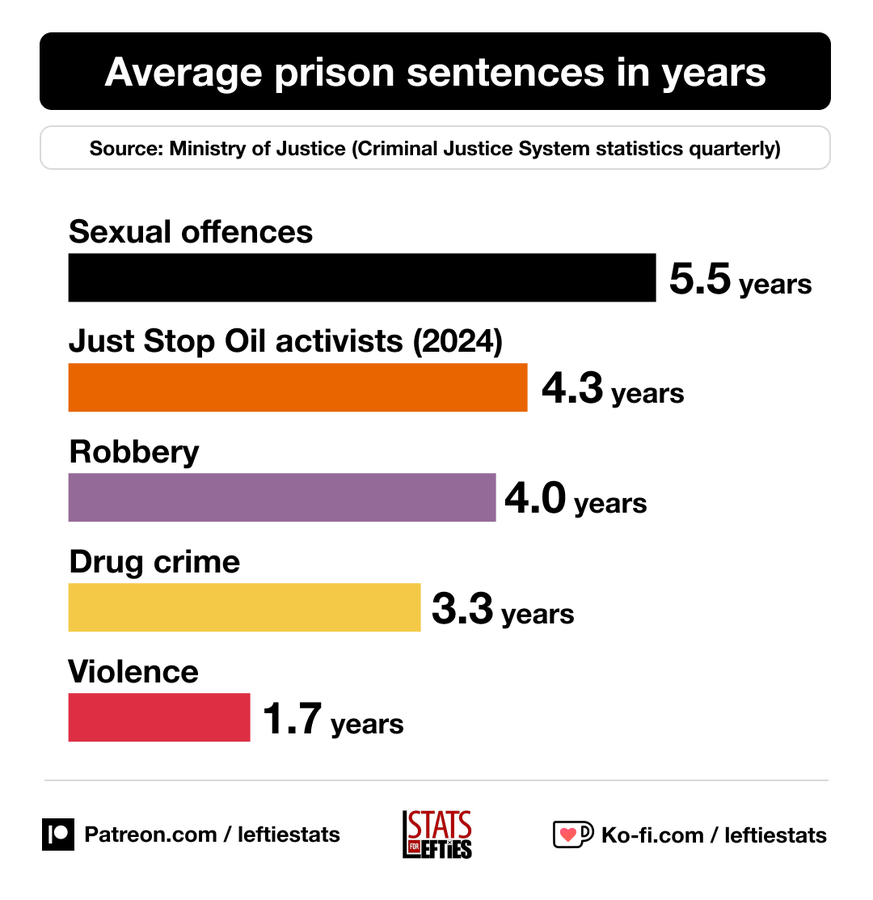
The excessive length of the sentences is chilling. The Whole Truth Five will spend longer in prison than some people convicted of sexual offences and violent crime. This is really frightening.

I do not yet know what will happen to the members of Youth Demand who were arrested in a café on Wednesday simply for planning a peaceful protest over Israel at the State Opening of Parliament in London. I will be watching out for further news.

The Labour policies announced in the King’s Speech shortly after those arrests were in several ways more progressive than I had feared. But they do not go nearly far enough, and they include nothing about repealing Tory attacks on political freedoms.

Arrests and convictions must not deter us from exercising our freedom of expression and our rights to peaceful protest. And we must ramp up the pressure on the new government to overhaul protest laws and police powers.

Otherwise, any of us could be facing five years in jail before too long.


My book The Peace Protesters: A history of modern-day war resistance explores nonviolent activism, particularly peace activism, in the UK in the last 40 years (published by Pen & Sword, 2022).

Sunak is fuelling militarism with his dangerous ‘National Service’ plan

If patriotism is “the last refuge of a scoundrel”, then militarism is the last desperate hope of a Prime Minister clutching at the thinnest of straws as he plummets to defeat.

Rishi Sunak’s plan to bring back so-called “National Service” might get some militarists and Daily Mail writers salivating with delight. It might even win him a few votes from right-wing hardliners tempted to vote for Reform UK.

Many of the most hardcore militarists have attacked Sunak’s government for not increasing the UK’s already massive military budget by as much as they would like. The billions that this scheme would cost would in effect mean another big rise in military spending.

But that’s far from the worst aspect of it. Eighteen-year-olds who join the armed forces for a year would be part of an institution that is exempt from basic employment laws. Armed forces personnel have no right to join trades unions or to give notice when they wish to leave. Unlike people in almost any other job, they can be imprisoned for refusing to do what their boss tells them to do. The orders that they can be required to obey include orders to kill others without reference to their own conscience.

Sunak’s proposed ”civilian” alternative to joining the armed forces would be little better. The experience of many other countries makes clear that those who choose the military option are often treated with greater esteem and have more chance when it comes to applying for jobs later.

For those who choose the civilian option, Sunak offers a weekend of “voluntary” work once a month for a year. This “voluntary” work would be compulsory. It is obvious that the concept of compulsory voluntary work makes as much sense as a square circle. While some of this work may well be beneficial to the community, it is not hard to imagine a scenario in which it is used to plug gaps in services that have resulted from government cuts and underfunding. Unpaid “volunteers” (in effect, conscripts) would be doing work that should be done by paid professional workers.   

And what of the 18-year-olds who refuse to be part of the scheme at all, as the Peace Pledge Union has today urged them to? James Cleverly said this morning that nobody will be imprisoned but that refusers will face other “sanctions“, whatever that means.

Thankfully, this ludicrous plan is unlikely to be introduced as the Tories have almost no chance of winning the general election. This does not mean that the proposal is not dangerous. It has already caused damage by making such militarist policies more mainstream.

Some years ago, the only people who talked about “bringing back national service” were right-wing pub bores and retired colonels writing angry letters to the Daily Telegraph. This has changed because of the deliberate ramping up of militarism in the last 15-20 years. In the wake of public opposition to the wars in Iraq and Afghanistan, militarist politicians and their allies have introduced Armed Forces Day, the Cadet Expansion Scheme, “military ethos” projects in schools and “armed forces covenants” for local authorities and other institutions to sign.

It is this rise in everyday militarism that has brought us to a point at which a proposal to bring back conscription can be taken seriously. This Tory policy, even if it is never introduced, will further help to normalise militarist attitudes and practices in the UK.

I can only hope that the number of people who will challenge and resist the proposal will help to increase resistance to militarism as well. Everyday militarism must be met with everyday conscientious objection.

Confessions of an extremist

I am an extremist. I object to the killing of Israeli children and to the killing of Palestinian children. That, it seems, is enough to make me an “extremist” in the eyes of Rishi Sunak’s government.

Communities Secretary Michael Gove is planning to change the definition of “extremism”. So far, he has not published a list of groups that he wishes to define as “extremist”. Commentators have suggested that the new definition is likely to cover people campaigning against the Israeli attacks on Gaza, as well as several groups concerned with tackling climate change.

Meanwhile, the UK government continues to sell weapons to the aggressors of Saudi Arabia and Israel, to maintain enough nuclear warheads to wipe out much of the world, to further reduce the right to strike and the right to peaceful protest, and to preside over a massively underfunded NHS and declining welfare state as more and more people in the UK are pushed into poverty and ill health.

None of these policies, however, are to be labelled “extremist”.

The biggest problem with Gove’s plan is that it is absurd to have a simple definition of the word “extremist” at all. It is surely obvious that different beliefs are extreme in different situations. Therefore, what consitutes extremism depends on the context.

150 years ago, you would have been an extremist if you called for women to be given the vote. Now you would be considered an extremist if you said that women should not have the vote. Even 30 years ago, you would have been an extremist if you said that same-sex couples should be allowed to marry with legal recoginition. This “extremist” position is now law in the UK, and many other countries.

Surely we should be debating not whether a particular idea is extreme or extremist, but whether it is right.

As Martin Luther King wrote in 1963:

“The question is not whether we will be extremists, but what kind of extremists we will be. Will we be extremists for hate or for love? Will we be extremists for the preservation of injustice or for the extension of justice?”

The UK government’s current definition of extremism includes opposition to democracy and “British values” – as if everyone in Britain has the same values. This allows ministers to formally place the views of certain of their opponents beyond the limits of acceptable beliefs. It is similar to the way McCarthyites labelled left-wing views as “unamerican”.

Now Michael Gove and his colleagues plan to go even further. According to today’s Observer:

“Organisations and individuals that breach a new official definition of extremism will be excluded from meetings or any engagement with ministers, senior civil servants, government advisory boards and funding. Councils will be expected to follow the government’s lead, cutting any financial ties or support to individuals or groups that have been categorised as extremist.”

This policy represents a massive assault on free expression and freedom of association. Ministers would be able, almost on a whim, to ban groups that they oppose from any engagement with official bodies. This is the sort of policy we might expect from Putin’s Russia. And it follows the introduction in recent years of the biggest restrictions on the right to peaceful protest in the UK since the Second World War.

The proposed criteria for labelling a group as “extremist” are so vague that a government could potentially place almost any organisation or individual who they did not like on the list. The Observer reports that a group could be defined as “extremist” if their behaviour includes attempts to “overturn, exploit or undermine the UK’s system of liberal democracy to confer advantages or disadvantages on specific groups”.

This is laughable. The Conservative Party has been conferrring advantages on a specific group – the very wealthy – for centuries. But people like me who want more democracy – such as by abolishing the monarchy – can be said to be opposed to the “UK’s system of liberal democracy” and thus regarded as “extremists”.

Of course some of the beliefs labelled “extremist” are views I deplore: such as racism, fascism, fundamentalism and other far-right ideologies. But we should tackle these because they are wrong, harmful and evil, regardless of whether the government regards them as extremist.

Someone who defends ISIS (for example) would rightly be denounced by the vast majority of people. However, ministers would label them as “extremists” even while those same ministers support the equally vile, immoral and murderous regime of Saudi Arabia. Indeed, British ministers are authorising the sale of arms to the Saudi regime, which are used in attacks on civilians in Yemen.

Similarly, supporting the muder of civilians by Hamas is “extremist”, whereas supporting the equally vile murder of civilians by the Israeli “Defence” Force is effectively UK government policy.

So by official definitions, it is not support for violence that makes you an “extremist”, but only support for violence carried out people who UK ministers oppose – rather than the many tryants and aggressors who they support.

Let’s not argue about who should be defined as an “extremist” – the state should not be maintaining a list. Let’s not deny we are extremists – I’m happy to be an extremist for peace, active nonviolence, human dignity and real democracy.

The Levellers, Chartists, Suffragettes and early Gay Pride marchers were regarded as extremist. Many of their views are now accepted by large majorities of people. Let’s be inspired by them to resist this latest attack on our rights and freedoms.