Palestine Action arrests threaten all our rights

I wrote the following article for the Church Times, who published it on 29th August 2025.

The Vice-President of the United States, J. D. Vance, has reiterated his claim that free speech is under threat in the UK. Any valid points that he might have about the policing of abortion protests are undermined by his failure to mention that hundreds of people are being arrested for supporting Palestine Action (PA).

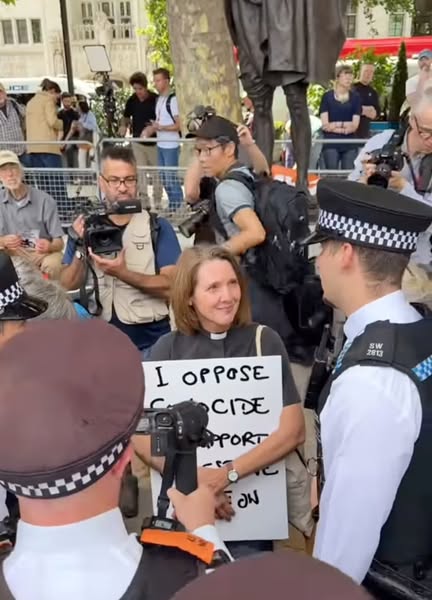
The banning of Palestine Action under the Terrorism Act had only just come into force last month when footage went viral of the arrest of the 83-year-old priest the Revd Sue Parfitt at a protest. After less than two months, the number of those arrested in connection with PA has exceeded 700. Among them are clergy of at least four denominations.

PA was banned after its members broke into RAF Brize Norton to damage weapons. But the people accused of entering Brize Norton have been arrested under existing laws, as have other PA members. The ban does not target PA’s activists, but those who publicly agree with them. It criminalises opinions.

Most people who have been arrested so far have carried signs that read “I oppose genocide. I support Palestine Action.” I wonder whether I would be arrested for a sign that read “I broadly support Palestine Action, but think some of their tactics are misguided.” I easily could be. The first five words are illegal.

The Home Secretary, Yvette Cooper, has doubled down. She claims that many PA supporters do not understand the nature of the group. So, why criminalise such apparently ignorant people? She says that court restrictions prevent her revealing “the full nature of this organisation”. In other words: trust the people with power: they know more than you do. I doubt whether this sort of request will work.

 PA was founded in 2020, when I was on the staff of the Peace Pledge Union (PPU), Britain’s leading pacifist group. One of PA’s two founders is a PPU member. Impeding the arms industry has been the core of PA’s activity. The group’s critics label its members as violent. But, whatever the rights or wrongs of destroying property, the word “violent” surely refers to harming a living being. To describe the destruction of weapons as violent is to give property the same value as people.

Only the most grotesque priorities can lead ministers to condemn damage to weapons while continuing to supply those weapons to regimes that bomb children.

It is when they have deviated from targeting arms production that PA’s members have lost support. When they daubed paint and scrawled graffiti on Rico House in Manchester, protesting against Israeli landlords, their target was far from obvious to people working in rented offices there, many from the mostly Jewish local area. Whatever their intention, PA gave the impression that they were targeting Jews rather than genocide. This deterred potential Jewish supporters, and led to criticism from PA sympathisers who were keen to combine opposition to Israeli aggression in Gaza with resistance to anti-Semitism.

When it comes to targeting weapons, however, widespread revulsion against genocide in Gaza has increased support for PA just as they have been banned.

Nonetheless, it is possible to disagree completely with PA, even to want its activists imprisoned, and still to oppose the group’s proscription under the Terrorism Act. Mass arrests for expressing opinions are a threat to all our rights

“I was there to bear witness to the call of Jesus to stand with those who are being silenced,” said the Revd Dr Sally Mann (pictured), a Baptist pastor arrested in London on 8 August. Passionately opposed to British arms sales to Israel, she said that she would be just as opposed to arming Hamas.

Like several other clergy, Dr Mann received support from her congregation. The morning after the Roman Catholic priest Fr John McGowan was arrested, he was applauded at mass; but, when he had arrived at the demonstration the day before, he heard someone calling out “Where are the church leaders? Why aren’t they saying anything?”

Several bishops and denominational leaders have condemned the supplying of arms to Israel, but have avoided mentioning the ban on PA.

Among non-churchgoers, the reaction is quite different. Look at social-media footage of Ms Parfitt’s or Dr Mann’s arrests and you will see comments from people saying that their perception of Christianity has improved. They have heard people speaking of Jesus as their reason for standing against genocide and risking arrest.

If this discovery leads them to attend a church, will they find the same enthusiasm for justice and peace?

Sixty people already face trial for supporting PA. More than 300 prominent British Jews have called for the PA ban to be reversed. The Liberal Democrats, the Green Party, Plaid Cymru, and several politicians, are backing Amnesty International and Liberty in calling for a review of terrorism legislation.

Silent bishops and denominations will face a choice as their own members stand trial for their beliefs. They can ignore one of the biggest issues facing us today; or they can bless those who hunger and thirst for righteousness. As Dr Mann puts it, “It is costly, but we need to call out genocide and war crimes no matter who commits them. Jesus shows us how to do this.”


My book, The Peace Protestors: A history of modern day war resistance (Pen & Sword, 2022) can be bought online from the Church Times Bookshop.

Backlash continues over police raid on Quaker Meeting House

Churches Together in England (CTE) have become the latest organisation to criticise the police raid on Westminster Quaker Meeting House.

CTE are a bit late to the party, given that a full two weeks passed between the raid on 27th March and the CTE statement on 10th April. Nonetheless, given that CTE includes Christians with such a range of views, and that as a body it’s not exactly known for progressive positions, the statement is very welcome.

CTE have asked for a meeting with the Metropolitan Police and called for “an appropriate review by the police and its accountability structures”. While police “accountability structures” are weak to the point of barely existing, it would be interesting to see what comes out of a meeting between CTE, the Quakers and the Metropolitan Police.

If you’re not yet aware of this incident: at least 20 police broke down the door of Westminster Quaker Meeting House on the evening of 27th March. They swarmed through the building and arrested six young women attending a welcome talk by the nonviolent protest group Youth Demand.

Police also entered the other rooms in the building, including a room being used by a life drawing class and – staggeringly – a room hosting a private counselling session.

Youth Demand is not a Quaker group. However, they share with many Quakers a commitment to nonviolent direct action, in this case over climate change and war in Gaza.

Quaker Meetings were frequently broken up by the authorities in the seventeenth century. Now as then a place of worship has been attacked by violent representatives of the state seeking to stop peaceful people from acting on their conscience.

There has been coverage of the Meeting House raid in many places, including on the front page of the Sunday Times on 30th March. Personally I have written about it for the Morning Star and for Premier Christianity.

Other critics of the police raid on the Meeting House include Christian Aid, the Green Party, several MPs and members of the House of Lords and even Jacob Rees-Mogg.

The much shorter list of people who have refused to condemn or even question the raid includes Yvette Cooper, the Labour Home Secretary.

Police raid Quaker place of worship hosting campaign group’s welcome talk

On Thursday 27th March, at least 20 police officers broke down the door of a place of worship in central London and arrested young people who belong to a peaceful protest group.

New anti-protest laws have in recent years allowed the police to become ever more heavy-handed and anti-democratic in their approach to protest. Raids on people who are planning direct action – and not even doing it – have become more common.

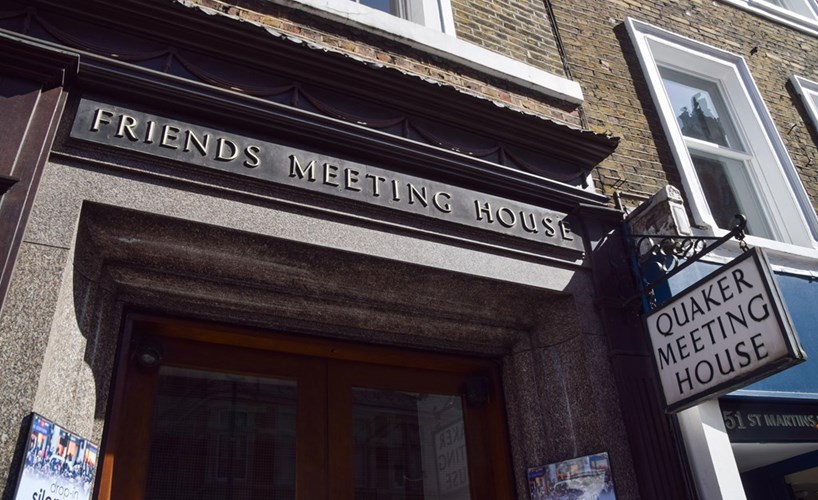
Nonetheless, the police attack on Westminster Quaker Meeting House (pictured right) is particularly alarming for several reasons.

Firstly, the event was described by Youth Demand as a “welcome talk that was “publicly advertised”, to discuss protests against the genocide in Gaza. In other words, this event was open to anyone. That includes people with no experience of taking part in, or even talking about, civil disobedience or direct action. Anybody who went along out of interest may very likely be frightened of attending any political meeting again. This is police intimidation.

Secondly, it seems you can now be raided for having conversations about actions that you might take. Given that this was a welcome meeting, it is disingenuous for the police to imply that everyone there was in the middle of some sort of high-level planning of mass disruption. The police comment given to the media focused on what “Youth Demand have stated” their intentions to be. This is very different to everyone present being intent on taking part in such things. Given that the police raided other Youth Demand members’ homes in London and Exeter, it seems that they were attempting not only to arrest certain members of Youth Demand but also to intimidate all the others.

Thirdly, the police have raided a place of worship. Apologists for the police have been quick to jump on social media and point out that the people arrested were not Quakers (or at least, probably not Quakers). This is irrelevant. Quakers have a strong theology of not separating the “sacred” and the “secular”, so they do not believe their buildings to be more sacred than other places. This is also irrelevant, however. Religious groups expect their buildings to be places of safety and welcome; those who visit them should be able to expect this (speaking personally, Westminster Quaker Meeting House was a great place of welcome and community to me after I nervously moved to London 20 years ago). Westminster Quaker Meeting House is also the home of two Quaker wardens, who have now experienced the violation of their home by the police.

The police are clearly abandoning the sort of sensitivity and caution that might once have made them reluctant to break into a place of worship. A statement from Quakers in Britain described the incident as “an aggressive violation of our place of worship”.

Of course, this whole incident cannot be understood without the context of the genocide in Gaza, which is enabled by Keir Starmer’s government. Like the Tory government before them, they are happy to arm Israeli troops killing civilians in Gaza and Saudi troops killing civilians in Yemen – and many other vicious regimes around the world. The young people arrested in Westminster Quaker Meeting House were not planning violence. They were seeking to resist violence.

This police raid seems fairly clearly to be an attempt to deter people from taking part in Youth Demand’s upcoming protests. For this reason if for no other, let’s make sure we support them! Tessa, a member of Youth Demand speaking outside Bromley Police Station yesterday insisted that “this blatant act of intimidation by the Met Police” would not stop them.

Among other things, it is vital that religious groups condemn the police’s behaviour and their violation of free speech, freedom of assembly and religious liberty. This time it was a Quaker Meeting House. Next time it could be a church, mosque, temple or synagogue.

God is not Father Christmas

Last Sunday (29th December 2024) I preached at Sherbourne Community Church in Coventry. I was very pleased to be asked to do so. They made me very welcome. Below is the text of my sermon.

To be clear: this is the text I wrote beforehand but in practice I deviated from the wording at times and added in a couple of extra comments. But the substance is the same.

The sermon followed two Bible readings, and focused particularly on the first one:

Luke 2, 41-52

Colossians 3, 12-17

At Christmas time, I’m sure many of us tend to think about memories of childhood Christmasses. As a child in primary school, I assumed that large swathes of the Bible were taken up with accounts of the birth of Jesus. Christmas seemed such a dominant event. Later, when I learnt more of the structure of the Bible and became aware that there were four gospels, I still imagined that a sizeable portion of each gospel must be focused on the nativity.

So it was a surprise to me as a teenager to discover that two of the gospels – Mark and John – don’t even mention Jesus’ birth. The other two – Matthew and Luke – give only a small portion of their story to it.

Matthew tells us that Joseph, Mary and Jesus returned from being refugees in Egypt once they heard that Herod had died. Matthew’s gospel then leaps forward to Jesus’ adulthood and his baptism by John the Baptist. Luke almost leaps straight from Jesus’ infancy to his adulthood – but not quite! He gives just a few lines to the story that we heard earlier, about the 12-year-old Jesus disappearing from his parents during a trip to Jerusalem.

Other than the nativity narratives, this is the only story about Jesus’ childhood that has made it into the Bible. In the second and third centuries, a number of writings claimed to tell the stories of Jesus’ childhood, but most of these were written long after the gospels that we have in our Bibles. So this very short story is quite exceptional.

I think it’s quite a strange story. Sometimes, if we’re familiar with a story, we can get so used to it that we forget how strange it would sound to someone hearing it for the first time. I’m not a parent, but I have sometimes had responsibility for children as an uncle and a godfather. I think you’d all be a bit alarmed if I told you that I had lost my goddaughter on a trip to London and had searched for three days before finding her in Westminster Abbey, discussing theology with the Bishop of London.

As we listened to this passage earlier, we heard that Jesus’ parents had been travelling home from Jerusalem for a day before they realised he wasn’t with them. You might find this surprising. Indeed, you might look at it and say, “A day! How did they go a day before noticing he wasn’t there? What extraordinarily unobservant parents!”

If we react like that, it’s because we’re making assumptions based on our own culture. Today, a child is the responsibility of their parents. They need to know where they are. But Jesus’ culture was a culture of extended families. The care of children was much more widely shared than it is now. With members of an extended family travelling together – possibly with other families – it is very likely that Mary and Joseph simply assumed that Jesus was with other relatives as they all travelled together in large groups. It must have been a shock to them to realise he wasn’t with any of them.

We can only imagine their fears, worries and possible panic as they searched for days before finding Jesus in the Temple. It’s understandable if we find ourselves a bit annoyed with Jesus at this point: surely he was old enough to realise his parents would be worried?

I suspect that is not the question that concerned Luke. The gospel-writer is interested in showing us that Jesus prioritised God’s ways over human ways and could discuss important issues. A number of scholars suggest that Luke’s was following a practice common in the life-stories of Roman emperors and other powerful figures in Greco-Roman society. Caesar Augustus, who was Roman Emperor at the time of Jesus’ birth, is said to have delivered an intellectual speech at the age of 12. Perhaps Luke is telling us that this Jewish peasant, Jesus, who began his life in a smelly room full of animals could be a match for the ruler of the Roman Empire.

Indeed, many of the titles that the New Testament gives to Jesus – king, saviour, son of God – were also titles used for Roman emperors. The gospels challenge the empire’s whole notion of what it means to be a king, saviour or god.

I’m struck by Luke’s wording towards the end of the story. He says that afterwards Jesus went to Nazareth with his parents “and was obedient to them”. The word that stands out to me is “obedient”. Jesus doesn’t seem to have been very obedient when he left his parents to go and chat in the Temple. Perhaps Luke is keen to encourage us not to think of Jesus as disobedient and to emphasise that after this point he obeyed his parents.

But I can’t help thinking that if Jesus had behaved like a model obedient child, he would never have gone back to the Temple at all. Jesus was not the model of an obedient child. Despite this, some people have clearly put quite a lot of effort into using – or misusing – Christian teaching as a way of controlling children – and indeed adults. It seems to me that this tendency is especially strong at Christmas.

Take Cecil Frances Alexander, the writer of Once in Royal David’s City. She tells us in Verse 3 of the carol that Jesus was obedient to his mother. The lyrics then declare, “Christian children all must be/ Mild, obedient, good as he”. 

Well, if children are to follow Jesus’ example, should they leave their parents and wander off to debate theology? That’s probably not what Cecil Frances Alexander had in mind when she wrote the hymn. The other hymns that she wrote include All Things Bright and Beautiful, which originally contained the verse ‘The rich man in his castle/ The poor man at his gate/ God made them, high and lowly/ He ordered their estate.” Thankfully that verse is now generally missed out. But it’s clear that for Cecil Frances Alexander, God is a god a who has created and blessed the social order, a god of order, obedience, hierarchy and control.

Don’t worry! I’m not suggesting that God wants children to just randomly ignore their parents or disobey their parents. But I am worried when we give the impression that Christianity is all about following rules and doing what you’re told. As Christians, and particularly as Protestants, we celebrate a God who saves us by grace because God loves us, not through any goodness of our own. We are not saved through obedience. We are not saved through rules. We are not saved because of our actions or because we’re somehow better than others. Salvation comes through God’s grace – God’s unmerited favour, flowing out of God’s love for us. We cannot earn God’s love. We cannot earn God’s forgiveness. We seek to do good in gratitude for God’s love and because we want to follow his way – not because God’s love can be earned.

Earlier, we heard those words from Colossians: “Above all, clothe yourselves with love, which binds everything together in perfect harmony.” It is love, not obedience, that saves us.

What has this to do with Christmas? As a child, I found that stories and songs around Christmas time were dominated by two individuals. One was Jesus. The other was Father Christmas. Unfortunately, I think I had a tendency to confuse their characteristics with each other.

Sometimes, Father Christmas is a friendly, cuddly figure, part of a nice, entertaining story to tell children. But he can also be misused. I remember a few years ago sitting at a café in December and gradually becoming aware of the conversation at the next table. A woman was telling her grandson that if he didn’t finish his dinner then Father Christmas might not bring him any presents. How would Father Christmas know, asked the child? He’s outside watching you, said the grandmother; I can see him through the window. The child spun round, trying to catch a glimpse of Santa through the window behind him. “You can’t see him,” said his grandmother. “Only I can see him.”

Thankfully, I restrained myself form leaning over and saying, “Well, that’s convenient, isn’t it?”

Even Santa Claus can be turned from a nice story for children into a means of control.  The cheerful tune of Santa Claus Is Coming To Town might distract us from the lyrics, which are basically a series of threats: “You better watch out”, “You better not cry”. And so on.

As a child, I found that God and Santa Claus blurred with each other. Santa Claus is apparently watching us, ready to punish or reward us. We have to “watch out” because he can see us all the time. He’ll divide us up into “naughty and nice” and we don’t want to be on the wrong list.

And as a child, that is exactly what I thought God was like. And there are many, many people – adults as well as children – who seem to think that this is the sort of God in which Christians believe. But this is exactly the sort of God that I don’t  believe in now. And I want to suggest that the God revealed in the birth of Jesus is the opposite of that sort of God.

The message of Christmas is summed up in the word Immanuel, meaning God With Us. In the birth of Jesus, God has entered into human life in a new way. At Christmas, we see that God is not a big, bearded man in the sky looking down on us. God is a refugee baby lying in a feeding-trough. God has appeared among us, born not as an emperor or a military leader but as a persecuted child in an obscure corner of a brutal empire. God is not simply up there, compiling lists of our sins and categorising us as “naughty” or “nice”. God is down here. God is with us. He shares our lives, he shares our pains, he shares our joy. Whether we enjoy Christmas or struggle through it, whether we laugh or cry on Christmas Day or any other day, God is with us, laughing and crying with us.

At times, it can be hard to believe it. It can be hard to feel it. But God is more than a feeling. God is with us whatever we’re feeling.

A year ago, the Lutheran pastor Munther Isaac made global headlines with the Christmas sermon that he preached in his home church in Bethlehem. As he surveyed the reality of life in Palestine and Israel, he asked, “Where is Jesus today?” He answered, “Jesus is under the rubble in Gaza”.

Jesus is under the rubble in Gaza.

This is the God made vulnerable in the child Jesus who walked away from his parents to return to the Temple. This is the God who as the man Jesus lived so much by the power of love and justice that the Roman Empire considered him a threat and executed him with one of the most painful forms of murder that human cruelty has ever invented. This is the God whose subtle, transformative power cannot be defeated by all the powers of sin, injustice and empire, and who as Jesus Christ rose from the dead and continues to be with us. This is the God who offers to rule in our hearts if we commit ourselves to him and reject those same forces of sin, those same idols of injustice and empire today.

God is not Father Christmas. There is no naughty-and-nice list in the Kingdom of Heaven. Jesus’ salvation does not come through obeying rules or fitting into structures. Of course, some rules are worth following. Some structures are good structures. But Jesus made clear that rules were made for people, not people for rules. Obedience cannot save us.

Jesus can save us. To be clear, I am not suggesting that it doesn’t matter how we live or what we do! That is the last thing I am saying. Jesus’ own teachings point to a way of life, to a way for the world, that challenges so many of the values that dominate our broken, unjust and unequal society. But he is down here with us as we resist them – and he will forgive us when we fail. So let’s rejoice in God’s salvation. Let’s seek Christ’s help to follow his teachings. Let’s pray, as the Letter to the Colossians puts it, that the peace of Christ will rule in our hearts. But let us also ask for forgiveness when we turn away – and let us be prepared to forgive others, just as the Lord has forgiven us.

And as we prepare for 2025, let us be ready to support each other, trusting in the reality that whatever we face, whatever the world faces, God is with us.
“The Jews” did not kill Jesus

Jesus was executed by the authorities of the Roman Empire.

This is one of the few features of Jesus’ life on which nearly all historians agree. There are many historians and biblical scholars who spend a lot of time arguing about which of the sayings and actions attributed to Jesus are likely to be historically accurate, about which of the incidents recorded in the gospels took place as historical events.

Scholars are on a spectrum from those who take the gospels as broadly accurate accounts of Jesus’ life to those who doubt all but a few details .

Virtually all of them, however, accept that Jesus was crucified. Crucifixion was a Roman method of execution (not a Jewish one) used against political troublemakers and rebellious slaves. It is almost inconcievable that Jesus’ followers, living in a tyrannical and violent regime, would have invented a story that would immediately label them as followers of someone that regime had executed as a threat.

For much of Christian history, however, Christians have put the blame on Jews – often on “the Jews” as a whole, as if every one of them bore responsibility for the killing of Jesus. This is particularly absurd given that Jesus was a Jew.

This claim has not only served as a justificiation for persecuting Jews. It has also helped to sidestep the intensely political nature of the death of Jesus. He was executed by an imperial power who objected to him promoting the Kingdom of God rather than the Empire of Rome (when you read the words “kingdom” and “empire” in an English Bible, they are translating the same Greek word, basileia).

The gospels, to varying degrees, show the Jewish leaders of the time colluding with the Roman authorities to execute Jesus. Matthew’s Gospel and John’s Gospel seem particularly keen to hold them responsible. There are various possible reasons for this, much debated by historians. All the gospels make clear, however, that in the end Jesus was executed on the orders of the Roman governor Pontius Pilate.

If the Jewish leaders encouraged Pilate to execute Jesus, this would not make all Jews responsible. But even here we need to be careful. Who were these Jewish leaders? They were the Roman-approved leaders: in practice, Rome would only allow a Jewish High Priest who did not resist Roman rule. It is unsurprising that when Jews rebelled against Roman rule in 70 CE (about 40 years after Jesus’ crucifixion), the Jewish rebels killed the High Priest and his colleagues. They were collaborators with the empire. They were not representative of the Jewish people.

I have been shocked in the run-up to Easter this year to see how persistent is the belief that “the Jews” killed Jesus. Perhaps I have become too used to academic New Testament scholarship (where Roman responsibliity is accepted) or to left-wing Christian groups (where the political nature of Jesus’ execution is emphasised).

I recently heard a street preacher in Birmingham declare that Jesus had been killed by “his own people, that’s the Jews”. I was shocked to see a reflection in the Church Times last week by Charles Moseley, in which he repeated the tired old claim that Pilate did not want to execute Jesus but gave into Jewish public opinion. Moseley did not not try to argue this point, or acknowledge that it has now been discredited. He simply asserted it as he might have done if writing 30 years ago.

Sadly, it seems that antisemitism is alive and well in many Christian circles at Easter. Ironically, those of us who campaign against the horrendous assaults of Israeli forces against people in Gaza are accused of antisemitism by political right-wingers and apologists for aggression. Yet Jesus was born in an empire, in a place where imperial soldiers controlled the population and religious leaders colluded with oppression. It is not dissimilar to the situation faced by many Palestinians today. This point is made repeatedly by Palestinian Christians, even when western Christians do not seem to have ears to hear it.

It is not resistance to empire and war that is antisemitic – to make such a claim is to conflate Jews in general with the current Israeli government and its forces. It is attempts to ignore the inherently political nature of Jesus’ death that lead to the blame being put on “the Jews”. Throughout Christian history – and still today – antisemitism has served the interests of those who want us to forget that Jesus challenged the political and social order. Following Jesus means continuing to challenge injustice and empire today.

Confessions of an extremist

I am an extremist. I object to the killing of Israeli children and to the killing of Palestinian children. That, it seems, is enough to make me an “extremist” in the eyes of Rishi Sunak’s government.

Communities Secretary Michael Gove is planning to change the definition of “extremism”. So far, he has not published a list of groups that he wishes to define as “extremist”. Commentators have suggested that the new definition is likely to cover people campaigning against the Israeli attacks on Gaza, as well as several groups concerned with tackling climate change.

Meanwhile, the UK government continues to sell weapons to the aggressors of Saudi Arabia and Israel, to maintain enough nuclear warheads to wipe out much of the world, to further reduce the right to strike and the right to peaceful protest, and to preside over a massively underfunded NHS and declining welfare state as more and more people in the UK are pushed into poverty and ill health.

None of these policies, however, are to be labelled “extremist”.

The biggest problem with Gove’s plan is that it is absurd to have a simple definition of the word “extremist” at all. It is surely obvious that different beliefs are extreme in different situations. Therefore, what consitutes extremism depends on the context.

150 years ago, you would have been an extremist if you called for women to be given the vote. Now you would be considered an extremist if you said that women should not have the vote. Even 30 years ago, you would have been an extremist if you said that same-sex couples should be allowed to marry with legal recoginition. This “extremist” position is now law in the UK, and many other countries.

Surely we should be debating not whether a particular idea is extreme or extremist, but whether it is right.

As Martin Luther King wrote in 1963:

“The question is not whether we will be extremists, but what kind of extremists we will be. Will we be extremists for hate or for love? Will we be extremists for the preservation of injustice or for the extension of justice?”

The UK government’s current definition of extremism includes opposition to democracy and “British values” – as if everyone in Britain has the same values. This allows ministers to formally place the views of certain of their opponents beyond the limits of acceptable beliefs. It is similar to the way McCarthyites labelled left-wing views as “unamerican”.

Now Michael Gove and his colleagues plan to go even further. According to today’s Observer:

“Organisations and individuals that breach a new official definition of extremism will be excluded from meetings or any engagement with ministers, senior civil servants, government advisory boards and funding. Councils will be expected to follow the government’s lead, cutting any financial ties or support to individuals or groups that have been categorised as extremist.”

This policy represents a massive assault on free expression and freedom of association. Ministers would be able, almost on a whim, to ban groups that they oppose from any engagement with official bodies. This is the sort of policy we might expect from Putin’s Russia. And it follows the introduction in recent years of the biggest restrictions on the right to peaceful protest in the UK since the Second World War.

The proposed criteria for labelling a group as “extremist” are so vague that a government could potentially place almost any organisation or individual who they did not like on the list. The Observer reports that a group could be defined as “extremist” if their behaviour includes attempts to “overturn, exploit or undermine the UK’s system of liberal democracy to confer advantages or disadvantages on specific groups”.

This is laughable. The Conservative Party has been conferrring advantages on a specific group – the very wealthy – for centuries. But people like me who want more democracy – such as by abolishing the monarchy – can be said to be opposed to the “UK’s system of liberal democracy” and thus regarded as “extremists”.

Of course some of the beliefs labelled “extremist” are views I deplore: such as racism, fascism, fundamentalism and other far-right ideologies. But we should tackle these because they are wrong, harmful and evil, regardless of whether the government regards them as extremist.

Someone who defends ISIS (for example) would rightly be denounced by the vast majority of people. However, ministers would label them as “extremists” even while those same ministers support the equally vile, immoral and murderous regime of Saudi Arabia. Indeed, British ministers are authorising the sale of arms to the Saudi regime, which are used in attacks on civilians in Yemen.

Similarly, supporting the muder of civilians by Hamas is “extremist”, whereas supporting the equally vile murder of civilians by the Israeli “Defence” Force is effectively UK government policy.

So by official definitions, it is not support for violence that makes you an “extremist”, but only support for violence carried out people who UK ministers oppose – rather than the many tryants and aggressors who they support.

Let’s not argue about who should be defined as an “extremist” – the state should not be maintaining a list. Let’s not deny we are extremists – I’m happy to be an extremist for peace, active nonviolence, human dignity and real democracy.

The Levellers, Chartists, Suffragettes and early Gay Pride marchers were regarded as extremist. Many of their views are now accepted by large majorities of people. Let’s be inspired by them to resist this latest attack on our rights and freedoms.

Tory Minister heckled in Coventry over arms sales to Israel

Security Minister Tom Tugendhat was heckled about arms sales to Israel and Saudi Arabia when he visited the famously anti-Tory city of Coventry yesterday.

Local mother and Christian campaigner Angela Ditchfield was forcibly removed from the building after accusing the UK government of “starving children in the UK and in Palestine”.

Tugendhat responded to the woman in front of him by telling her that she should not be protesting on International Women’s Day. He then spoke about Hamas’ rape and murder of Israeli women, implying that Angela Ditchfield supports Hamas. She does not.

She wished him, “Happy International Women’s Day” before challenging him about women burying their own children in Gaza. He did not respond.

Tugendhat was there to speak about community cohesion – a bizarre subject from a government that is continuously stirring up division. Tugendhat’s Tories have worked relentlessly over their 14 years in government to dismantle the public services and welfare state that are so vital for keeping society together.

As Security Minister, Tugendhat shares responsibility for the UK government’s militaristic policies as well as their repeated attempts to use issues of security to suppress rights to peaceful protest.

Last November, Tugendhat claimed untruthfully that anti-war campaigners were planning to protest near the Cenotaph on Armistice Day. Along with similar comments from other ministers, he stirred up an atmosphere that saw far-right activists turn up to “protect the Cenotaph” and fight with police. In reality, the anti-war march started in a different part of central London several hours later. So much for community cohesion.

Shortly before she stood up to challenge the minister, Angela sent me a message about her reasons for doing so. Her own words express her pain and sadness over the impact of the government’s policies.

This is what Angela said:

This week, we have gathered to hear the minister talk about how to build community cohesion and resilience – a very important topic.

We’ve seen senior Conservative and Labour politicians agree about many policies recently. Can we celebrate that unity?

Ministers have agreed to keep selling weapons to a regime ripping apart every aspect of social fabric in Palestine.

The UK continues to sell weapons to Israel as it bombs churches, mosques, hospitals, schools, universities and whole neighbourhoods full of homes. And now starving people going to an aid truck.

Both parties have agreed to leave poor children hungry in the UK, and cut funding to those feeding starving children in Gaza. 

If we want cohesion and security, we must reinstate funding to the UN in Palestine, and also feed children here.

Tom’s statement celebrates food banks and warm spaces run by churches – as though it’s ok that old people cannot afford to heat their homes and eat, due to government refusal to invest in house insulation and renewable energy.

Still, at least our elderly are not being bombed or seeing their grandchildren massacred.

The government must stop selling weapons to Israel and push for an immediate ceasefire. 

And not just a ceasefire.

If we want security and community, we must call for an end to apartheid and ethnic cleansing.

We must call for a release of the hostages and political prisoners on both sides.

There is a stitch-up of UK democracy between the two main parties. Most of us live in places where our vote doesn’t count, and the MPs supposed to represent us have been told to ignore us if we don’t like genocide or extinction.

Community cohesion has to include talking about refugees and other migrants as human beings, with respect and compassion.

It has to include not demonising anyone who cares about a genocide in Palestine, or about the potential extinction of the human race.

It has to include not stirring up hate against Muslims.

And if we want security for the UK, we need to stop trying to bomb the rest of the world into submission – we must stop bombing Yemen.

We must stop supporting the apartheid regime that is Israel, and call for peace and justice for all in the Holy Land.

Cheer Rochdale, not Galloway

I’m giving three cheers for the people of Rochdale for having voted for a left-wing candidate standing on an anti-war ticket. I’m offering no cheers for George Galloway, who is sadly the candidate in question.

In the last few weeks, the people of Rochdale might be wondering what they have done to deserve the choice of candidates with which they were faced. The Labour candidate was disowned by his own party for antisemitic comments. This was shortly after the Green candidate had been disowned by his own party for Islamophobic comments.

Other options included two former Labour MPs standing for different parties: Galloway was standing for the Workers’ Party of Britain (the latest version of the George Galloway Party). The far-right Reform Party (the current incarnation of the Nigel Farage Party) was represented by former Labour MP Simon Danzcuk, who previously had to leave Parliament after sending sexually explicit messages to a 17-year-old girl.

The Conservative candidate was, of course, standing on a platform of supporting the most incompetent government in living memory.

It would be entirely understandable if the people of Rochdale had opted for the Monster Raving Loony Party candidate on the grounds that he seemed a more serious option than most of his opponents.

By electing a candidate who stood primarily on a platform of opposing the war in Gaza, people in Rochdale have shown the strength of anti-war feeling among large parts of the British population, and disproved the common claim that people vote only on narrow domestic issues.

The fact that a local independent candidate came second has clearly taken the London-based media by surprise, given their tendency to overlook local and regional differences and see everything from the perspective of Westminster.

Between them, the three “main” parties scored only 26.7%. It is impossible to know what would have happened if the Labour candidate had retained the party’s support and fought an effective campaign. It is possible that Labour may have won. But looking at the size of Galloway’s victory last night, I find it hard to believe that a Labour candidate would have beaten him if that candidate had not departed from Keir Starmer’s position on Gaza.

One lesson to take away from Rochdale is that independent candidates and alternative parties are on the march.

This is encouraging. I just wish it was someone other than George Galloway who had benefited from it.

In 2020, Galloway described me as a “hero”, for taking nonviolent direct action against the arms trade. In 2022, he mocked me and then blocked me on Twitter after I encouraged him to condemn the Russian invasion of Ukraine as well as opposing NATO.

The problem with Galloway is not simply that he is a supporter of homophoba and transphobia, and increasingly anti-immigration. It is also that he is not really anti-war.

I share Galloway’s opposition to the murderous Israeli attacks on Gaza and to the nuclear-armed expansionist alliance that is NATO. Unike Galloway, I also oppose other warmongers, including Vladimir Putin and Hamas.

When Ukraine was invaded, I was working as Campaigns Manager of the Peace Pledge Union (PPU), Britain’s leading pacifist organisation. We condemned Putin’s invasion and kept in touch with our comrades in the Russian Movement of Conscientious Objectors, as well as other Russian peace activists and the Ukrainian Pacifist Movement. We also criticised the UK and US governments’ cynical use of the invasion to expand NATO power, and their resistance to peace talks.

Despite this, we received abusive messages from angry militarists accusing us of being Putin apologists. Meanwhile, actual Putin apologists were sending us angry messages accusing us of supporting NATO. People who think that war solves problems often seem unable to understand that anyone might oppose all militarism and not support any armed forces on any side.

While this is the PPU’s usual approach, we were pleased that the Stop the War Coalition also clearly and repeatedly condemned Putin’s invasion as well as NATO. While we would expect Galloway to disagree with the PPU, he also seems to have fallen out with the Stop the War Coalition.

Galloway has not issued a word of condemnation for Putin’s aggression. Shortly after Galloway’s election in Rochdale this morning, his deputy party leader Chris Williamson refused in an interview to condemn the Hamas attack on Israeli civilians on 7th October.

Galloway and Williamson are not anti-war. They are pro-war – it’s just they’re on a different side to the one that the British establishment expect us all to support.

I think the people of Rochdale were right to vote for an apparently anti-war MP. Hopefully they will replace him with an actual anti-war MP at the next election.

Sunak says democracy is under threat – but it’s people like him who are threatening it

Rishi Sunak thinks that democracy is under threat in the UK. I agree with him. The difference is that I think it’s under threat from people such as Rishi Sunak and he seems to think it’s under threat from people like me. 

In the last few years, successive UK governments have eroded fundamental civil liberties and human rights, imposing greater restrictions on peaceful protest than have been seen in Britain since the Second World War.

The police have been allowed to exceed even these powers with virtually no consequences. My personal experience of this reality came with my unlawful arrest by Thames Valley Police when I objected to the proclamation of Charles Windsor as king in September 2022. Many others have faced far worse consequences. 

But now, Sunak and his allies in the right-wing media want to restrict the right to protest even further. They are justifying this assault on democracy by claiming that they are doing it to protect democracy. 

Sunak claims that there is a “growing consensus that mob rule is replacing democratic rule”.

I find it difficult to believe that such a claim could be taken seriously by many people at all, let alone that there is a “consensus” about it. Sunak’s assertion makes about as much sense as Suella Braverman’s fantasy statement that “the Islamists, the extremists and the anti-Semites are in charge now” (I’m pretty sure the Tories are still in charge, though of course some of them are indeed extremists and anti-Semites).

According to Sunak, the threat of mob rule comes from left-wing protests. In recent days, a number of ministers have attacked the overwhelmingly peaceful anti-war marches that have been regularly taking place against the Israeli forces’ murderous assaults on the people of Gaza. Home Secretary James Cleverley says that protests should stop because protesters have “made their point“. He has not suggested that Israeli forces could stop killing children because they have made their point. I would much rather not be spending time protesting against the slaughter of innocent people. The need to do so will end only when the slaughter ends. 

Parts of the media are whipping up talk of the fear and threats faced by MPs. I strongly oppose death threats to anyone. Having received quite a few of them myself over the years, I sympathise with MPs who receive a lot more and who genuinely fear for their safety. But banning protests will not make them any safer.

Six MPs have been killed in the UK in the last century – a much lower number than in some countries, but still outrageous.

The first four were killed by Irish Republicans. Of the most recent two, David Amess was killed by an Islamic fundamentalist and Jo Cox by a far-right white supremacist. Both these murders were horrific and any humane person rightly condemns them. Neither Cox nor Amess would have been saved by restricting rights to protest.

Some papers have focused on the very small number of protests that have taken place outside MPs’ homes. I agree that protesting at people’s homes is generally wrong – especially if there are children there, as they may be frightened and are not to blame for their parents’ actions. The reality is that demonstrations at politicians’ homes are relatively rare and usually small-scale.

I suspect that most of the commentators calling for a crackdown on protests know this. But talking them up diverts attention from the reality of peaceful and diverse groups of people who are marching every week against violence. 

We already have laws to deal with the vile instances of antisemitism that have increased since October. Such outrages are in no way representative of the anti-war marches that have brought together Muslims, Jews, Christians, atheists and many others to oppose the Israeli government’s military aggression. The vast majority of them also oppose Hamas’ aggression. 

The only major violent demonstration in central London in recent months was not an anti-war protest but was in effect a pro-war protest. Far-right activists fought with the police near the Cenotaph, which they claimed they had come to “protect” from people protesting against the war in Gaza on Armstice Day. Their fury had effectively been whipped up by the likes of Sunak, Braverman and Tom Tugendhat, who all must have known that in reality the anti-war march was going nowhere near the Cenotaph.

Democracy is not simply about walking into a polling station every five years and then shutting up until you’re allowed to vote again. Sunak apparently sees no irony in talking of democracy despite having been elected as Prime Minister only by the Conservative Party, and appointed to the post by a monarch elected by nobody at all. Under First-Past-the-Post, a winning party never receives more than half the votes, but is declared to have been elected democratically. 

Nonetheless, we are lucky to have more elements of democracy in the UK than can be found in much of the world. The democracy we have – however limited – is something to celebrate.

We have it not because the rich and powerful generously handed it down to us. The only reason we have any democracy at all is that our ancestors went out onto the streets and campaigned for it. Chartists, Levellers, women’s suffrage campaigners and others struggled and in some cases died for the elements of democracy that we now enjoy. It is not Sunak and the Daily Mail, but people marching against war in Gaza, who stand in the tradition of such people. 

In a country in which the super-rich have vastly disproportionate power, wealthy individuals such as Rishi Sunak are the last people likely to support taking democracy further. We can expect no help from them in working towards real democracy, in which we would have democratic control of local communities and democratic control of workplaces. 

Sunak’s government sells arms to Israel and Saudi Arabia and suppresses peaceful protest. Anti-war demonstrators are exercising their rights to resist war with active nonviolence. One side in this argument is anti-violence and pro-democracy. And Sunak is on the other side. 

Justin Welby conflates submission to the state with the service of God

The Archbishop of Canterbury has used his New Year’s Day message to promote militarism and armed force even while Palestinian Christians continue to criticise his position on Gaza and Israel.

Justin Welby’s message comes only days after two Christian pacifists were arrested for pouring fake blood on the gates of Downing Street in protest at the UK government’s complicity in genocide in Gaza.

There are times when I gladly defend Justin Welby. I think he does a better job than many Archbishops of Canterbury have done – though I admit that’s a low bar. He has spoken out about poverty and the rights of refugees. Sadly, when it comes to armed force and monarchy, he is fully in tune with the values of the establishment.

Welby began his New Year message by talking about Charles Windsor’s coronation last year. He said that “our” military were at “the centre of the celebrations”.

This of course is true – monarchy has always been closely tied to militarism. However, Welby claims that the armed forces had such a major role because:

“… they, like many, many others in the country, embodied the theme of the coronation: service”.

Membership of the armed forces is often spoken of in terms of “military service”. The question that Welby did not address was who or what the armed forces are serving.

In a tweet yesterday, Welby went so far as to apparently equate military service with the sacrificial life of Jesus. He wrote:

Going to @RAFBrizeNorton to film my New Year Message, I met servicemen and women there who embody the spirit of service, following the example of Jesus, who came ‘not to be served, but to serve’ (Matthew 20,28).”

This equation of two very different lifestyles is both outrageous and dangerous. Jesus embodied nonviolent resistance – even in the face of the brutal Roman Empire, which he mocked, challenged and resisted but did not take up arms against.

Whatever view you take of the ethics of violence, it is surely obvious that not everyone who is dedicated to “service” is serving the same person or the same thing. But early in his New Year message, Welby said:

They [armed forces personnel] promised to be faithful, and to observe and obey all orders.. .Forces personnel are living out that oath every day.”

This is surely different to Jesus’ example of serving God and his neighbours. Members of the armed forces are obliged to obey orders given in the monarch’s name by their officers and NCOs.

However well-intentioned individual armed forces personnel may be (and I don’t doubt that many of them are), they are required to serve the state, not God or humanity. They must obey orders without reference to their own conscience or faith. Recent years have seen a string of British armed forces personnel imprisoned for refusing orders that go against their conscience. Examples include Michael Lyons, Joe Glenton and Malcolm Kendall-Smith.

I don’t for a moment claim to be a better Christian than those Christians who join the armed forces. I frequently fail to follow Jesus’ teachings, to love my neighbour as myself and to seek God’s guidance. I cannot begin to understand how seeking to follow Jesus is any way compatible with joining an organisation – any organisation – whose members are required to obey orders without question, for no authority should trump our loyalty to the Kingdom of God.

The rest of Welby’s four-and-a-half-minute message is little more than a puff piece for the UK armed forces. The archbishop rightly champions their work providing humanitarian relief, but fails to point out that this is not their central purpose or to ask why this cannot be done by a civilian force. In an outrageously misleading moment, Welby claimed that British troops are:

“…supporting civilians in the midst of conflict, in places like the Middle East”.

Welby must surely know that UK armed forces provide military training and support to the forces of countries such as Israel and Saudi Arabia, which are engaged in the systematic killing of civilians (in Palestine and in Yemen respectively).

Far from supporting civilians in the Middle East, the UK government’s troops are complicit in the killing of civilians in the Middle East.

Thankfully, Welby spoke about “the human cost of war”. He added:

Jesus Christ tells us to stand with those suffering because of war, and to seek to make peace. And we trust in God, who promises peace with justice.”

I agree with Welby on that one. That’s precisely why I cannot share his enthusiasm for an organisation that does not make peace but perpetuates and justifies war.

The archbishop seems to be conflating service of God with service of the state and the monarch.

Welby’s words are likely to cause further dismay for Palestinian Christians, who have been highly critical of the failure of the leaders of many western churches – including the Church of England – to call for an immediate ceasefire and to condemn genocide in Gaza. Many church leaders have rightly condemned Hamas’ vile attack on Israeli civilians on 7 October, but have waffled or made excuses instead of condemning Israeli forces’ equally vile killing of Palestinian civilians.

Munther Isaac, a Lutheran pastor in Bethlehem, challenged church leaders internationally in his Christmas sermon, accusing them of providing “theological cover” for genocide and thus “compromising the credibility of our gospel message”. He insists that “Jesus is under the rubble in Gaza”.

Three days before Welby’s New Year message was broadcast, two British Christians were arrested in Downing Street. Virginia Moffatt and Chris Cole poured fake blood over the gates in protest against the UK government’s military and political support for Israeli forces. They were arrested.

I have been honoured to campaign alongside Virginia and Chris in the past. As it happens, they are both Catholics. They frequently act alongside other Christian pacifists from different traditions, as well as with many other war resisters of various faiths and none. If Jesus is under the rubble in Gaza, then Virginia and Chris were acting in solidarity with him.

The archbishop’s New Year message and the nonviolent action at the gates of Downing Street provide two very different examples of British Christian responses to war. I know which one of them reminds me more of Jesus and the prophets.