We face a choice: the power of Herod or the power of Jesus

This morning (Sunday 28th December 2025) I led worship at New Road Baptist Church in Coventry. I was honoured to be asked to do so, as this is the church that I attended for years when living in Oxford, and where I served as a deacon.

Below is the text of my sermon. To be clear: this is basically the text that I wrote beforehand but in practice I deviated from the wording at times and added in a few extra comments.

The picture below shows a scene from The Massacre of the Innocents by Leon Cogniet.

The sermon followed two Bible readings:

Matthew 2, 13-23

Hebrews 2, 10-18

King Herod was frightened. He was not frightened of an invading army, or violent rebels, or a rival politician, or even the Roman Emperor who had given him his power. He was frightened of a baby.

Who’s frightened of a baby? King Herod the Great, as he was known, understood something about power. He ruled over a sizeable chunk of the area that we now call Israel and Palestine, which was then part of the Roman Empire. Herod was declared by the Roman Senate to be “King of the Jews”. He was really a puppet ruler for the Roman imperial authorities.

So when the magi turn up and ask where the “King of the Jews” is to be born, Herod is alarmed. He is the King of the Jews! On one level, it’s a bizarre question. It would be like asking Keir Starmer where the Prime Minister is, or asking Donald Trump where you can find the person who really should be President of the United States.

So Herod tricked the magi, and asked them to let him know after they have found Jesus, so that he can visit him. His real purpose, we soon learn, is to kill him. That brings us to the part of the story that we heard earlier. This horrible, terrifying story that tells of how Herod massacred children to try to ensure that Jesus was dead.

Now this may not seem a very cheerful story to be discussing in the Christmas season! Sometimes we don’t know what to do with this story. It often isn’t included in readings at events such as Nine Lessons and Carols. If we include it in Christmas services, we are tempted to brush over it, an inconvenient disruption to the smooth flow of a comfortable story. Although today, 28th December, is observed particularly by our Catholic and Anglican friends as the Feast of the Holy Innocents, when these murdered children are remembered.

I want to suggest that recognising this horrible atrocity – and others like it – is very relevant to the hope and joy that we talk about at Christmas.

This is because the birth of Jesus isn’t simply a reason to feel cheerful for a day at Christmas. In Jesus, God is with us not only when we’re celebrating or feeling cheerful. God is with us however we’re feeling. Whether you love Christmas or dread it, Jesus’ birth is good news. The nativity is a story of hope in the midst of despair, love in the face of violence, solidarity in the depths of loneliness and power of a sort that the Herods of the world do not understand.

As we discussed earlier, Jesus was not visited by three kings, but by an unspecified number of magi, or wise men. Ironically, however, the story of Jesus’ birth in Matthew’s Gospel is a story with kings in it – not three kings, but two kings. On the one hand, we have King Herod, described by the Roman Empire as King of the Jews. On the other hand, we have Jesus, described by the magi as King of the Jews.

Thus Matthew’s Gospel places before two very different belief systems, two different sets of values, two different notions of power, two different calls for our loyalty – King Herod or King Jesus.

To understand this more, let’s get back into the details of the story. I think this account in Matthew’s Gospel is very relevant to life today. Scholars debate and disagree with each other about its historical accuracy. However accurate Matthew’s account is in historical terms, it is widely accepted by historians that Herod was a brutal ruler. I am not going to go into questions of precise historical fact now, however. I want to focus on how in this story Matthew presents us with truths about Jesus and about the choices that face us.

This story may seem to be full of things that seem alien to us, but if we dig a bit deeper, we will find many aspects that are really quite familiar. Herod had the sort of power that is maintained with violence and fear. I dare say he may not have been able to imagine a king who would reign in any other sort of way. Accustomed to violence and fear as he was, he responds to the birth of Jesus in the way he knows how. He orders a massacre of children in Bethlehem to ensure that the threat of Jesus is ended before it has begun. He is prepared to sacrifice the lives of many, many innocent children for that aim.

It is very hard to imagine the fear that must have gripped Mary and Joseph when Joseph was warned in a dream about Herod’s murderous plan. Did he wake up, screaming and crying perhaps? He must have woken Mary and told her about the dream. We can imagine them hastily picking up Jesus and grabbing what few possessions they could, all the while fearing that soldiers would burst through the door. That fear may well have gripped them every minute of every day until they made it to Egypt as refugees. And what of the fear and horror of the children who were killed, and their parents?

There are a few Christmas carols that do mention Herod’s massacre. The carol Unto Us a Boy is Born speaks of Herod killing the boys in Bethlehem “in his fury”. The Coventry Carol refers to Herod “raging”.

What rage? What fury? Matthew’s Gospel says that Herod was infuriated when he realised he had been tricked by the magi. But did he order this massacre in a fit of rage? Well, he might have done. But it’s also possible that this massacre was ordered not in a moment of anger but as a calm, calculated political decision. Perhaps Herod sat down with his advisers and concluded that the only way to be sure that he had dealt with the threat posed by this baby was to kill all the babies in the area.

Did Herod find some way to justify this massacre to himself? We can imagine Herod’s advisers gathering around him, telling him what he wanted to hear. Perhaps they feared that this surprising baby could become the focus for a new rebellion against Roman rule. I can imagine them telling Herod, “Well, your majesty, if this baby becomes a focus of rebellion, then there could be a violent uprising, and the Roman authorities will retaliate, and far, far more innocent people will be killed”. And they might go on. They might suggest that it is better to kill a few innocent children now so as to avoid a rebellion that could lead to far more innocent people being killed overall. 

Now that argument might not sound very convincing. But it is of course the sort of argument that certain types of politicians and commentators use all the time.

This year that is now ending, 2025, marks the 80th anniversary of the nuclear bombings of Hiroshima and Nagasaki. Nobody denies that those nuclear weapons killed innocent people – including far more children than Herod ever killed – but many will justify that massacre on the grounds that it saved more lives overall. There are people who are prepared to defend killings of Israeli children by Hamas, and other people who justify the killings of Palestinian children by the Israeli armed forces. Once you start talking about the “greater good”, you can end up justifying pretty much anything.

This is the sort of argument that the Herods of the world understand. This is the sort of power that they know about. What Herod could not have understood was that this Jesus was not merely a rival for the title “King of the Jews”. He posed a challenge to the whole structure of power and violence that Herod and the Roman Empire – and many others like them – represented.

The Herods of the world think that power comes with violence and control. Yet as he grew up Jesus lived so much by the power of love and justice that the Roman Empire considered him a such a threat that they executed him.

By the time Jesus was an adult, King Herod the Great was long dead. But Herod’s son, Herod Antipas, executed John the Baptist and was involved in the events leading to Jesus’ own execution. And the Roman imperial authorities to whom the Herods owed their loyalty made another attempt to get rid of Jesus. They thought they could rid of this troublesome Jewish peasant by crucifying him. He did not seem to have any power or strength in the way that the Herods and the Ceasars understand power.

But with Jesus’ resurrection, God confounded the world’s notions of power. The forces of sin and injustice were put on notice that their days are numbered. In Jesus we hear the good news that God’s subtle, transformative power of love and justice is on the way to winning. As Martin Luther King said, “the moral arc of the universe bends towards justice”.

Jesus calls us to live by his power. But unlike a tyrant who demands obedience, Jesus simply, gently invites us to follow him. As we heard earlier in the passage from the Letter to the Hebrews, Jesus is not afraid to call us siblings.

But it is hard sometimes to really trust in Jesus’ sort of power. We are all, I think, tempted at times to fall back on trusting in Herod’s sort of power.

Two weeks ago, I was in London, watching a group of far-right activists celebrating their racist, xenophobic and homophobic beliefs. These sort of rallies sadly happen quite often. What was unusual about this one, however, is that it was described as a “carol service” .

As many of you will know, a number of British far-right activists are claiming to defend Christianity and what they call “Christian Britain”. This is often a thinly veiled excuse to attack migrants, Muslims, Jews or LGBT+ people. On the platform at his bizarre event were several people dressed in clerical collars – clergy from fringe right-wing denominations, giving theological sanction to the far-right.

I cannot of course see into the hearts of the people on that platform. It is not for me to question the sincerity of their faith. Only God sees into their hearts, as only God sees into mine: God will judge them and me. But I can say that I do not recognise the Jesus who such people claim to be promoting.

Tragically, as Christians, we have all too often tried to turn Jesus into Herod. We have justified violence and coercion in Jesus’ name, we have insisted that Christians should have privileges in what we call a “Christian country”, and if we do not actually send people to kill the innocent, we shut the doors of our hearts and the borders of our countries and send people back to die.

Before we judge others for doing these things, let’s ask ourselves how often we have been tempted to slip back into trusting in Herod’s sort of power rather than Jesus’ power. Sometimes we are tempted to believe that only violence, coercion and privilege will be successful. If we find ourselves using the sort of arguments that Herod might have used, it is time to stop and think.

We are all challenged to make the choice between the power understood by the Herods of this world and the alternative sort of power embodied in Jesus. This is a challenge that faces us every day, in decisions big and small.

Of course, Jesus’ call is not the same for everyone. Jesus calls us to varied tasks and I do not think that he expects us all to agree about everything. But we do not have to share all the same views to take the power of Jesus as our starting-point.

And we will be tempted, and sometimes we will fail. We will face the temptation to trust in Herod’s power, to accept the idols of money, military might and selfishness. But as the Letter to the Hebrews says, Jesus himself has been tempted and he is able to help those who are being tempted. Every time we fail, God calls us again to turn around and follow the power found in a refugee baby lying in a feeding-trough.

Today and every day, in the coming year of 2026 and in every year, we face a choice: the power of the tyrant or the power of the baby. It’s up to us.   

________________________________________________________________________________________________________________

My book, The Upside-Down Bible: What Jesus really said about money, sex and violence (Darton, Longman and Todd, 2015) can be bought in paperback or e-book, priced £9.99.
Make sure no-one’s fooled by the far-right’s Christmas event

Well done to the Church of England, who have sharply criticised Tommy Robinson’s far-right Christmas-themed event planned for London this coming Saturday.

I was getting a bit frustrated with the CofE for their failure to condemn the event sooner, but I’ll happily put that aside and focus on the fact that they have done so now. In the case of some CofE leaders, they have done so more strongly than I had dared to hope.

The Baptist Union of Great Britain, the Methodist Church and the United Reformed Church had already condemned Robinson’s plans, along with various other churches and Christian groups.

Some Christians would prefer just to ignore the far right. I understand about denying them the “oxygen of publicity”. The problem is that if they’re already getting publicity for the lies they tell, we need publicise the truth.

Robinson’s and his band of far-right clergy have put out a slick and sophisticated video and social media posts. The video includes a handful of racist and homophobic clergy, mostly from tiny right-wing denominations. They claim that this event is “not political”. They clearly want to give the impression that this is an innocuous Christmas carol event.

Their propaganda seems to be working. I have been saddened and disturbed to read posts in Christian Facebooks groups from people either approving of Robinson’s rally or urging people not to condemn it. Some of these are not from out-and-out racists; some are even from people who might be considered theologically progressive.

The far right event is called “Putting Christ Back Into Christmas” and involves carols and worship in Whitehall on Saturday. It is organised by “Unite the Kingdom” (UTK), whose aim is to divide the kingdom. This is the group who organised the racist rally in London in September, which included violent assaults on people of colour and peaceful counter-protesters.

For resisting the far-right’s narrative, and for reaching out to people who are taken in by UTK’s claims about the nature of the event, there are some helpful resources out there:

  • The Centre for the Study of the Bible and Violence have collated a range of resources – from artworks to writings to discussion materials.
  • The Joint Public Issues Team – who represent the Baptist Union, Methodist Church and United Reformed Church – have links to various resources on their website.
  • Jon Kuhrt has written a helpful article contrasting the organisers’ claims about the event with Robinson’s description of it to his own supporters.
  • There will be some alternative acts of worship on the day, not all of which can be publicised in advance. Please let me know if you are interested in details (although I don’t know about all of them!).
  • There is a counter-demonstration for people of all faiths and none at Downing Street from 1pm on Saturday.

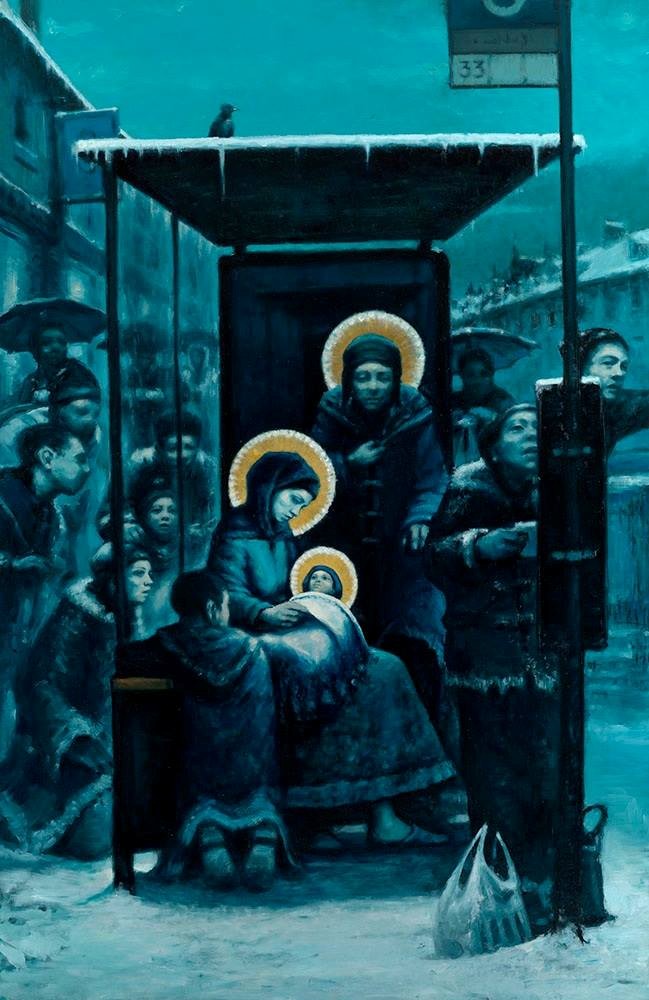
________________________________________________________________________________________________________________The above image of the Bus Stop Nativity is produced by Andrew Gadd, who is kindly allowing it to be reproduced for free.

I’m a Christian, and I don’t give a toss what Tesco call their trees

Some people are getting very angry with Tesco for calling their Christmas trees “evergreen trees”. The usual claims of “they’re banning Christmas” are especially loud this year, backed not only by the usual culture warriors but by full-on violent far-right figures such as Tommy Robinson.

In a year that has seen the far-right advance further in the UK than at any time for decades, they’re making big claims about defending Christianity. They are backed by a handful of far-right clergy, mostly in tiny denominations, and unintentionally helped along by a greater number of clergy and churches who are dithering about how to respond.

As well as talking endlessly on social media about Christmas trees, the far-right are trying to drum up Christian support by getting angry about Christmas markets being called “festive markets” and local councils putting up “winter lights”.

Culture warriors and right-wing nationalists say that people are trying to “ban” Christmas. In reality, nobody is doing anything to stop them using Christmas Trees (derived from a German practice) or traditions of Santa Claus (based on a Turkish saint) to celebrate the birth of Jesus (a Middle Eastern refugee). With no sense of irony, they will do all this to show how British they are.

It is not the name changes, but the people who jump to criticise them, who are trivialising Christmas.

I celebrate the birth of Jesus because it is about things far more important, exciting and life-changing than what what a corporation call their plastic trees.

There will be hundreds of people sleeping rough in unbearably cold weather on Christmas night. There will be many, many more freezing indoors because they can’t afford the heating, while others remain on seemingly endless waiting lists for physical and mental health needs. And that’s just in the UK. Might Jesus not be more concerned about meeting these people’s needs than about whether celebratory trees bear his name?

If you go on Twitter (or “X”), it quickly becomes clear that the far-right’s love of Christmas trees is less about supporting Christians and more about attacking people of other faiths, particularly Muslims. They claim that Tesco and local councils are avoiding the word “Christmas” so as not to “offend” Muslims. I don’t know how many Muslims these people actually speak to, because in reality it would be quite hard to find many – or any – Muslims in the UK who are offended by Christians celebrating Christmas, let alone people who want to “ban” them from doing so.

It is easy to laugh at the far-right’s absurdity. Indeed, sometimes I do. But we are in danger of overlooking a serious threat. Far-right rhetoric has become mainstream in the last year in ways that some of us could not have imagined. With Reform UK leading in the opinion polls and a Labour government pandering to their rhetoric, this is not the time for churches to faff about.

Neutrality in the face of injustice is no part of the calling of a Christian. We must speak out firmly against the far-right’s claim to be defending “Christian” Britain. We must uphold the value and dignity of all human beings as central to what the New Testament, and Christian discipleship, are all about.

If churches don’t act clearly and strongly against the threat, the far-right will advance further. And they will advance in British churches.

There is a lot of talk about “listening” to the concerns of far-right protesters and so on. Of course Christians should listen to everyone. That does not mean we should be neutral about them. We need to listen and challenge. We should be open to challenge ourselves of course. That is no excuse for inaction.

Ironically, it is within Christian teaching that we find the very means to resist people while also listening to them and not hating them. Jesus taught the love of enemies. Paul and other New Testament writers also taught the love of enemies. The love of enemies is central to Christian ethics. It is odd how rarely we talk about it in most churches.

The love of enemies does not mean having no enemies.

Racists are our enemies. Fascists are our enemies. We are called to love them. We are called to see the image of God in them and recognise them as equal human beings. And we are called to stand against them, oppose and speak out against all that they stand for. Love is not neutrality. Love is not passivity. Love is a refusal to descend to the level of those who preach hatred.

Middle class Christians sometimes talk unhelpfully about far-right protesters’ “legitimate concerns”. They often mean concerns around housing, NHS funding and so on, which the far-right blame on migrants. Of course it is right to be concerned about such things. It is not remotely legitimate to blame migrants for them. We need not only to listen to the concerns but to challenge the narrative that the concerns are misused to justify.

I suspect that many far-right leaders know that migration is not the cause of these problems, even if their foot-soldiers have been fooled. Instead of legitimising the far-right’s arguments, we need to put forward a bold alternative vision that champions the rights of migrants and people born in Britain to decent housing and healthcare and public services. These problems are caused not by migration but by inequality and sinful economic structures.

As Christians, let us speak up for the Christ who championed the poor and marginalised, urged the rich to repent, resisted unjust systems and broke down barriers that divided people based on nationality or prejudice.

This is the Christ we need to proclaim loudly at Christmas. This call for love and justice is what Christmas should be about – not the names of commercial trees.

________________________________________________________________________________________________________________

My book, The Upside-Down Bible: What Jesus really said about money, sex and violence (Darton, Longman and Todd, 2015) can be bought in paperback or e-book, priced £9.99.

God is not Father Christmas

Last Sunday (29th December 2024) I preached at Sherbourne Community Church in Coventry. I was very pleased to be asked to do so. They made me very welcome. Below is the text of my sermon.

To be clear: this is the text I wrote beforehand but in practice I deviated from the wording at times and added in a couple of extra comments. But the substance is the same.

The sermon followed two Bible readings, and focused particularly on the first one:

Luke 2, 41-52

Colossians 3, 12-17

At Christmas time, I’m sure many of us tend to think about memories of childhood Christmasses. As a child in primary school, I assumed that large swathes of the Bible were taken up with accounts of the birth of Jesus. Christmas seemed such a dominant event. Later, when I learnt more of the structure of the Bible and became aware that there were four gospels, I still imagined that a sizeable portion of each gospel must be focused on the nativity.

So it was a surprise to me as a teenager to discover that two of the gospels – Mark and John – don’t even mention Jesus’ birth. The other two – Matthew and Luke – give only a small portion of their story to it.

Matthew tells us that Joseph, Mary and Jesus returned from being refugees in Egypt once they heard that Herod had died. Matthew’s gospel then leaps forward to Jesus’ adulthood and his baptism by John the Baptist. Luke almost leaps straight from Jesus’ infancy to his adulthood – but not quite! He gives just a few lines to the story that we heard earlier, about the 12-year-old Jesus disappearing from his parents during a trip to Jerusalem.

Other than the nativity narratives, this is the only story about Jesus’ childhood that has made it into the Bible. In the second and third centuries, a number of writings claimed to tell the stories of Jesus’ childhood, but most of these were written long after the gospels that we have in our Bibles. So this very short story is quite exceptional.

I think it’s quite a strange story. Sometimes, if we’re familiar with a story, we can get so used to it that we forget how strange it would sound to someone hearing it for the first time. I’m not a parent, but I have sometimes had responsibility for children as an uncle and a godfather. I think you’d all be a bit alarmed if I told you that I had lost my goddaughter on a trip to London and had searched for three days before finding her in Westminster Abbey, discussing theology with the Bishop of London.

As we listened to this passage earlier, we heard that Jesus’ parents had been travelling home from Jerusalem for a day before they realised he wasn’t with them. You might find this surprising. Indeed, you might look at it and say, “A day! How did they go a day before noticing he wasn’t there? What extraordinarily unobservant parents!”

If we react like that, it’s because we’re making assumptions based on our own culture. Today, a child is the responsibility of their parents. They need to know where they are. But Jesus’ culture was a culture of extended families. The care of children was much more widely shared than it is now. With members of an extended family travelling together – possibly with other families – it is very likely that Mary and Joseph simply assumed that Jesus was with other relatives as they all travelled together in large groups. It must have been a shock to them to realise he wasn’t with any of them.

We can only imagine their fears, worries and possible panic as they searched for days before finding Jesus in the Temple. It’s understandable if we find ourselves a bit annoyed with Jesus at this point: surely he was old enough to realise his parents would be worried?

I suspect that is not the question that concerned Luke. The gospel-writer is interested in showing us that Jesus prioritised God’s ways over human ways and could discuss important issues. A number of scholars suggest that Luke’s was following a practice common in the life-stories of Roman emperors and other powerful figures in Greco-Roman society. Caesar Augustus, who was Roman Emperor at the time of Jesus’ birth, is said to have delivered an intellectual speech at the age of 12. Perhaps Luke is telling us that this Jewish peasant, Jesus, who began his life in a smelly room full of animals could be a match for the ruler of the Roman Empire.

Indeed, many of the titles that the New Testament gives to Jesus – king, saviour, son of God – were also titles used for Roman emperors. The gospels challenge the empire’s whole notion of what it means to be a king, saviour or god.

I’m struck by Luke’s wording towards the end of the story. He says that afterwards Jesus went to Nazareth with his parents “and was obedient to them”. The word that stands out to me is “obedient”. Jesus doesn’t seem to have been very obedient when he left his parents to go and chat in the Temple. Perhaps Luke is keen to encourage us not to think of Jesus as disobedient and to emphasise that after this point he obeyed his parents.

But I can’t help thinking that if Jesus had behaved like a model obedient child, he would never have gone back to the Temple at all. Jesus was not the model of an obedient child. Despite this, some people have clearly put quite a lot of effort into using – or misusing – Christian teaching as a way of controlling children – and indeed adults. It seems to me that this tendency is especially strong at Christmas.

Take Cecil Frances Alexander, the writer of Once in Royal David’s City. She tells us in Verse 3 of the carol that Jesus was obedient to his mother. The lyrics then declare, “Christian children all must be/ Mild, obedient, good as he”. 

Well, if children are to follow Jesus’ example, should they leave their parents and wander off to debate theology? That’s probably not what Cecil Frances Alexander had in mind when she wrote the hymn. The other hymns that she wrote include All Things Bright and Beautiful, which originally contained the verse ‘The rich man in his castle/ The poor man at his gate/ God made them, high and lowly/ He ordered their estate.” Thankfully that verse is now generally missed out. But it’s clear that for Cecil Frances Alexander, God is a god a who has created and blessed the social order, a god of order, obedience, hierarchy and control.

Don’t worry! I’m not suggesting that God wants children to just randomly ignore their parents or disobey their parents. But I am worried when we give the impression that Christianity is all about following rules and doing what you’re told. As Christians, and particularly as Protestants, we celebrate a God who saves us by grace because God loves us, not through any goodness of our own. We are not saved through obedience. We are not saved through rules. We are not saved because of our actions or because we’re somehow better than others. Salvation comes through God’s grace – God’s unmerited favour, flowing out of God’s love for us. We cannot earn God’s love. We cannot earn God’s forgiveness. We seek to do good in gratitude for God’s love and because we want to follow his way – not because God’s love can be earned.

Earlier, we heard those words from Colossians: “Above all, clothe yourselves with love, which binds everything together in perfect harmony.” It is love, not obedience, that saves us.

What has this to do with Christmas? As a child, I found that stories and songs around Christmas time were dominated by two individuals. One was Jesus. The other was Father Christmas. Unfortunately, I think I had a tendency to confuse their characteristics with each other.

Sometimes, Father Christmas is a friendly, cuddly figure, part of a nice, entertaining story to tell children. But he can also be misused. I remember a few years ago sitting at a café in December and gradually becoming aware of the conversation at the next table. A woman was telling her grandson that if he didn’t finish his dinner then Father Christmas might not bring him any presents. How would Father Christmas know, asked the child? He’s outside watching you, said the grandmother; I can see him through the window. The child spun round, trying to catch a glimpse of Santa through the window behind him. “You can’t see him,” said his grandmother. “Only I can see him.”

Thankfully, I restrained myself form leaning over and saying, “Well, that’s convenient, isn’t it?”

Even Santa Claus can be turned from a nice story for children into a means of control.  The cheerful tune of Santa Claus Is Coming To Town might distract us from the lyrics, which are basically a series of threats: “You better watch out”, “You better not cry”. And so on.

As a child, I found that God and Santa Claus blurred with each other. Santa Claus is apparently watching us, ready to punish or reward us. We have to “watch out” because he can see us all the time. He’ll divide us up into “naughty and nice” and we don’t want to be on the wrong list.

And as a child, that is exactly what I thought God was like. And there are many, many people – adults as well as children – who seem to think that this is the sort of God in which Christians believe. But this is exactly the sort of God that I don’t  believe in now. And I want to suggest that the God revealed in the birth of Jesus is the opposite of that sort of God.

The message of Christmas is summed up in the word Immanuel, meaning God With Us. In the birth of Jesus, God has entered into human life in a new way. At Christmas, we see that God is not a big, bearded man in the sky looking down on us. God is a refugee baby lying in a feeding-trough. God has appeared among us, born not as an emperor or a military leader but as a persecuted child in an obscure corner of a brutal empire. God is not simply up there, compiling lists of our sins and categorising us as “naughty” or “nice”. God is down here. God is with us. He shares our lives, he shares our pains, he shares our joy. Whether we enjoy Christmas or struggle through it, whether we laugh or cry on Christmas Day or any other day, God is with us, laughing and crying with us.

At times, it can be hard to believe it. It can be hard to feel it. But God is more than a feeling. God is with us whatever we’re feeling.

A year ago, the Lutheran pastor Munther Isaac made global headlines with the Christmas sermon that he preached in his home church in Bethlehem. As he surveyed the reality of life in Palestine and Israel, he asked, “Where is Jesus today?” He answered, “Jesus is under the rubble in Gaza”.

Jesus is under the rubble in Gaza.

This is the God made vulnerable in the child Jesus who walked away from his parents to return to the Temple. This is the God who as the man Jesus lived so much by the power of love and justice that the Roman Empire considered him a threat and executed him with one of the most painful forms of murder that human cruelty has ever invented. This is the God whose subtle, transformative power cannot be defeated by all the powers of sin, injustice and empire, and who as Jesus Christ rose from the dead and continues to be with us. This is the God who offers to rule in our hearts if we commit ourselves to him and reject those same forces of sin, those same idols of injustice and empire today.

God is not Father Christmas. There is no naughty-and-nice list in the Kingdom of Heaven. Jesus’ salvation does not come through obeying rules or fitting into structures. Of course, some rules are worth following. Some structures are good structures. But Jesus made clear that rules were made for people, not people for rules. Obedience cannot save us.

Jesus can save us. To be clear, I am not suggesting that it doesn’t matter how we live or what we do! That is the last thing I am saying. Jesus’ own teachings point to a way of life, to a way for the world, that challenges so many of the values that dominate our broken, unjust and unequal society. But he is down here with us as we resist them – and he will forgive us when we fail. So let’s rejoice in God’s salvation. Let’s seek Christ’s help to follow his teachings. Let’s pray, as the Letter to the Colossians puts it, that the peace of Christ will rule in our hearts. But let us also ask for forgiveness when we turn away – and let us be prepared to forgive others, just as the Lord has forgiven us.

And as we prepare for 2025, let us be ready to support each other, trusting in the reality that whatever we face, whatever the world faces, God is with us.