Ant Middleton wants a leader with ‘Christian values’- but Christian values are the opposite of his far-right nationalism

I recently wrote an article for Premier Christianity in response to Ant Middleton’s claim that he wants to defend “Christian values” as a candidate for Mayor of London. They published it in on 18th August. Below is a slightly extended version of the article.

As followers of Jesus, we are taught to be “wise as serpents and innocent as doves” (Matthew 10:16).

I am alarmed therefore by how many Christians are cheering politicians who promise to protect “Christian values”. We should not be so naïve as to welcome such comments without asking what is meant by them.

Celebrity and ex-SAS soldier Ant Middleton recently posted on X: “Our Capital City of our Christian country needs to be run by a native Brit with generational Christian values, principles and morals coursing through their veins”.

But what does he mean by “generational Christian values”? Following Jesus is not hereditary. It is a personal choice, albeit with major implications for society. Middleton also argued that only people born in the UK, and whose parents and grandparents were born in the UK, should hold “top tier government positions”. He may have overlooked the fact that this would rule out several former prime ministers, including Winston Churchill.

To attack a political opponent on grounds of ethnicity is to undermine the Christian values that Middleton claims to defend

Middleton made the above remarks amid an announcement that he planned to stand in the 2028 London mayoral elections. He was initially tipped to be the Reform UK candidate, but recently announced that he would stand as an independent to defend “British culture”. In his post, Middleton took aim at current Mayor of London, Sadiq Khan. Whatever we might think about Khan’s policies, the birthplace of his parents should be irrelevant.

Breaking down the divide

I cannot see into Middleton’s heart or question the sincerity of his faith. Only God sees into his heart, just as only God sees into my heart or yours. I can, however, say that his comments seem utterly incompatible with Jesus’ teachings.

Jesus broke down hostility between Jews and Samaritans, and Jews and Gentiles. The New Testament is full of challenges to ethnic and social divisions so that “there is no Gentile or Jew, circumcised or uncircumcised, barbarian, Scythian, slave or free, but Christ is all, and is in all” (Colossians 3:11). To attack a political opponent on grounds of ethnicity is to undermine the Christian values that Middleton claims to want to defend.

We should note that many who use the rhetoric of “Christian values” also talk of defending “British values”. Many also tend to be strongly nationalistic and anti-migrant. In the 2015 UKIP manifesto, Nigel Farage MP, now leader of Reform UK, said Britain needed “a much more muscular defence of our Christian heritage and our Christian Constitution”.

Independent MP Rupert Lowe recently launched a new political movement, Restore Britain. On X, he said it’s aim was to “slash immigration, protect British culture, restore Christian principles, carpet-bomb the cancer of wokery”.

Yet both men consistently use demeaning language when speaking about migrants and refugees and rely on highly questionable statistics. Farage recently claimed that Afghan men in the UK are 22 times more likely to be convicted of rape than British-born men. He did not, and could not, cite the slightest shred of evidence for this claim, which was later disproved by critical journalists. Despite this, it was repeated without evidence by his supporters on social media.

I do not expect all Christians to agree on all aspects of migration policy – or any other issue. Christian values cannot, however, be squared with demonising particular people groups, dismissing the needs of refugees or showing less concern for people of one nationality than those of another.

Scripture is full of commands such as: “The foreigner residing among you must be treated as your native-born. Love them as yourself, for you were foreigners in Egypt. I am the Lord your God” (Leviticus 19:34).

A Christian Britain?

Nationalistic and anti-migrant parties mistake Christianity for Britishness – and for their very narrow notion of Britishness at that. If you visit parts of social media inhabited by these groups, you will find simplistic equations between being British, being white and being Christian. The reality that a large percentage of British Christians are not white seems to pass them by.

The central role of Christianity in British history is difficult to overstate. While Jesus’ teachings have at times inspired people with power in Britain, they have on many more occasions inspired people to resist the powerful.

Following Jesus is not hereditary. It is a personal choice

Jesus’ teachings inspired anti-slavery activists. In the 17th century, they inspired people to stand up for religious liberty against the monarchy, leading to the emergence of Baptists, Congregationalists, Quakers and other Christian movements we still recognise today.

Christian faith has been central to peace workers and war resisters in Britain and around the world, including people working for justice and reconciliation in Northern Ireland.

The nationalistic and authoritarian attitudes of Middleton, Farage and Lowe have little in common with these people’s values. They are more comparable to the values of the rulers and powerful bodies who many of them campaigned against.

Christian values continue to inspire British people to take action. “I believe Jesus actually meant what he said and he modelled nonviolent resistance to oppressive power,” said Baptist Pastor Sally Mann, who was arrested in London on 9th August. Sally had peacefully declared support for Palestine Action, a group banned under the Terrorism Act despite destroying weapons rather than using them.

On the same day, Rev Robin Hanford, a Unitarian Chrisitan minister, was assaulted by far-right demonstrators in Nuneaton for supporting refugees. They tried to pull off his clerical collar and accused him of being a “traitor to his religion”. But it is Robin’s views and not theirs that are consistent with Jesus’ approach to nationality.

“Not everyone who says to me ‘Lord, Lord’ will enter the kingdom of heaven,” said Jesus (Matthew 7:21). The nationalistic politicians and candidates who want to preserve Britian’s “Christian values” seem less keen to pay attention to Jesus’ words.

I pray that God will give us courage to follow Jesus’ example of standing with the marginalised and pulling down barriers, rather than falling for the claims of those who misuse Christian language to attack people different to themselves.

The Peace of Christ or the Peace of Rome?

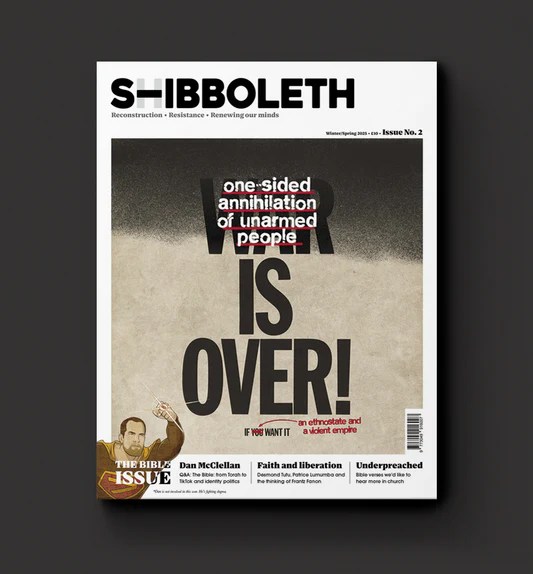
I was honoured to be asked to write about active nonviolence for Shibboleth, an excellent new Christian magazine that I heartily recommend (not just my own article!). This is my article, which appeared in Issue 2.

Jesus was executed by one of the most violent empires in history.

It is staggering just how rarely this is mentioned in churches. For centuries, we have been told that Jesus was killed by “the Jews”. Antisemitism has combined with attempts to depoliticise Jesus’ message by shifting the blame away from imperial authorities.

We cannot, however, get away from the fact that Jesus was condemned to death by Pontius Pilate, Roman governor of Judea. The gospels present the Jewish leaders as complicit in Jesus’ death, but these were the Jewish leaders who collaborated with Roman rule and owed their position to not upsetting the Romans. They were not representative of Jews generally.

Supporters of Roman rule championed the “Pax Romana” or Peace of Rome. For them, “peace” was a euphemism for order, control or an absence of conflict. There is no conflict when all resistance is crushed. The Romans claimed to bring “peace and security” to conquered lands. “When they say ‘peace and security’, then sudden destruction will come upon them,” wrote Paul in one of his earliest letters (1 Thessalonians 5,3).

Jesus proclaimed a very different sort of peace. I suggest that to understand Jesus’ teachings, we need to recognise that he was speaking to people for whom violence was a daily reality. They included civilians abused by Roman soldiers, slaves beaten by their “owners”, women mistreated by men.

Yet many Christian discussions of the ethics of violence start from the wrong place. They focus on war between nation-states and the decisions of governments.

Of course, national wars appear in the Hebrew Bible (Old Testament), which contains varied attitudes to violence. Those passages that justify massacres do not in any sense point to the God revealed in Jesus Christ. Many other parts of the Hebrew Bible include prophetic condemnations of violence and oppression. At certain points, Israelite forces are reminded to rely only on God’s strength – Gideon is told to reduce the size of his army so his victory is attributed not to military power but to God’s power (Judges 7,2).

Wars between nation-states today generally involve people being ordered to fight by their governments, based on the bizarre premise that we all have more in common with our rulers than with people like us who happen to have been born on the other side of a line on a map.

But the Christ who breaks down barriers exposes the reality of violence. And it is with Jesus’ teachings that a Christian ethic must surely begin.

When Jesus’ spoke about turning the other cheek, he was speaking to people who were used to being hit.

“If anyone strikes you on the right cheek…” says Jesus (Matthew 5,39). To be hit on the right cheek (with the right hand) implies a backhanded slap. This was the way in which people disciplined supposed inferiors. Masters backhanded slaves, men backhanded their wives, employers backhanded workers.

The submissive response to being hit is not to turn the other cheek but to cower, cringe or step backwards. These are all very understandable reactions. To respond with violence is also understandable, though probably futile when the aggressor has far more power. But calmly turning the other cheek is a gesture of nonviolent defiance, potentially confusing the aggressor and tipping the balance of power, at least for a moment.

Of course it does not work in every situation. The same can be said of Jesus’ teaching to go “another mile” – which would cause trouble for Roman soldiers who were permitted to require civilians to carry their packs for only one mile (Matthew 5,41). These methods of nonviolent defiance are suggestions. Different contexts need different suggestions, with similar principles.

Jesus’ protest in the Temple is sometimes presented as inconsistent with turning the other cheek. I suggest instead that Jesus’ teachings and actions are entirely consistent. The Temple protest was disruptive but not violent (violence involves hurting people, not damaging tables). It involved the same principles of nonviolent resistance that Jesus championed in the Sermon on the Mount.

Active nonviolence is not about judging those who are driven to resist violence with violence. I cannot condemn someone who picks up a gun in a horrendous situation that I have never faced and cannot imagine. This is different to encouraging such things.

Active nonviolence is about seeking to live by a different power. This is the power of the Kingdom of God that Jesus proclaimed, which turns notions of kingship on their head. The Kingdom is both now and not yet, a future reality that is glimpsed in the here and now in every moment that testifies to the love of God, from small moments of kindness to global campaigns against injustice.

Given its centrality in the New Testament, it is very surprising that we don’t talk more in churches about loving our enemies. Loving enemies does not mean having no enemies (how can you love your enemies if you haven’t got any?!). Nor is it a concept that can just be explained away, as with Augustine of Hippo’s tortuous argument that it is possible to love someone while killing them. Arms dealers and militarist politicians are my enemies, but I cannot kill or demonise them, nor fail to recognise my own sin and complicity in violence, if I love them in the upside-down power of the Kingdom of God.

The New Testament makes clear that living by this power – or trying to – is not about avoiding conflict. As Martin Luther King pointed out, a commitment to peace involves conflict with those who wage war. When Jesus said that he had “not come to bring peace but a sword”, he spoke about divisions within families and communities, so in that context he meant “peace” in the narrow sense of an absence of conflict (Matthew 10,34-36). The gospel involves conflict with forces of violence and injustice.

The New Testament does not teach us either to kill our enemies or to pretend that we have no enemies. Serving the Kingdom of God involves engaging in conflict with love – something that it is not possible in our own strength, but only by the subversive, transformative power of God that we see in the life, death and resurrection of Jesus. This is a power that forces of violence and domination will not tolerate. That is why, as the Quaker peace campaigner Helen Steven used to put it, following Jesus “leads straight into trouble”.

The Christ who saves us calls us to live differently

Last month (on 6th April 2025) I preached at Sherbourne Community Church in Coventry. I was very pleased to be asked to do so. Below is the text of my sermon (I am sorry not to have posted it sooner; I was delayed by health problems and other issues).

To be clear: this is the text I wrote beforehand but in practice I deviated from the wording at times and added in a couple of extra comments. But the substance is much the same.

The sermon followed two Bible readings:

John 12, 1-8

Philippians 3, 3-14

Some parts of the gospels are really weird. Some of us have got so used to reading the gospels that we can forget how odd parts of them would sound if we hadn’t read them before. And we have a great example with the passage from John 12 that we heard earlier.

Here we have Mary pouring a load of expensive perfume over Jesus’ feet. This story appears in various forms in other gospels too, although there are significant variations – about who the woman is who does this, and about how she does it. But the idea of a woman physically pouring oil on Jesus seems to have been widely recognised in one form or another.

And what a strange thing it is to do. And in John’s version of the story, Judas pops up says that it would be better to have sold the ointment and given the money to the poor. And if you’re like me, you might find yourself thinking, Didn’t Judas have a point?

Okay, John tells us that Judas had an ulterior motive, that he really wanted to embezzle the money. But if he had been going to give it to the poor, would that not have been a better use for this ointment than chucking it all over Jesus? If we believe Judas – and we might not, of course – then the ointment could have been sold for 300 denarii. That would have been the best part of a year’s wages for someone on a low income in that society.  Are there not better things that could have been done with it?

Jesus responds to Judas’ comment by reminding his disciples that they can continue to support the poor. Compassion for the poor out is not simply a one-off act for unusual moments like this. “You always have the poor with you,” he says.

Outrageously, there are still Christians who misuse this line to argue that Christians should not try to end poverty. This is ridiculous. Jesus was reminding his disciples of the situation they were in and would continue to be in for the foreseeable future. He was not opposing attempts to end poverty. Poverty is not something created by God. It is created by humans. Indeed, nowadays we know the world has enough to feed all the people in it, if we organised things differently. We – humans – created poverty and we – humans – can end it.

Jesus’ comment – like all his comments – was made in a specific context. Jesus thanks Mary for her faith in him. And the writer of the gospel uses it to make a point about Jesus: the ointment is to anoint him for his burial. Because Jesus would soon die, executed in unimaginable pain by the forces of the Roman Empire.

For much of John’s Gospel, Jesus seems to be very focused on his upcoming death. I find it hard to imagine how this would have affected his day-to-day thoughts. And here we have a connection with the second reading – the reading from Philippians that we heard.

Paul wrote the Letter to the Philippians while he was in prison, while he awaited to find out whether he would be executed. I find that Paul’s letters tend to make a lot more sense when we realise that he wrote them to particular people at particular times. He didn’t know that people would be reading them 2,000 years later!

Paul’s mental anguish seems clear in his letter to the Philippian Christians. He wrestles with thoughts about whether he will live or die, about his desire to be with Jesus clashing with his hope of living longer and continuing to serve Christ’s people on Earth. At times he seems to fear for the communities he has founded that he may be leaving behind. Here, perhaps, we encounter Paul at his most vulnerable. Philippians contrasts with the finely crafted theological nuance of Paul’s letter to the Romans, with the passionate anger of his letter to the Galatians, with his frustrated attempts to resolve conflicts in his letters to the Corinthians. In Philippians, Paul seems very aware that he might be at the end of his life.

This sheds light on the words that we heard earlier. We hear Paul listing things he could boast about, particularly when it comes to religion. He has always been an observant and religious Jew, he says. He was blameless under the law. He persecuted Christians. All the things his critics boast about, he could boast about too!

But then he tells us that none of this matters. “Whatever gains I had, these I have come to regard as loss because of Christ,” he tells us.

Paul’s religious observances would not save him. His zeal and law-keeping would not save him. His persecution of people with different beliefs would not save him. He can be saved only through the grace of God, by the love of God that Jesus reveals.  

But 2,000 years later, we can still make the mistake of relying on religious observances. Of course, it is good to go to church, to pray, to come together as Christ’s people to worship and talk and share Communion. It can be helpful to observe Lent and be disciplined in prayer. These are good and helpful things to do. We can honour God through them. But they will not save us. We do not have eternal life and salvation because of these things. We do not have them because of any our actions but because of God’s action through Jesus.

As Paul puts it the Philippian Christians, he does not have a righteousness of his own but only the righteousness that comes from God.

Some years ago, I helped a friend sell off his possessions at a car boot sale. We had a successful morning and as we were packing up, we found that one of the few items that we had left was a kite. We were approached by a couple with a small child, who was very upset. He had hoped to buy a kite he had seen on a nearby stall, but when he went back to it, the kite had been sold. Now he noticed that we had a kite. But he didn’t have the money to pay for it. Perhaps we were feeling generous because our sales had gone well, but we gave the child the kite. His tears turned to smiles, and his parents were very grateful.

“We’ve made a small child very happy,” I said to my friend afterwards. He replied, “Yes. If there’s a God, chalk that up!”.

Now my friend is an atheist, though perhaps he was having a moment of doubt. But he gave the kite to the child because he thought it was a good and compassionate thing to do, to make someone happy, not because he was trying to get into heaven. If I had given the kite to the child out of a desire for heaven, would that not make me more selfish than my atheist friend? I hope and think that God approved of our gift to the child, but I did not do it in an attempt to earn points with God or to buy my way to salvation.

In theory, as Christians, and particularly as Protestant Christians, we believe that salvation comes through the grace of God in Jesus, not through what we do. But do we really dare to believe this? That God’s love is so big, so wide, so mind-bendingly transformative, that God’s grace in Jesus can save us from our sins and bring us eternal life?

This is so hard to believe! A lot of people, including a lot of Christians, talk as if eternal life will come to us because of our actions. Some Christians talk as if they think they will be saved by believing exactly the right things about Jesus, about the Bible, about theology. But that’s just another way of trusting in our actions rather than in God. We are saved by Christ, not by Christianity. Some people seem to think that LGBT+ people are excluded from God’s salvation, as if we are saved by heterosexuality.

If I thought any of these things to be true, I would be very worried about my own chances of being saved. I am bisexual. Some of my beliefs might, for all I know, be completely mistaken. And if I am to be judged on my actions, I honestly am far from sure that my good deeds would outweigh my bad ones. But Paul reminds us repeatedly that there is no salvation in such things but only in turning to God’s love and forgiveness.

If we believe in salvation by God’s grace then does that mean that how we live doesn’t matter? Does this mean we can carry on day-to-day, conforming to the world around us and simply waiting for God’s salvation when we die?

No, I don’t think it does. Because putting our trust in Jesus means that we have a different starting point, a different focus, from the dominant values of this world. And that means that we will live differently, or at least that we will seek to live differently, while being prepared to turn to God and ask for forgiveness even if we repeatedly fail.

This takes us back to the text of Paul’s Letter to the Philippians. I hope you’ll bear with me if I tell you a personal story.

Twelve years ago, I was at a protest outside the London arms fair. The DSEI arms fair, which takes place every two years in east London, involves arms companies doing deals with representatives of governments from around the world, including some of the world’s most vicious and aggressive regimes. In 2013, I joined with other Christians in blocking an entrance to the arms fair by kneeling in prayer. When we refused to move, we were arrested and, at the police station I was the first of the group to be processed. As I was checked in, I asked if I could have a Bible to read in my cell. A policeman reached to a shelf behind the desk and gave me the Bible that they kept there.

I was in the cell by the time my friend Chris was processed. He also asked for a Bible. “You want a Bible too!” said a surprised police officer. “The last bloke asked for a Bible.” They managed to find another Bible for Chris, but by the time the third person was processed, the station was running out of Bibles. When the third person, James, was processed, they told him they would try to find a Bible, but he was already in the cell by the time they did so. One of the officers went to James’ cell and told him that he’d only managed to find a New Testament. “That’s okay,” said James. “I hope you’re not going to keep me here long enough to read both testaments”.

As I sat in my cell with my Bible. I decided to read Philippians. This was because I knew that Paul had written it in prison. Perhaps this was a bit arrogant on my part. It would be ridiculous to compare my own situation to Paul’s. He was in prison indefinitely awaiting a likely death sentence. I had just been locked up for a few hours. Nonetheless, the calming and encouraging words that Paul wrote in prison had a positive effect on me.

But they might not have done. Reading Paul’s words about how we are saved by Jesus alone, I could have concluded that the actions I had taken at the arms fair were not worthwhile. Resisting the arms trade couldn’t earn me points with God, couldn’t get me into heaven. Shouldn’t I just sit quietly at home, live the same as everyone around me, and wait for eternal life to come because of my faith in Jesus?

No, I couldn’t. Of course, not all of us are called to do things that lead us to be arrested. Following Jesus and his call on our lives takes many different forms for many different people. Some who respond most faithfully to Jesus live quiet lives of compassion that can easily go unnoticed – but they are not unnoticed by God.

As Paul writes in Philippians, “I want to know Christ and the power of his resurrection”. I pray that God will give me more ability to trust in Jesus, to really trust in him, which at times I find so hard. To trust Jesus rather than in my own efforts or in the dominant attitudes of the world.

It seems to me that the more we trust in Jesus, the more we have to live differently. The more we trust in Jesus, the less trust we will place in the idols that dominate this world – the idols of money and markets and military might – systems that humans have created but which we find ourselves bowing down and serving. If we trust in the Kingdom of God that Jesus proclaims then we cannot trust in the powers of this world. Psalm 146 reminds us, “Put not your trust in the powerful, mere mortals in whom there is no help”.  

Following Jesus is not about a list of rules. It is about a different starting-point, rooted in the love that Jesus reveals. This leads us back to that passage from John’s Gospel. Should Mary have sold the ointment and given the money to the poor? Perhaps that would have been just as good an option – or even a better option – than pouring it over Jesus. But in that moment, she acted on her faith in Jesus by anointing him in preparation for his death. And Jesus thanks her, Jesus praises her, for the actions that come from her faith.

We are called to live with our focus on God, not to be saved but in response to being saved by Jesus. We are not saved by our actions, our religious observances or our correct opinions, but only by the love of God that we encounter in Jesus. That love enables us, as Paul writes in Romans 12, to refuse to conform to the world around us and instead to allow ourselves to be transformed by God’s love. This is the love revealed in Jesus, a love that can transform us, a love that can transform the world.

God is not Father Christmas

Last Sunday (29th December 2024) I preached at Sherbourne Community Church in Coventry. I was very pleased to be asked to do so. They made me very welcome. Below is the text of my sermon.

To be clear: this is the text I wrote beforehand but in practice I deviated from the wording at times and added in a couple of extra comments. But the substance is the same.

The sermon followed two Bible readings, and focused particularly on the first one:

Luke 2, 41-52

Colossians 3, 12-17

At Christmas time, I’m sure many of us tend to think about memories of childhood Christmasses. As a child in primary school, I assumed that large swathes of the Bible were taken up with accounts of the birth of Jesus. Christmas seemed such a dominant event. Later, when I learnt more of the structure of the Bible and became aware that there were four gospels, I still imagined that a sizeable portion of each gospel must be focused on the nativity.

So it was a surprise to me as a teenager to discover that two of the gospels – Mark and John – don’t even mention Jesus’ birth. The other two – Matthew and Luke – give only a small portion of their story to it.

Matthew tells us that Joseph, Mary and Jesus returned from being refugees in Egypt once they heard that Herod had died. Matthew’s gospel then leaps forward to Jesus’ adulthood and his baptism by John the Baptist. Luke almost leaps straight from Jesus’ infancy to his adulthood – but not quite! He gives just a few lines to the story that we heard earlier, about the 12-year-old Jesus disappearing from his parents during a trip to Jerusalem.

Other than the nativity narratives, this is the only story about Jesus’ childhood that has made it into the Bible. In the second and third centuries, a number of writings claimed to tell the stories of Jesus’ childhood, but most of these were written long after the gospels that we have in our Bibles. So this very short story is quite exceptional.

I think it’s quite a strange story. Sometimes, if we’re familiar with a story, we can get so used to it that we forget how strange it would sound to someone hearing it for the first time. I’m not a parent, but I have sometimes had responsibility for children as an uncle and a godfather. I think you’d all be a bit alarmed if I told you that I had lost my goddaughter on a trip to London and had searched for three days before finding her in Westminster Abbey, discussing theology with the Bishop of London.

As we listened to this passage earlier, we heard that Jesus’ parents had been travelling home from Jerusalem for a day before they realised he wasn’t with them. You might find this surprising. Indeed, you might look at it and say, “A day! How did they go a day before noticing he wasn’t there? What extraordinarily unobservant parents!”

If we react like that, it’s because we’re making assumptions based on our own culture. Today, a child is the responsibility of their parents. They need to know where they are. But Jesus’ culture was a culture of extended families. The care of children was much more widely shared than it is now. With members of an extended family travelling together – possibly with other families – it is very likely that Mary and Joseph simply assumed that Jesus was with other relatives as they all travelled together in large groups. It must have been a shock to them to realise he wasn’t with any of them.

We can only imagine their fears, worries and possible panic as they searched for days before finding Jesus in the Temple. It’s understandable if we find ourselves a bit annoyed with Jesus at this point: surely he was old enough to realise his parents would be worried?

I suspect that is not the question that concerned Luke. The gospel-writer is interested in showing us that Jesus prioritised God’s ways over human ways and could discuss important issues. A number of scholars suggest that Luke’s was following a practice common in the life-stories of Roman emperors and other powerful figures in Greco-Roman society. Caesar Augustus, who was Roman Emperor at the time of Jesus’ birth, is said to have delivered an intellectual speech at the age of 12. Perhaps Luke is telling us that this Jewish peasant, Jesus, who began his life in a smelly room full of animals could be a match for the ruler of the Roman Empire.

Indeed, many of the titles that the New Testament gives to Jesus – king, saviour, son of God – were also titles used for Roman emperors. The gospels challenge the empire’s whole notion of what it means to be a king, saviour or god.

I’m struck by Luke’s wording towards the end of the story. He says that afterwards Jesus went to Nazareth with his parents “and was obedient to them”. The word that stands out to me is “obedient”. Jesus doesn’t seem to have been very obedient when he left his parents to go and chat in the Temple. Perhaps Luke is keen to encourage us not to think of Jesus as disobedient and to emphasise that after this point he obeyed his parents.

But I can’t help thinking that if Jesus had behaved like a model obedient child, he would never have gone back to the Temple at all. Jesus was not the model of an obedient child. Despite this, some people have clearly put quite a lot of effort into using – or misusing – Christian teaching as a way of controlling children – and indeed adults. It seems to me that this tendency is especially strong at Christmas.

Take Cecil Frances Alexander, the writer of Once in Royal David’s City. She tells us in Verse 3 of the carol that Jesus was obedient to his mother. The lyrics then declare, “Christian children all must be/ Mild, obedient, good as he”. 

Well, if children are to follow Jesus’ example, should they leave their parents and wander off to debate theology? That’s probably not what Cecil Frances Alexander had in mind when she wrote the hymn. The other hymns that she wrote include All Things Bright and Beautiful, which originally contained the verse ‘The rich man in his castle/ The poor man at his gate/ God made them, high and lowly/ He ordered their estate.” Thankfully that verse is now generally missed out. But it’s clear that for Cecil Frances Alexander, God is a god a who has created and blessed the social order, a god of order, obedience, hierarchy and control.

Don’t worry! I’m not suggesting that God wants children to just randomly ignore their parents or disobey their parents. But I am worried when we give the impression that Christianity is all about following rules and doing what you’re told. As Christians, and particularly as Protestants, we celebrate a God who saves us by grace because God loves us, not through any goodness of our own. We are not saved through obedience. We are not saved through rules. We are not saved because of our actions or because we’re somehow better than others. Salvation comes through God’s grace – God’s unmerited favour, flowing out of God’s love for us. We cannot earn God’s love. We cannot earn God’s forgiveness. We seek to do good in gratitude for God’s love and because we want to follow his way – not because God’s love can be earned.

Earlier, we heard those words from Colossians: “Above all, clothe yourselves with love, which binds everything together in perfect harmony.” It is love, not obedience, that saves us.

What has this to do with Christmas? As a child, I found that stories and songs around Christmas time were dominated by two individuals. One was Jesus. The other was Father Christmas. Unfortunately, I think I had a tendency to confuse their characteristics with each other.

Sometimes, Father Christmas is a friendly, cuddly figure, part of a nice, entertaining story to tell children. But he can also be misused. I remember a few years ago sitting at a café in December and gradually becoming aware of the conversation at the next table. A woman was telling her grandson that if he didn’t finish his dinner then Father Christmas might not bring him any presents. How would Father Christmas know, asked the child? He’s outside watching you, said the grandmother; I can see him through the window. The child spun round, trying to catch a glimpse of Santa through the window behind him. “You can’t see him,” said his grandmother. “Only I can see him.”

Thankfully, I restrained myself form leaning over and saying, “Well, that’s convenient, isn’t it?”

Even Santa Claus can be turned from a nice story for children into a means of control.  The cheerful tune of Santa Claus Is Coming To Town might distract us from the lyrics, which are basically a series of threats: “You better watch out”, “You better not cry”. And so on.

As a child, I found that God and Santa Claus blurred with each other. Santa Claus is apparently watching us, ready to punish or reward us. We have to “watch out” because he can see us all the time. He’ll divide us up into “naughty and nice” and we don’t want to be on the wrong list.

And as a child, that is exactly what I thought God was like. And there are many, many people – adults as well as children – who seem to think that this is the sort of God in which Christians believe. But this is exactly the sort of God that I don’t  believe in now. And I want to suggest that the God revealed in the birth of Jesus is the opposite of that sort of God.

The message of Christmas is summed up in the word Immanuel, meaning God With Us. In the birth of Jesus, God has entered into human life in a new way. At Christmas, we see that God is not a big, bearded man in the sky looking down on us. God is a refugee baby lying in a feeding-trough. God has appeared among us, born not as an emperor or a military leader but as a persecuted child in an obscure corner of a brutal empire. God is not simply up there, compiling lists of our sins and categorising us as “naughty” or “nice”. God is down here. God is with us. He shares our lives, he shares our pains, he shares our joy. Whether we enjoy Christmas or struggle through it, whether we laugh or cry on Christmas Day or any other day, God is with us, laughing and crying with us.

At times, it can be hard to believe it. It can be hard to feel it. But God is more than a feeling. God is with us whatever we’re feeling.

A year ago, the Lutheran pastor Munther Isaac made global headlines with the Christmas sermon that he preached in his home church in Bethlehem. As he surveyed the reality of life in Palestine and Israel, he asked, “Where is Jesus today?” He answered, “Jesus is under the rubble in Gaza”.

Jesus is under the rubble in Gaza.

This is the God made vulnerable in the child Jesus who walked away from his parents to return to the Temple. This is the God who as the man Jesus lived so much by the power of love and justice that the Roman Empire considered him a threat and executed him with one of the most painful forms of murder that human cruelty has ever invented. This is the God whose subtle, transformative power cannot be defeated by all the powers of sin, injustice and empire, and who as Jesus Christ rose from the dead and continues to be with us. This is the God who offers to rule in our hearts if we commit ourselves to him and reject those same forces of sin, those same idols of injustice and empire today.

God is not Father Christmas. There is no naughty-and-nice list in the Kingdom of Heaven. Jesus’ salvation does not come through obeying rules or fitting into structures. Of course, some rules are worth following. Some structures are good structures. But Jesus made clear that rules were made for people, not people for rules. Obedience cannot save us.

Jesus can save us. To be clear, I am not suggesting that it doesn’t matter how we live or what we do! That is the last thing I am saying. Jesus’ own teachings point to a way of life, to a way for the world, that challenges so many of the values that dominate our broken, unjust and unequal society. But he is down here with us as we resist them – and he will forgive us when we fail. So let’s rejoice in God’s salvation. Let’s seek Christ’s help to follow his teachings. Let’s pray, as the Letter to the Colossians puts it, that the peace of Christ will rule in our hearts. But let us also ask for forgiveness when we turn away – and let us be prepared to forgive others, just as the Lord has forgiven us.

And as we prepare for 2025, let us be ready to support each other, trusting in the reality that whatever we face, whatever the world faces, God is with us.

“The Jews” did not kill Jesus

Jesus was executed by the authorities of the Roman Empire.

This is one of the few features of Jesus’ life on which nearly all historians agree. There are many historians and biblical scholars who spend a lot of time arguing about which of the sayings and actions attributed to Jesus are likely to be historically accurate, about which of the incidents recorded in the gospels took place as historical events.

Scholars are on a spectrum from those who take the gospels as broadly accurate accounts of Jesus’ life to those who doubt all but a few details .

Virtually all of them, however, accept that Jesus was crucified. Crucifixion was a Roman method of execution (not a Jewish one) used against political troublemakers and rebellious slaves. It is almost inconcievable that Jesus’ followers, living in a tyrannical and violent regime, would have invented a story that would immediately label them as followers of someone that regime had executed as a threat.

For much of Christian history, however, Christians have put the blame on Jews – often on “the Jews” as a whole, as if every one of them bore responsibility for the killing of Jesus. This is particularly absurd given that Jesus was a Jew.

This claim has not only served as a justificiation for persecuting Jews. It has also helped to sidestep the intensely political nature of the death of Jesus. He was executed by an imperial power who objected to him promoting the Kingdom of God rather than the Empire of Rome (when you read the words “kingdom” and “empire” in an English Bible, they are translating the same Greek word, basileia).

The gospels, to varying degrees, show the Jewish leaders of the time colluding with the Roman authorities to execute Jesus. Matthew’s Gospel and John’s Gospel seem particularly keen to hold them responsible. There are various possible reasons for this, much debated by historians. All the gospels make clear, however, that in the end Jesus was executed on the orders of the Roman governor Pontius Pilate.

If the Jewish leaders encouraged Pilate to execute Jesus, this would not make all Jews responsible. But even here we need to be careful. Who were these Jewish leaders? They were the Roman-approved leaders: in practice, Rome would only allow a Jewish High Priest who did not resist Roman rule. It is unsurprising that when Jews rebelled against Roman rule in 70 CE (about 40 years after Jesus’ crucifixion), the Jewish rebels killed the High Priest and his colleagues. They were collaborators with the empire. They were not representative of the Jewish people.

I have been shocked in the run-up to Easter this year to see how persistent is the belief that “the Jews” killed Jesus. Perhaps I have become too used to academic New Testament scholarship (where Roman responsibliity is accepted) or to left-wing Christian groups (where the political nature of Jesus’ execution is emphasised).

I recently heard a street preacher in Birmingham declare that Jesus had been killed by “his own people, that’s the Jews”. I was shocked to see a reflection in the Church Times last week by Charles Moseley, in which he repeated the tired old claim that Pilate did not want to execute Jesus but gave into Jewish public opinion. Moseley did not not try to argue this point, or acknowledge that it has now been discredited. He simply asserted it as he might have done if writing 30 years ago.

Sadly, it seems that antisemitism is alive and well in many Christian circles at Easter. Ironically, those of us who campaign against the horrendous assaults of Israeli forces against people in Gaza are accused of antisemitism by political right-wingers and apologists for aggression. Yet Jesus was born in an empire, in a place where imperial soldiers controlled the population and religious leaders colluded with oppression. It is not dissimilar to the situation faced by many Palestinians today. This point is made repeatedly by Palestinian Christians, even when western Christians do not seem to have ears to hear it.

It is not resistance to empire and war that is antisemitic – to make such a claim is to conflate Jews in general with the current Israeli government and its forces. It is attempts to ignore the inherently political nature of Jesus’ death that lead to the blame being put on “the Jews”. Throughout Christian history – and still today – antisemitism has served the interests of those who want us to forget that Jesus challenged the political and social order. Following Jesus means continuing to challenge injustice and empire today.

The first Palm Sunday was a riot

At LGBT+ events that have turned into commercialised parties, it is not uncommon to see critical placards declaring that “Stonewall was a riot”, or “Pride is a protest”. I was delighted to see that the Queer Theology podcast in the USA now sells T-shirts that declare “The first Palm Sunday was a riot”.

Palm Sunday – which is today – celebrates Jesus riding into Jerusalem on a donkey at the head of what was clearly a controversial protest. The occupying Roman authorities and their collaborators were surely threatened by crowds cheering the “Son of David” – a title associated with people claiming to be kings of Israel. Passover was approaching, a time when the authorities grew nervous of rebellion and Roman troops stood armed by the Temple, ready to react.

This reality is too much for many churches today, who have turned the event into a fluffy story about donkeys, palm leaves and the importance of Jesus.

But that importance, I suggest, can be really understood only its social and historical context. In marching through a city in a parody of an imperial procession, Jesus’ followers were claiming that it was Jesus, not the Roman Emperor, who was their real king.

This is significant: if we seek to serve the Kingdom of God, we will not be serving the kingdoms and powers of this world. Sadly, it’s a message that many churches are keen to avoid.

Admittedly, it requires a broad use of the term “riot” to ascribe that word to Palm Sunday – because this was a nonviolent protest, but no less disruptive and illegal for that.

Once we see that Jesus’ march into Jerusalem was a planned protest, certain confusing details in the gospels make a lot more sense. For years I was rather baffled by a part of the story, before the march begins, in which Jesus asks some of his disciples to go and fetch a colt that they would find tied to a door. If anyone asked them why they were taking the colt, they were to say, “The Lord needs it”. According to the gospels, when they said this, the people let them take the colt (Mark 11,1-6; also Matthew 21,1-3 and Luke 19, 29-34).

Why would they do such a thing? Surely the phrase wouldn’t make sense to people unless they were following Jesus. If that were the case, why not just talk more straightforwardly?

It all made a lot more sense when I realised that the collection of the colt was a pre-arranged event. The pyhrase “the Lord needs it” seems to have served as a sort of password, letting the people with the colt know that the people collecting the animal had indeed come from Jesus. An illegal protest cannnot be organised too openly.

Ched Myers, in his excellent book Binding the Strong Man, points to a number of similar instances in the text that probably arise from this sort of underground planning.

Later in the story, when Jesus is preparing for the Passover that will be his last meal before his arrest, he tells two of his disciples that they should follow “a man carrying a jar of water”. They are to follow him to a house, and they are to say a particular sentence to the people in the house, who will then show them to the right room (Mark 14,12-16).

But water-carrying was generally done by women. Myers suggests that a man carrying water would stand out, so that the disciples would know who to follow. Indeed, the idea of a man carrying water was sufficiently odd that Matthew, in his editing of Mark’s account, changed the description to “a certain man” (Matthew 26,18).

Historians and biblical scholars spend a lot of time and energy debating which of the stories in the New Testament are more or less likely to be historically accurate. The events of Palm Sunday (if not every detail of every story) tend to score highly. Early Christians were unlikely to have invented a story that made clear that Jesus was a threat to the vicious rulers of the Roman Empire under which they still lived.

Jesus led a dangerous and unlawful protest against the authorities – a reality that many churches have spent centuries trying to ignore.