You can tell when a march is big if you’re near the back of it. It you have to wait for hours before you even start moving, it’s a good sign that there are far more marchers than were expected.
The people at the front of yesterday’s Together Alliance march in central London reportedly reached the end of the route only shortly after those of us near the back had begun to march. Organisers estimated that half a million people had taken part.
There were people of many faiths and none, of many backgrounds, ages, nationalities, sexualities and genders; students, workers, unemployed people, young people and pensioners. There were trades unions, community organisations, faith groups and campaign networks.
We were united in rejecting the racism and hatred peddled by far-right groups such as Reform UK, Restore Britain and Unite the Kingdom. We were united for an inclusive, compassionate Britain in which resources are divided fairly and minorities are not scapegoated for the actions of billionaires and the consequences of unjust structures.
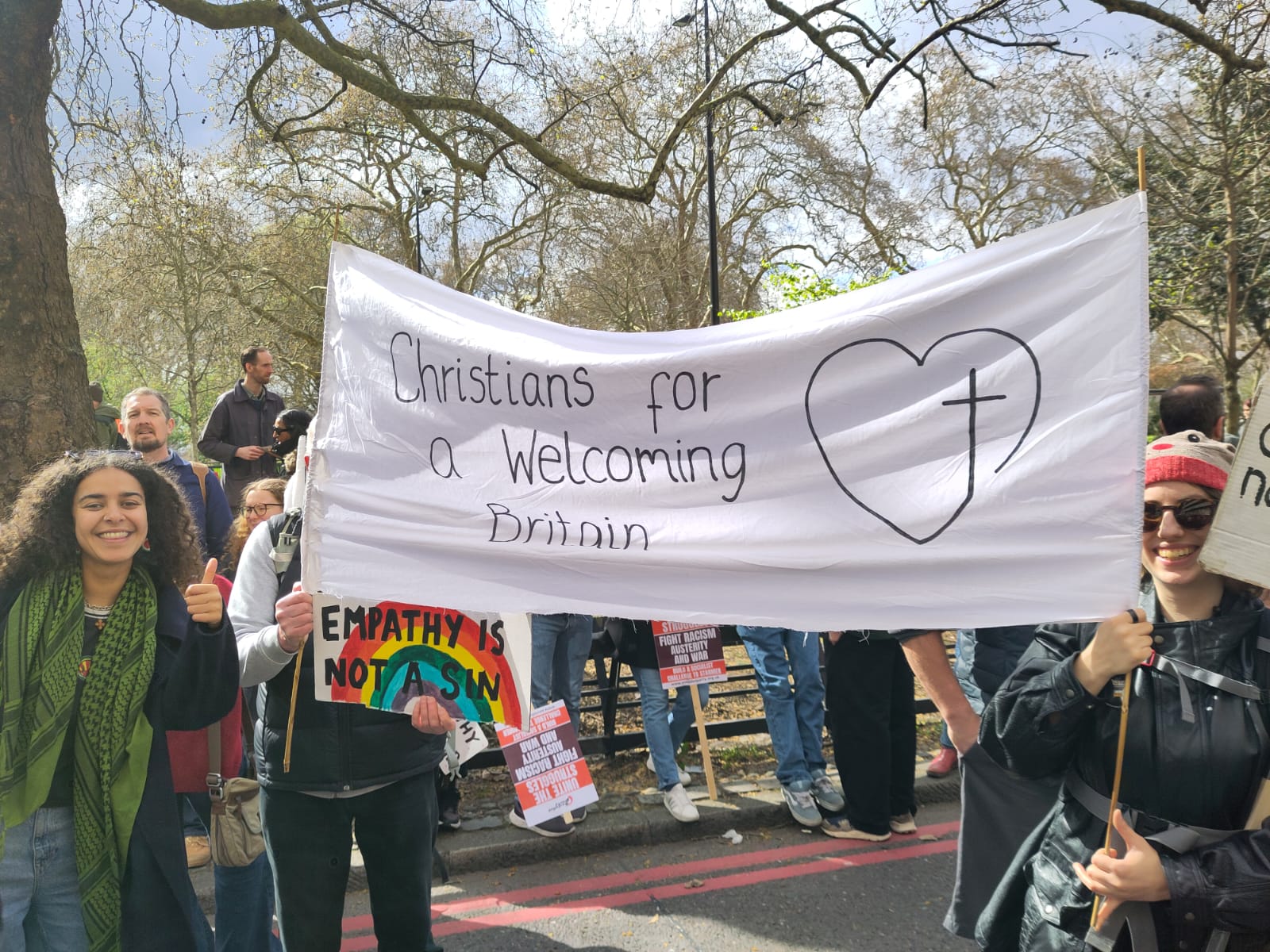
Amongst the many “blocs” (loosely organised sections) of the march was the Christian Bloc.
The point of the Christian Bloc was not to divide Christians from the other marches. That would undermine the unity that the march was championing! Rather, it was to the challenge the far-right’s attempts to co-opt Christianity. Christian nationalism has been increasingly visible in the UK in the last two years or so. Far-right figures claim to be defending “Christian Britain” as an excuse to demonise Muslims, Jews, LGBTQ+ people and others. We wanted to send a clear message that these people don’t speak for Christianity. There are many British Christians ready to stand in solidarity with our neighbours of other faiths and none.
When the idea of a Christian Bloc was first talked about, I thought we might get a few dozen people – perhaps over a hundred if things went well. A few days ago, organisers from groups including Better Story and Christians for a Welcoming Britain were suggesting there would be hundreds.
But I still hadn’t quite taken it in. When friends messaged me to say they would be in the Christian Bloc, I responded by saying “See you there!” – or similar words. Christian blocs at protests are usually small enough that if you know someone else who is going, you can be fairly sure that you will bump into each other. It hadn’t occurred to me that the Christian Bloc would be so big that I would simply not see many friends or acquaintances who were also there.
My first big surprise came when I arrived at Oasis Church Waterloo for the pre-march service. There were, by my admittedly rather rough estimate, about 400 people there. They were struggling to fit more people in. The numbers increased as the Christian Bloc assembled. As we marched down Piccadilly, the Guardian estimated that there were 1,000 people on the Christian Bloc alone.
We were not of course the only Christians on the march. I know that there were other Christians in the trade union blocs, the refugee blocs, the LGBTQ+ Bloc and elsewhere. They included some who had attended the church service before the march began. Nonetheless, I am delighted that so many joined a bloc that was specifically there to challenge the far-right’s misuse of Christianity and to reject Christian nationalism.
As the Christian Bloc marched, it was great to share greetings and encouragement with others, including Jewish and Muslim groups marching near us.
Well done and thank you to everyone who took part or expressed support!
Christian nationalism may be growing in the UK. So is the resistance to it. We need to keep going!
Last Sunday (31st August 2025) I preached at Sherbourne Community Church in Coventry. As always, I was pleased to be asked to do so. Below is the text of my sermon.
To be clear: this is basically the text I wrote beforehand but in practice I deviated from the wording at times and added in a couple of extra comments. However, the substance is much the same.
I want to pick up on a sentence we heard earlier in the passage that was read to us from the Letter to the Hebrews: “Do not neglect to show hospitality to strangers, for by doing that some have entertained angels without knowing it.”
Now hospitality has always been important to Christian faith. I feel I should mention St Benedict, founder of the Benedictine order of monks. Benedict told his monks to greet ever visitor to the monastery as if they were welcoming Christ himself.
Of course hospitality is important in many cultures, but the form it takes varies from one culture to another. One of the first times I visited Northern Ireland, I recall visiting a friend’s relative in a farmhouse in a remote and very rural part of County Armagh. As we sat round the kitchen table talking, I found myself feeling quite disappointed, even slightly annoyed, that we had not been offered a cup of tea. Eventually, after being there about 40 minutes, our host finally asked if we would like a cup of tea. I was relieved, and said yes. Then I was taken by surprise. We were offered not just tea, but biscuits, cakes and scones and jam. I soon learnt this was a pattern. Cups of tea in rural Northern Ireland are not offered straight away, but when they are offered, they come with enough biscuits and cakes to constitute a small meal. Hospitality is different in different contexts.
Which takes us back to the Letter to the Hebrews. Who wrote the Letter to the Hebrews? Don’t worry if you don’t know the answer to that – nor does anybody else! It’s not one of Paul’s letters; it doesn’t claim to be written by Paul. Various scholars have various theories about the authorship. However, we just don’t know.
We do, however, know something about the people to whom it was sent: the readers of the letter. It is thought likely that they were a congregation in Rome, mostly of “Hebrews” – that is to say, Jewish Christians. These people who received the letter were people who had suffered, who faced persecution from the Roman authorities. As we heard in the passage earlier, the writer told them, “Remember those who are in prison, as though you were in prison with them; those who are being tortured, as though you yourselves were being tortured.” This wasn’t a suggestion to pray about remote situations. It’s clear from elsewhere in the letter that the congregation who received this letter were persecuted people. Some of them had been to prison. Some of them had been tortured.
These were people with every reason to be frightened. It would be entirely understandable if they were extremely cautious about who they opened their doors to.
But what does this letter-writer say to them? “Do not neglect to show hospitality to strangers”. Persecuted, frightened people, unsure who they can trust, urged to be hospitable to strangers. Strangers: people we don’t know, people who are different to us.
This is not an invitation to naivety. Of course those people who were facing persecution knew very well that they had to be careful. We too are right to be careful about what today we call safeguarding. But being careful does not mean distrusting people just because they are strangers, or different to us. They, like us, are made in God’s image. God loves them just as God loves us.
The love of strangers, the love across barriers of difference, is central to the gospel of Jesus Christ. As we heard in the reading from Luke, Jesus encouraged people organising a banquet not only to invite complete strangers different to themselves but to invite people who could never pay them back. The apostle Paul teaches in Galatians that “There is no longer Jew or Gentile, there is no longer slave or free, there is no longer male and female, because you are all one in Christ Jesus”.
With the coming of Jesus, divisions of nationality, class, gender and status are overcome by the Kingdom of God. This is a central aspect of the gospel that we as Christians proclaim!
However, I suspect that most of us exclude people far more than we like to think we do. We may often do so unconsciously. When I started a new job a few years ago, I was shown round by two colleagues who said they would introduce me to “everyone” who worked there. At one point, we passed the cleaners as they went about their work. I paused uncertainly as my two colleagues carried on walking. It was clear that “everyone” did not include the cleaners.
What does it really mean to be welcoming, to be hospitable? I work as a chaplain in a multi-faith chaplaincy team at a university. I would like to tell you about a student who I met last year. I’m going to call him Matthew. That’s not his real name, but I want to respect his privacy. Matthew was a postgraduate student from Nigeria. We have quite a lot of students from Nigeria at the university. Most of them are Christians.
Matthew turned up at the Chaplaincy one day in a state of considerable sadness. It was only a few weeks after he had arrived in Britain. His parents back home in Nigeria had discovered that he was gay. They had immediately broken off all contact with him. On top of the unimaginable distress that this caused him, they had withdrawn all financial support and stopped paying his tuition fees, meaning Matthew faced destitution and removal from his course.
If Matthew returned to Nigeria, he would be arrested for the crime of having sex with another man. More than that, he could well be murdered, a not uncommon fate for gay people in his community.
I thank God that my colleagues and I were able to help Matthew to access some short-term financial support, and to introduce him to a church locally that welcomed him and did not condemn him for his sexuality. He decided to apply for asylum in the UK and I did what I could to introduce him to people who could advise him on the asylum process. He was welcomed by a group of LGBT+ asylum-seekers, most of whom are Christians or Muslims, who gave him a sense of community and encouragement.
But then one day when Matthew came to see me in the Chaplaincy he had an awkward question. Despite the heartbreaking split with his family and the fears for his future, he had felt uplifted in the UK by the welcome and support he had encountered from the church he attended and from the LGBT+ asylum-seekers’ group. Up until that point he had not paid much attention to the British media. But now he had started to do so. He saw with alarm the way that asylum-seekers were described in many mainstream British newspapers. He was baffled by coverage that implied that life was easy for asylum-seekers when he knew from experience that the process of proving the need for asylum was tough, confusing and humiliating. Why, he asked, did so many British people seem to hate asylum-seekers?
I sat there facing him, and I was ashamed. Ashamed that parts of the British media, and parts of Britain, had descended to this. Ashamed that one of the richest countries in the world, with one of the highest military budgets in the world, claimed to be unable to meet the basic needs of its population as well as to welcome those fleeing persecution. But also I was ashamed of myself, and of the Christian Church, that we have not done more to stand up to the sort of narrative, to these sort of attitudes.
I remember Matthew’s fear that he would be put in hotel accommodation. He had met other asylum-seekers who lived in hotels, where several people would be crammed into a dirty room that was not cleaned and sheets were not changed regularly, with the normal facilities of the hotel cut off from them. And now, in August 2025, in addition to enduring this humiliation, asylum-seekers housed in hotels in Britain have had to endure people protesting outside the hotels claiming absurdly that they are living in luxury.
Now of course, there are many important debates to be had about migration, about asylum, about the right policies to adopt for different situations. I am sure that those of us in this church, like Christians generally, will disagree with each other about which party to vote for and which policies to endorse. And that’s a good thing. I don’t trust churches where they all agree with each other! However, I suggest that hospitality, support for people in distress, refusal to demonise groups of people, rejection of lies – these should be principles that as Christians we can stand by. And that means challenging the anti-migrant, anti-asylum-seeker and frankly racist narratives that are gripping much of the UK.
How did we arrive at the point in which it is normal to imply that all asylum-seekers are rapists because two asylum-seekers have been arrested for rape? One of the surest signs of prejudice against a group is to hold all its members responsible for the actions of individuals.
We cannot pretend that these things are not happening. Nor can we as Christians ignore the Bible’s consistent emphasis on the need to welcome the stranger. Take Leviticus 19,34: “The foreigner residing among you must be treated as your native-born. Love them as yourself, for you were foreigners in Egypt. I am the Lord your God.” This is not simply a one-off quote but typical one.
It would be a lot easier not to have preached about this subject. But faced with lectionary readings on hospitality in a week of anti-migrant riots, it would have been bizarre to avoid it.
Nonetheless, I am conscious of the danger of hypocrisy. The writer of the Letter to the Hebrews encouraged persecuted and probably traumatised people to welcome strangers. In effect, they were encouraged to show love even to their persecutors. If we criticise anti-migrant protesters for demonising others, do we risk demonising them? Do we risk talking of all of them as if they are all the same? The New Testament does not teach us to pretend we have no enemies. But it teaches us to love everyone, to love our enemies even though they are our enemies. It teaches us to recognise our own sin, and our own complicity in the sins of others.
So as we challenge exclusion, and racism, and prejudice, and the denial of hospitality, let us have the courage to ask ourselves. Who are we excluding? To whom are we failing to show hospitality? In the church, in our politics, or simply in our everyday lives, who do we demonise, overlook or simply leave out?
As the Letter to the Hebrews says, let’s remember to show hospitality to strangers, to people different to us. In doing so, we may entertain angels unawares. Or at the very least, we may entertain human beings, created in the very image of God.


 Symon Hill